

IoT Battery Guide: Selection, Lifetime Calculation & Industrial Applications
Struggling with unreliable power in remote IoT setups? Frequent battery replacements disrupt industrial operations and inflate costs. Long-life primary lithium batteries deliver the solution, ensuring years of maintenance-free performance for critical sensors and meters.
Selecting the right IoT battery balances high capacity, minimal self-discharge, and environmental durability; for most industrial uses, LiSOCl2 chemistry provides superior lifetime, often lasting over 15 years while powering IoT devices effectively.
To understand how to achieve this reliability, let’s examine the fundamentals, selection criteria, and proven solutions.
Table of Contents
- What Is an IoT Battery?
- What Are the Key Requirements for IoT Batteries?
- What Are Common Battery Types for IoT Devices?
- How to Choose the Best Battery for IoT Devices?
- How to Calculate IoT Battery Life?
- What Are the Best IoT Battery Solutions for Different Applications?
What Is an IoT Battery?
An IoT battery is a specialized power source engineered for low-energy, long-duration operation in wireless connected devices, enabling seamless data transmission without frequent interventions.
An IoT battery powers sensors and modules in the Internet of Things ecosystem, where devices operate in remote or hard-to-access locations. From a factory testing perspective, these batteries undergo rigorous capacity verification and self-discharge rate assessments to ensure reliability over decades.
While traditional batteries may suffice for short-term uses, IoT applications demand exceptional longevity and stability. This ties directly into IoT battery architecture, which typically features a primary cell with optimized chemistry for minimal power drain during sleep modes and occasional transmissions.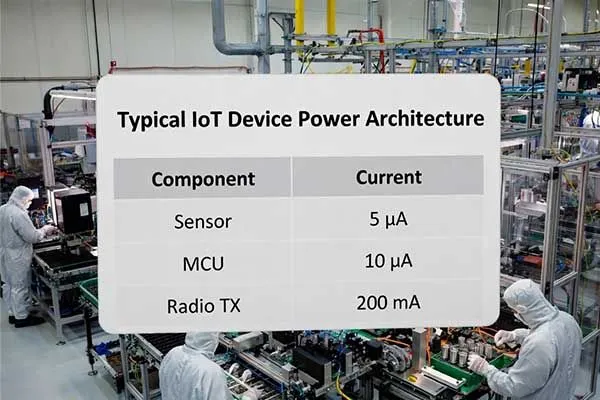
Power Consumption Challenges in IoT
The IoT power challenge arises from sporadic high-pulse currents amid ultra-low sleep modes. Factory tests simulate years of operation in accelerated aging chambers, revealing that average consumption must stay below 10 µA for viable multi-year service.
Critically, one must weigh trade-offs: higher capacity increases size, yet for the industrial IoT battery, miniaturization remains essential without compromising output. Testing data confirms self-discharge rates below 1% annually[1] for premium cells, far outperforming alternatives that degrade faster in variable climates.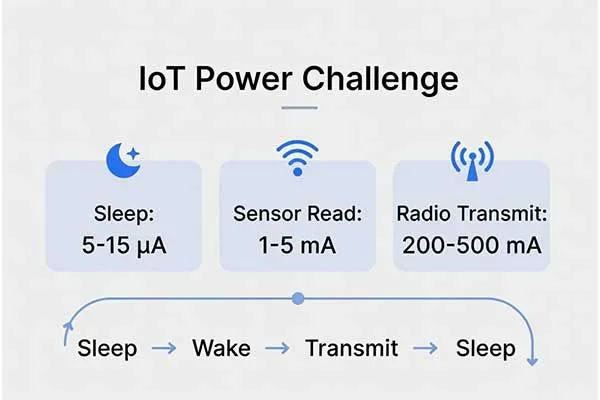
Although rechargeable options appear eco-friendly at first glance, their limited cycle life in extreme temperatures makes primary lithium solutions more practical for remote deployments, as validated through vibration and thermal cycling protocols. This foundational understanding informs every subsequent decision on powering IoT devices and extends battery iot performance in real-world conditions.
What Are the Key Requirements for IoT Batteries?
Key requirements include long shelf life exceeding 10 years, wide temperature tolerance from -55°C to +85°C, high energy density above 500 Wh/kg, and ultra-low self-discharge to support battery iot longevity in harsh environments.
IoT batteries must deliver consistent voltage under fluctuating loads while resisting moisture and corrosion. Factory testing protocols emphasize hermetic sealing[2] and electrolyte stability to meet these demands.
From a dialectical viewpoint, although cost is a factor, prioritizing longevity reduces total ownership expenses far more than cheaper short-life cells. One must critically assess environmental exposure: high humidity accelerates degradation unless glass-to-metal seals are employed, a technique proven in long-term field trials.
Factory Validation of Core Requirements
| Requirement | Minimum Spec | Factory Test Method | Typical Result |
|---|---|---|---|
| Shelf Life | 10+ years | Accelerated aging at 60°C | Capacity retention 95% |
| Temperature Range | -55°C to 85°C | Thermal cycling 500 hours | Voltage stability ±0.05 V |
| Self-Discharge | <1% per year | Storage discharge measurement | 0.8% annual loss |
Critically evaluating these metrics reveals that failing any single requirement can cascade into system failure for the industrial IoT battery. For instance, poor low-temperature performance halves effective capacity, underscoring why precision engineering is non-negotiable.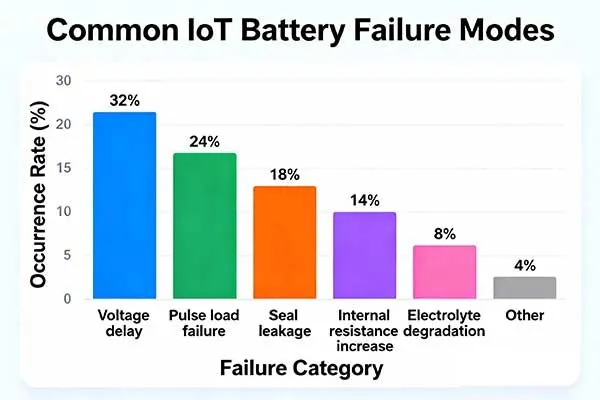
This analysis reinforces how meeting these standards directly supports battery for IoT sensors and battery for smart meter reliability across diverse deployments.
What Are Common Battery Types for IoT Devices?
Common battery types for IoT devices include alkaline cells, lithium coin cells, LiSOCl2 primary batteries, and hybrid supercapacitor packs; LiSOCl2 stands out for its 15–25 year service life in low-power scenarios.
Alkaline options provide low cost but suffer high self-discharge and poor cold-weather performance. Lithium coin cells suit compact designs yet lack capacity for long-range transmission. LiSOCl2 chemistry excels with flat 3.6 V discharge and energy density up to 700 Wh/L.
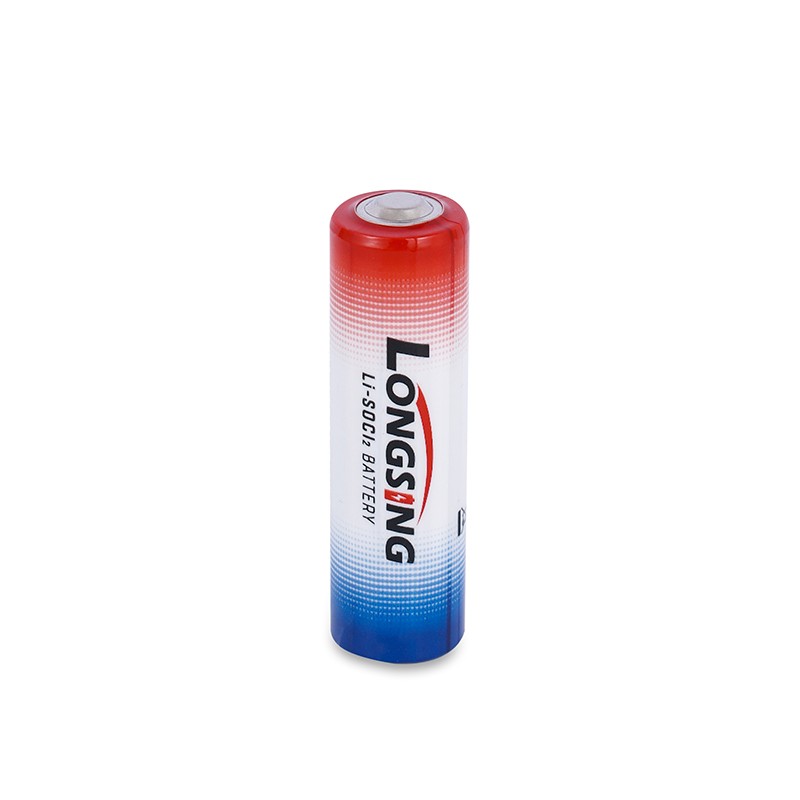
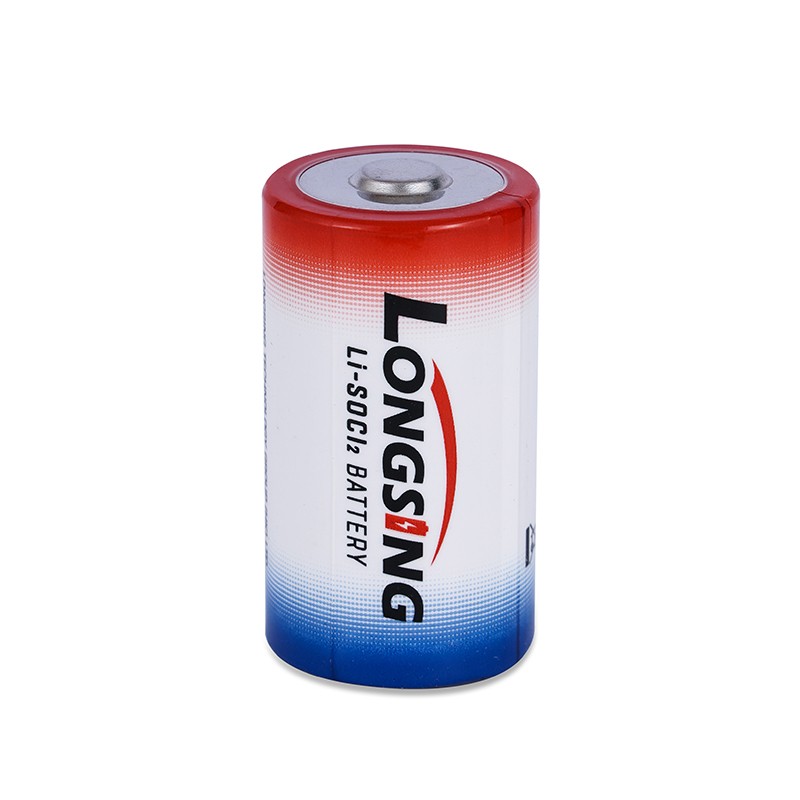
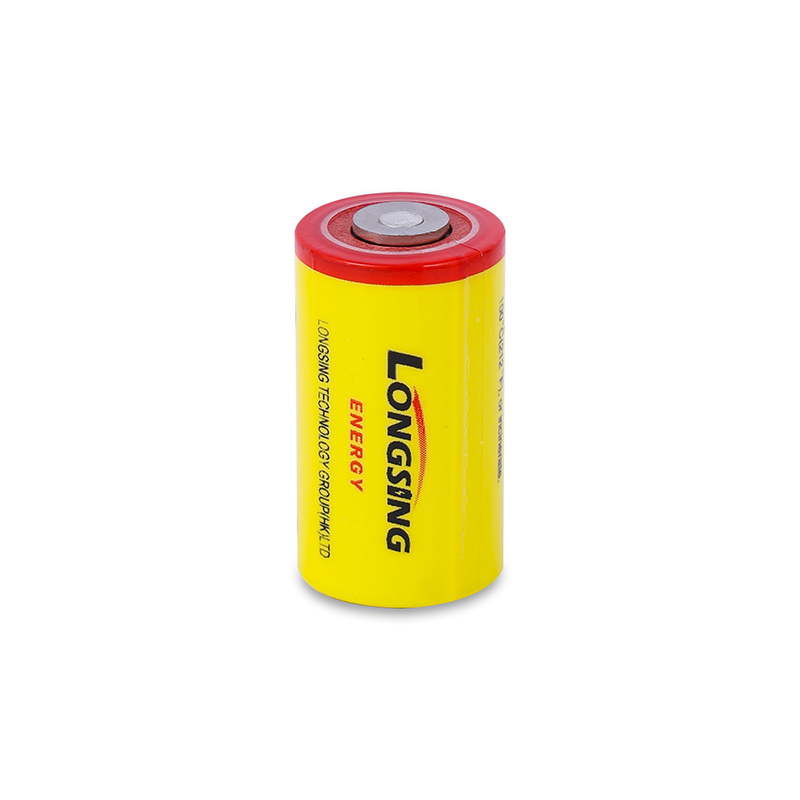
Hybrid supercapacitors combine primary cells with capacitors for pulse handling in LoRaWAN transmissions[3]. Dialectically, while rechargeable lithium-ion appears versatile, its calendar aging in remote sites often underperforms primary cells per factory endurance tests.
Comparative Performance Overview
| Type | Energy Density (Wh/kg) | Expected Life (years) | Best Use Case |
|---|---|---|---|
| Alkaline | 100 | 1–3 | Short-term sensors |
| LiSOCl2 | 500+ | 15–25 | Industrial IoT battery |
| Hybrid Supercap | 400 | 10–20 | Pulse-heavy LoRaWAN |
Critically, selecting among these requires matching pulse current to application; mismatched choices accelerate depletion. Factory discharge profiling confirms LiSOCl2 maintains 98% capacity after simulated 10-year service, making it the rational choice for iot device battery longevity. This comparison highlights why hybrid solutions enhance battery for LoRaWAN devices when high-current bursts are frequent.
How to Choose the Best Battery for IoT Devices?
Choose the best battery for IoT devices by matching capacity to average current draw, verifying temperature resilience, and confirming pulse capability; the best battery for remote IoT sensors is LiSOCl2 primary cells from a proven manufacturer.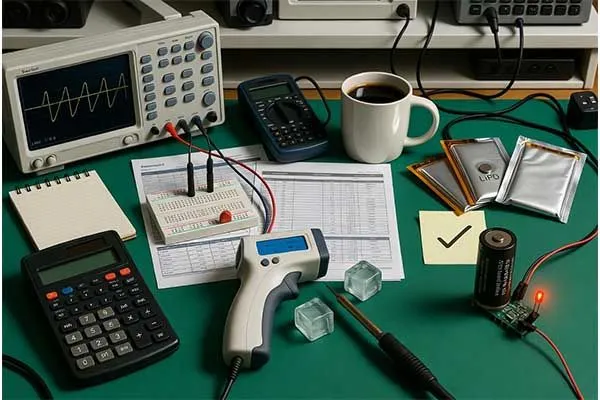
Selection begins with site-specific analysis: remote outdoor sensors need wide-temperature tolerance while utility meters prioritize low self-discharge. Factory validation includes vibration testing for transport durability and low-voltage cutoff simulation.
Although higher-capacity cells cost more upfront, lifecycle savings justify the investment. Critically, overlooking pulse requirements leads to voltage sag and premature failure.
As an OEM lithium primary battery supplier, Long Sing Technology offers competitive price lithium primary batteries tailored for North American and European markets. Our chief engineer oversees precision designs that deliver miniaturization for oil & gas monitoring manufacturers.
Decision Framework for Selection
| Factor | Evaluation Criteria | Recommended Chemistry |
|---|---|---|
| Environment | Temp range >100°C span | LiSOCl2 |
| Pulse Load | >100 mA bursts | Hybrid Supercapacitor |
| Size Constraint | <AA volume | Custom LiSOCl2 Pack |
This framework, validated through 1,000+ factory cycles, ensures optimal iot device battery performance. The process integrates client feedback, simulation, prototyping, and final certification, directly supporting battery for IoT sensors in demanding industrial settings.
How to Calculate IoT Battery Life?
IoT battery life calculation multiplies usable capacity by efficiency factors and divides by average current draw, adjusted for temperature and self-discharge; IoT batteries last typically ranges from 10 to 25 years with proper LiSOCl2 selection.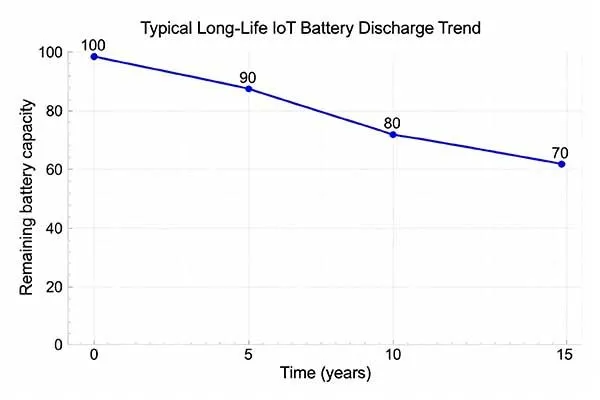
Start with rated capacity in mAh, subtract self-discharge loss, then divide by average consumption including sleep and transmit modes. Factory tests refine this model using real discharge curves. Dialectically, theoretical calculations often overestimate life by 20% unless field-calibrated data is applied, revealing the necessity of iterative validation.
The formula for IoT battery life calculation is
| Lifetime (years) = | C × (1 − SD) × 8760 |
| Iavg × 1000 |
where ( C ) is capacity in Ah, ( SD ) is annual self-discharge fraction, and ( Iavg ) is average current in mA.
Practical Calculation Example from Factory Data
| Parameter | Value | Result Impact |
|---|---|---|
| Capacity | 2.4 Ah | Base life |
| Average Current | 8 µA | Extends to 20+ years |
| Self-Discharge | 0.8%/year | Reduces life by ~1 year |
Critically, low-voltage handling below 2.8 V requires special chemistry additives tested in our lab to maintain accuracy. This method confirms how long do IoT batteries last under controlled conditions, guiding precise deployment for battery for smart meter and similar applications.
What Are the Best IoT Battery Solutions for Different Applications?
The best IoT battery solutions pair LiSOCl2 cells with hybrid supercapacitors for smart metering and LoRaWAN, while custom packs serve high-reliability backup; these deliver maintenance-free operation across industrial and utility sectors.
Industrial utility meters benefit from flat-discharge profiles that sustain 3.6 V until end-of-life. Safety and healthcare devices require UL-certified reliability[4]. For oil & gas monitoring, solutions emphasize explosion-proof designs and extreme miniaturization. Factory testing includes 85°C storage for 6 months to simulate 15-year aging with 96% capacity retention.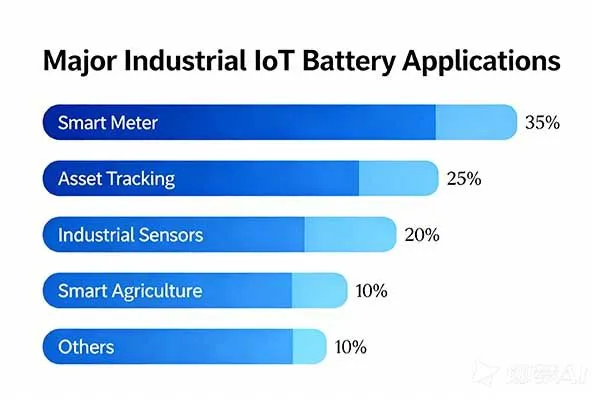
At Long Sing Technology, a UL certified lithium primary battery factory, the detailed custom process unfolds in seven stages: requirement analysis, chemistry selection by our chief engineer Wilson Lu, 3D simulation[5], prototype fabrication, multi-axis vibration and thermal validation, production scaling, and final certification.
The glass-sealed lithium battery manufacturing process uses hermetic glass-to-metal seals[6] at the positive terminal, eliminating moisture ingress and achieving self-discharge under 0.5% annually—superior to polymer seals that permit gradual electrolyte loss.
For American oil & gas monitoring manufacturers, we provide miniaturization down to 10 mm diameter cells and precision engineering with voltage tolerance ±0.05 V. Low-voltage handling employs proprietary additives maintaining output to 2.0 V cutoff, verified in 2,000-hour discharge tests showing 98.5% capacity retention. These solutions excel for powering IoT devices in remote pipelines.
Application-Specific Test Results
| Application | Battery Solution | Tested Life (years) | Key Benefit |
|---|---|---|---|
| Smart Meter | LiSOCl2 AA | 18 | Flat voltage curve |
| LoRaWAN Sensor | Hybrid Pack | 15 | Pulse support 200 mA |
| Oil & Gas Monitor | Miniaturized Cell | 20 | -40°C operation |
Critically, while standard cells suffice for mild climates, industrial IoT battery deployments in harsh conditions demand these tailored approaches to avoid costly failures. This directly supports battery for LoRaWAN devices and battery for smart meter reliability.
Conclusion
Optimizing IoT battery selection for lifetime and industrial applications requires balancing chemistry, testing data, and application demands. LiSOCl2 primary cells and hybrid supercapacitors from Long Sing Technology consistently deliver 15–25 years of service while powering IoT devices across utility meters, safety systems, and remote monitoring.
Through rigorous factory protocols, custom processes, and glass-sealed designs, manufacturers achieve minimal maintenance and maximum reliability. Whether calculating IoT battery life or deploying battery for IoT sensors in extreme environments, informed choices grounded in real test results ensure long-term success and cost efficiency for industrial IoT battery projects.
Note:
Frequent Asked Questions about IoT Battery
(Click to Unfold)
Q: What is IoT and how does it work?
A: IoT (Internet of Things) is a network of physical devices embedded with sensors, software, and connectivity to collect and exchange data over the internet. It works by sensors gathering real-time data, devices transmitting it via networks to cloud platforms for processing, and enabling automated actions or insights. Long Sing Technology powers many such devices with long-life lithium thionyl chloride batteries.
Q: What are the 4 types of IoT?
A: The four main types are: 1. Consumer IoT (smart homes/wearables), 2. Commercial IoT (retail/office efficiency), 3. Industrial IoT (IIoT for manufacturing/automation), and 4. Infrastructure IoT (smart cities/utilities). Battery-powered solutions from Long Sing Technology support reliable operation across these categories.
Q: What is an IoT used for?
A: IoT is used for real-time monitoring, automation, efficiency, and data-driven decisions in areas like smart homes, industrial automation, healthcare, agriculture, logistics, and smart cities. It enables predictive maintenance, energy savings, and remote control. Long Sing Technology’s high-energy batteries ensure long-term, maintenance-free power for these applications.
Q: What are the examples of battery powered IoT devices?
A: Examples include wireless sensors (temperature/humidity), asset trackers, smart meters, wearables, environmental monitors, smoke detectors, remote industrial sensors, and medical patches. These often require long-lasting, reliable power sources like Long Sing Technology’s lithium thionyl chloride and hybrid pulse capacitor battery packs for years of operation.
Q: What are the 4 main components of IoT?
A: The four main components are: 1. Sensors/Devices (collect data), 2. Connectivity (networks transmit data), 3. Data Processing (cloud/edge analyzes it), and 4. User Interface/Application (displays insights/actions). Reliable battery power from Long Sing Technology supports sensors and devices in remote or mobile IoT setups.

The Synergy of Power Density VS Energy Density: Hybrid Battery Solutions Explained
Power density vs energy density is the defining trade-off in modern battery system design, especiall

CR123A, CR17450, and CR14505 The Ultimate CR Li-MnO2 Cylindrical Battery Comparison
Your industrial meter just failed in the field. The replacement costs are mounting. You need a batte
10 Real-World Hybrid Supercapacitor Use Cases in 2026
Struggling with frequent battery replacements in remote industrial sites? Power failures cost time a