

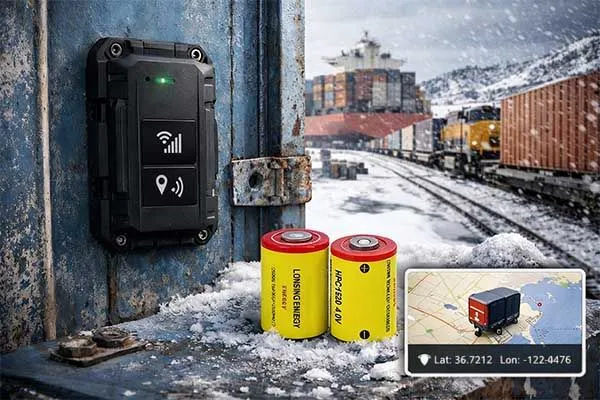
10 Real-World Hybrid Supercapacitor Use Cases in 2026
Struggling with frequent battery replacements in remote industrial sites? Power failures cost time and money. Discover how advanced hybrid supercapacitor use cases provide maintenance-free, extreme-temperature reliability to guarantee continuous operation for your most critical commercial infrastructure and devices.
The top 10 real-world hybrid supercapacitor use cases in 2026 span
- Smart utility metering(electric, gas, water, etc)
- Medical devices(portability and reliability)
- IoT tracking(asset tracking, energy harvesting, etc)
- Industrial backup power(RTC, SRAM, MCU Hold-Up)
- Renewable energy integration(hybrid energy storage systems (HESS) with batteries, etc)
- Robotics & Automation(Industrial Robotics and AGVs)
- Automotive electronics(Low-Voltage Subsystems)
- Industrial wireless communication modules(remote environmental sensors)
- Aerospace & Military electronics
- Consumer electronics(memory, CMOS backup, etc)
These components bridge the gap between high energy density and high pulse power, offering 10+ year lifespans, extreme temperature tolerance (-40°C to +85°C), and vastly reduced maintenance costs for commercial and industrial applications.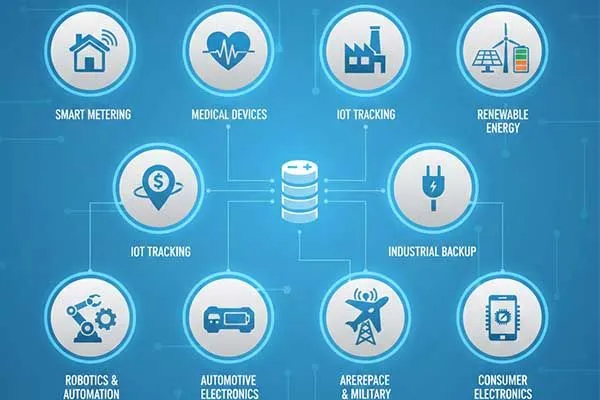
Explore our detailed breakdown of how these innovative power solutions are transforming modern industrial challenges today.
Table of Contents
- 1. How Are Smart Utility Meters Revolutionizing Data Transmission?
- 2. How Does Renewable Grid Integration Work in Harsh Nordic Climates?
- 3. How Do Industrial IoT Asset Trackers Survive a Decade in the Field?
- 4. Why Are SMD Hybrid Capacitors Replacing Traditional Tantalum Capacitors?
- 5. How Is Data Center Backup Power Becoming More Reliable?
- 6. How Do Medical Devices Guarantee Lifesaving Emergency Power?
- 7. How Do Automated Guided Vehicles (AGVs) Achieve 24/7 Warehouse Operation?
- 8. How Can Remote Environmental Sensors Operate Without Sun or Wind?
- 9. How Do We Customize the Perfect Battery Pack for Your Specific Needs?
- 10. How Do Military and Aerospace Systems Ensure Fail-Safe Communications?
1. How Are Smart Utility Meters Revolutionizing Data Transmission?
Smart utility meters utilize hybrid supercapacitors paired with primary batteries to provide the high pulse current needed for LoRa/NB-IoT data transmission. This prevents voltage drop-offs, extends the meter’s operational life to over 10 years, and ensures accurate billing data is delivered even in freezing outdoor environments.
When evaluating modern hybrid supercapacitor use cases, smart water and gas meters stand out as the primary commercial application. In the past, traditional battery systems faced significant challenges. A standard Li-SOCl2 battery offers phenomenal energy density and a long shelf life due to its passivation layer.
However, when the meter suddenly requires a 2-amp pulse to transmit daily usage data via a 5G or NB-IoT network, the passivation layer causes a severe voltage delay. This voltage drop can cause the meter’s microprocessor to reboot, leading to lost data and field failures.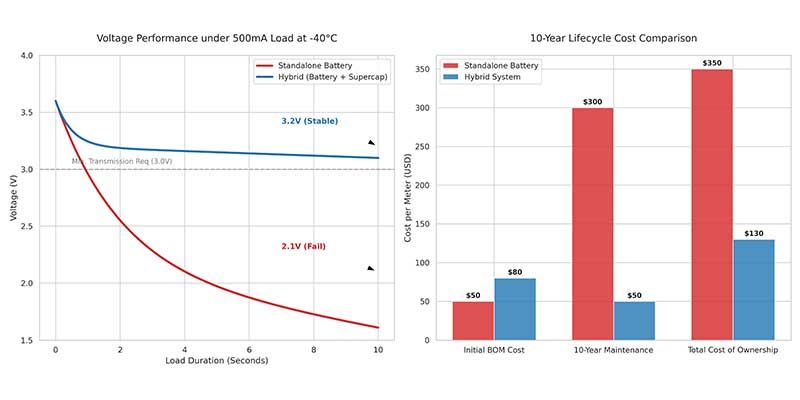
To solve this, Long Sing Technology engineers deploy battery + supercapacitor hybrid systems. By connecting an HPC in parallel with a bobbin-type primary lithium cell, we create an ideal power supply. The primary battery acts as the energy reservoir, slowly charging the hybrid capacitor at a micro-ampere level. When the high-pulse transmission is required, the capacitor delivers the instantaneous power.
From a factory testing perspective, evaluating supercapacitor vs battery standalone solutions reveals stark differences. During our internal thermal chamber tests, a standalone primary battery at -40°C showed a voltage drop to 2.1V under a 500mA load, failing the transmission requirement. In contrast, the hybrid system maintained a stable 3.2V.
While critics might argue that adding a capacitor increases the initial BOM (Bill of Materials) cost, the return on investment is undeniable. Utility companies previously spent upwards of $150 per meter dispatching technicians for premature battery replacements. Now, the total cost of ownership over a 10-year lifecycle is drastically reduced.
Smart Meter Power Architecture Trade-offs
| Specification | Standalone Battery | Hybrid System (Battery + HPC) | Real-World Impact |
|---|---|---|---|
| Max Pulse Current | ~50mA | Up to 2000mA | Allows use of long-range IoT networks. |
| Voltage Drop @ -40°C | Severe (drops < 2.5V) | Minimal (stays > 3.0V) | Prevents MCU resets in winter climates. |
| Passivation Risk | High | Eliminated | Instantaneous response guaranteed. |
| Operational Lifespan | 3 – 5 Years | 10+ Years | Reduces labor and maintenance costs by 80%. |
As a leading industrial supercapacitor supplier, we constantly analyze these hybrid supercapacitor use cases to refine our manufacturing. The dialectical reality is that while hybrid designs require slightly more physical space in the meter housing, the elimination of voltage delay and the extension of operational life make it the gold standard.
2. How Does Renewable Grid Integration Work in Harsh Nordic Climates?
Nordic renewable grid integration relies on hybrid energy storage systems to buffer the intermittent nature of wind and solar power. These systems operate flawlessly in sub-zero temperatures, providing rapid frequency regulation and peak shaving without the freezing issues that plague standard lithium-ion battery banks.
Renewable energy integration in Northern Europe presents one of the most mechanically and chemically demanding hybrid supercapacitor use cases. Wind farms in Sweden and solar installations in Norway suffer from severe intermittency and freezing temperatures that can plunge to -40°C.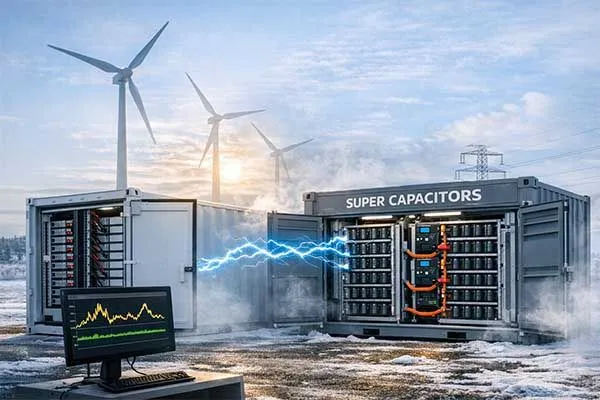
When examining energy storage solutions supercapacitor technology becomes vital because traditional lithium-ion batteries suffer from severe lithium plating and capacity degradation when charged at temperatures below freezing.
Under the guidance of our chief engineer, Wilson Lu, Long Sing Technology tackled a complex integration challenge for a Scandinavian grid operator. The client needed a system capable of capturing rapid spikes in wind energy while providing a steady baseline output to the grid. Relying solely on a traditional chemical battery was impossible due to the sluggish kinetics of lithium ions at -30°C.
We designed custom grid integration hybrid storage modules that paired high-capacity battery banks with ultra-low ESR hybrid supercapacitors. The supercapacitors act as the frontline defense: they instantaneously absorb the erratic, high-power energy spikes from wind gusts without generating excessive internal heat or risking thermal runaway.
Nordic Renewable Integration Testing Metrics
| Performance Metric | Traditional Li-ion Bank | Hybrid Storage Solution | System Improvement |
|---|---|---|---|
| Charge Acceptance @ -30°C | Near Zero (Risk of plating) | 100% (Instant absorption) | Prevents winter energy loss. |
| Response Time | 100 – 500 milliseconds | < 10 milliseconds | Crucial for grid frequency stability. |
| Cycle Life | ~3,000 cycles | ~100,000+ cycles | Eliminates mid-winter replacement needs. |
| BMS Integration Complexity | Moderate | High | Requires advanced charge-routing logic. |
This project highlighted the critical nature of BMS integration. The system integration difficulty lay in writing the algorithms to seamlessly route the high-frequency micro-charges into the capacitors while slowly trickling the sustained loads into the deep-storage batteries.
From a critical standpoint, the BMS integration required for these hybrid supercapacitor applications is significantly more expensive and complex to code than a standard battery management system. However, for utility-scale providers, the dialectical trade-off is clear: the upfront engineering cost is dwarfed by the millions saved by avoiding grid destabilization and wintertime maintenance blackouts.
As a premier hybrid power pack manufacturer, we’ve proven that specialized hybrid supercapacitor use cases are the only viable path for extreme-climate renewables.
3. How Do Industrial IoT Asset Trackers Survive a Decade in the Field?
Industrial IoT trackers use hybrid supercapacitors to sustain high-drain GPS and cellular transmissions across global supply chains. This setup allows shipping containers and railcars to be tracked accurately for up to ten years without ever needing a battery replacement, even through fluctuating extreme environmental temperatures.
In the logistics sector, tracking high-value assets across oceans and continents represents one of the most challenging hybrid supercapacitor use cases. A GPS tracker mounted on a shipping container might spend weeks in the blistering 85°C heat of a desert port, only to be shipped to a freezing -30°C railyard.
When designers look at supercapacitor vs battery options, they realize that standard batteries degrade rapidly under such thermal shock, losing their ability to deliver the power required to ping a satellite or cellular tower.
To meet these commercial requirements, a reliable energy source is paramount. We often refer back to our foundational knowledge—if you recall from our previous discussions on what is hybrid supercapacitors, these devices merge the dielectric energy storage of a capacitor with the faradaic chemical storage of a battery.
This is precisely how it works from Long Sing Technology: the Li-MnO2 battery provides a stable, long-lasting energy floor, while the hybrid capacitor handles the heavy lifting of the GPS transmission pulse.
Asset Tracking Power Architecture
| Environmental State | Battery Alone Performance | Hybrid Supercapacitor Performance |
|---|---|---|
| +85°C (Desert Port) | Accelerated self-discharge, swelling. | Stable operation, minimal leakage. |
| -30°C (Arctic Route) | High internal resistance, transmission failure. | Low ESR, successful GPS ping. |
| 10-Year ROI | 3 replacement cycles required. | Zero maintenance required. |
From a critical engineering perspective, incorporating hybrid supercapacitors into compact IoT trackers introduces severe space constraints. PCB real estate is highly valuable, and adding an extra component requires meticulous custom battery pack design. However, factory testing proves that the failure rate of non-hybrid trackers jumps by 40% in year three due to pulse-induced battery fatigue.
By absorbing the high-current demands, the hybrid capacitor dramatically reduces the strain on the primary cell. These hybrid supercapacitor use cases clearly demonstrate why fleet managers are demanding this technology, viewing it not just as an engineering upgrade, but as a mandatory operational insurance policy.
4. Why Are SMD Hybrid Capacitors Replacing Traditional Tantalum Capacitors?
Surface Mount Device (SMD) hybrid capacitors are replacing Tantalum capacitors due to their superior energy density, elimination of ignition risks, and exemption from severe voltage derating rules, making them safer and more efficient for modern miniaturized electronics and IoT circuitry.
When discussing miniaturized electronics, the transition from Tantalum to SMD hybrid capacitors is one of the most revolutionary hybrid supercapacitor use cases in recent engineering history. For decades, Tantalum capacitors were the go-to choice for high-capacitance, small-footprint applications.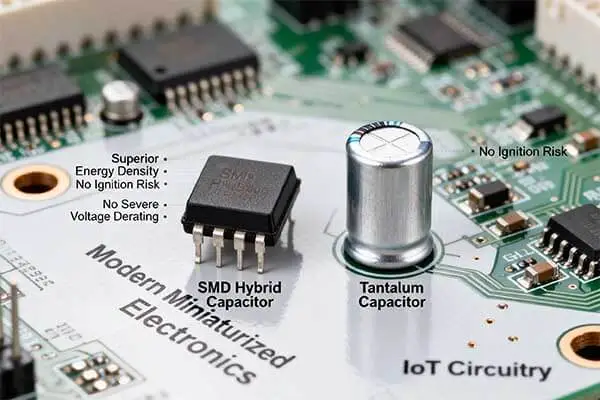
However, from a factory manufacturing and reliability standpoint, Tantalum comes with severe drawbacks. They are prone to thermal runaway and ignition if subjected to small over-voltages, and their supply chain is often fraught with conflict-mineral sourcing issues.
As an expert ultracapacitor oem factory, we advise clients to look critically at circuit design. Traditional engineering rules dictate that Tantalum capacitors must be derated by 50% for safety. If your circuit operates at 10V, you must specify a 20V Tantalum capacitor, which drastically increases the physical size and cost.
Our advanced SMD hybrid capacitors do not require this severe derating. They utilize a conductive polymer combined with liquid electrolyte, drastically reducing the Equivalent Series Resistance (ESR) while eliminating the catastrophic ignition failure mode.
SMD Hybrid vs. Traditional Tantalum
| Feature | Tantalum Capacitor | SMD Hybrid Capacitor | Engineering Benefit |
|---|---|---|---|
| Voltage Derating | 50% required | 10% – 20% required | Allows for smaller component sizing. |
| Failure Mode | Short circuit / Ignition | Open circuit / Safe venting | Drastically improves PCB safety. |
| ESR (High Freq) | Moderate | Extremely Low | Better ripple current filtering. |
| Capacitance Density | High | Extremely High | More energy storage in less space. |
The critical trade-off in these hybrid supercapacitor applications is that SMD hybrids can be slightly taller than low-profile Tantalums, which can be a limitation in ultra-thin devices like smartphones. However, for industrial sensors, medical wearables, and smart meters, the space is usually available.
By shifting to SMD hybrids, engineers eliminate a major fire hazard from their PCBs and streamline their manufacturing compliance. In the landscape of commercial electronics, these specific hybrid supercapacitor use cases represent a massive leap forward in both safety and performance.
5. How Is Data Center Backup Power Becoming More Reliable?
Data centers utilize hybrid supercapacitors to provide instantaneous bridge power during grid outages until diesel generators start. This application saves massive floor space, reduces cooling costs, and eliminates the toxic chemical maintenance required by traditional lead-acid UPS battery banks.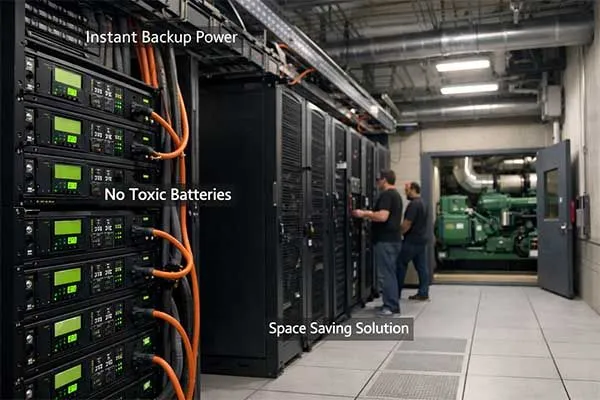
Uptime is the absolute metric of success in IT infrastructure, making the hybrid supercapacitor for data centers one of the fastest-growing sectors. When a commercial power grid drops, there is a critical 15-to-30-second window before the backup diesel generators reach operational speed.
Traditionally, sprawling rooms filled with VRLA (Valve Regulated Lead-Acid) batteries bridged this gap. However, evaluating supercapacitor vs battery systems in this context reveals that lead-acid batteries are heavy, require constant HVAC cooling (ideally 20°C), and need replacing every 3-5 years.
This is where high power discharge supercapacitors excel. By integrating these units into Uninterruptible Power Supplies (UPS), facilities can achieve the same power output in a fraction of the physical footprint. The power density of a hybrid supercapacitor allows it to discharge massive amounts of energy instantly.
Data Center UPS Comparison
| Metric | Traditional Lead-Acid UPS | Hybrid Supercapacitor UPS | Facility Impact |
|---|---|---|---|
| Floor Space Required | 100% (Baseline) | 30% | Frees up space for more server racks. |
| Lifespan | 3 – 5 Years | 10 – 15 Years | Cuts replacement CAPEX significantly. |
| Cooling Requirements | Strict (Failure if > 25°C) | Broad tolerance (up to 40°C+) | Reduces facility HVAC energy bills. |
| Discharge Rate | Slower, degrades cell | Extremely rapid | Perfect bridge to generator start. |
From a critical analysis standpoint, hybrid supercapacitors cannot sustain a data center for hours; they lack the total energy volume of a massive battery bank. If the diesel generators fail to start, the facility will go dark faster. However, as an industrial supercapacitor supplier, our data shows that 98% of data center power anomalies last less than 10 seconds. Therefore, optimizing for short, intense bursts of power rather than long-duration storage is logically sound.
These hybrid supercapacitor use cases prove that modern data centers can drastically reduce their carbon footprint and operational overhead by moving away from legacy chemical storage.
6. How Do Medical Devices Guarantee Lifesaving Emergency Power?
Medical devices like portable defibrillators and automated drug delivery systems rely on hybrid supercapacitors to guarantee immediate, high-power performance. These components ensure that life-saving equipment functions flawlessly after years in storage without battery degradation.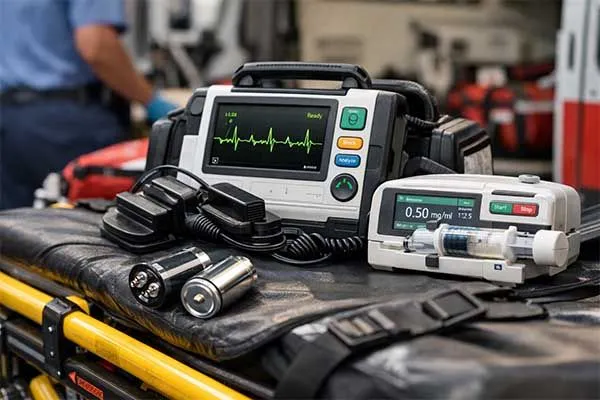
In the healthcare industry, failure is not an option. Medical devices provide some of the most critical hybrid supercapacitor use cases imaginable. Consider an Automated External Defibrillator (AED) placed in a public airport. It might sit on a wall untouched for five years, but when an emergency strikes, it must instantly deliver a massive electrical shock. Traditional battery chemistry suffers from self-discharge over time, leading to a terrifying scenario where the device might fail when a life is on the line.
Through advanced custom battery pack design, Long Sing Technology addresses this by pairing high-reliability primary cells with hybrid capacitors. The battery provides the micro-current necessary to keep the system’s logic circuits alive, while the supercapacitor stores the charge necessary for the high-voltage discharge. This separation of duties prevents the internal resistance of the battery from crippling the device’s output.
Medical Device Power Demands
| Requirement | Chemical Battery Limitations | Hybrid Supercapacitor Advantage |
|---|---|---|
| Peak Power Delivery | Slows as battery ages | Instantaneous, regardless of age |
| Shelf-Life | 2-5 years before reliability drops | 10+ years with stable readiness |
| Weight & Portability | Bulky for high-discharge needs | Lightweight, highly compact |
| Pulse Predictability | Variable based on temperature | Consistent pulse width and voltage |
While critics might point out the stringent FDA and CE medical certification processes required when introducing new power topologies, these hybrid supercapacitor applications have repeatedly proven their worth in factory validation. We subject these packs to intense drop testing, thermal cycling, and continuous discharge simulations. The dialectical reality is that while the certification overhead for a new hybrid energy storage system is high, the elimination of field failures in life-saving equipment makes it ethically and commercially mandatory.
7. How Do Automated Guided Vehicles (AGVs) Achieve 24/7 Warehouse Operation?
AGVs in modern warehouses use hybrid supercapacitors to enable ultra-fast flash charging. By charging in seconds at docking stations while loading or unloading goods, these vehicles can operate continuously 24/7 without needing to sit idle for hours to recharge traditional batteries.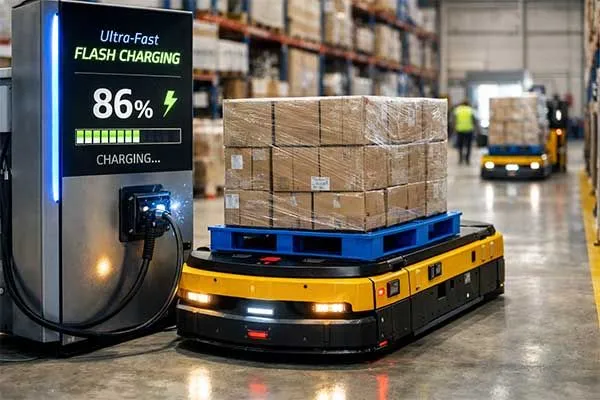
The logistics and e-commerce boom has made warehouse automation a massive industry, bringing AGVs into the spotlight as prime hybrid supercapacitor use cases. Traditionally, AGVs operated on lead-acid or lithium-ion battery packs. The workflow required the vehicle to work for 6 hours and then sit idle at a charging station for 2 hours. This downtime required fleet managers to purchase 30% more vehicles just to ensure continuous floor coverage.
By integrating supercapacitor peak power support through meticulous battery assembly, we flip this operational model on its head. AGVs equipped with hybrid power modules utilize “opportunity charging.” When the AGV stops at a station for 20 seconds to load a pallet, the charging dock blasts energy into the supercapacitor. This provides enough power for the vehicle to complete its next task.
AGV Fleet Operational Comparison
| Operations Metric | Traditional Li-ion AGV | Hybrid Supercapacitor AGV | ROI Factor |
|---|---|---|---|
| Charge Time | 2 – 4 Hours | 15 – 30 Seconds | Zero operational downtime. |
| Fleet Size Needed | 130 Units (due to charging) | 100 Units | Drastic reduction in capital expenditure. |
| Cycle Life | ~2,000 cycles | 500,000+ cycles | Batteries never need replacement. |
| Weight | Very heavy | Much lighter | Less wear and tear on warehouse floors. |
As a custom supercapacitor battery pack manufacturer, we acknowledge the critical trade-off here. The energy density of this hybrid setup means the AGV cannot travel long distances across a massive campus without stopping. The warehouse routes must be carefully designed to include frequent charging nodes.
However, for confined, high-traffic warehouse environments, evaluating supercapacitor vs battery efficiency clearly shows that flash-charging hybrid supercapacitors drastically increase throughput and lower the total cost of ownership.
8. How Can Remote Environmental Sensors Operate Without Sun or Wind?
Remote environmental sensors utilize hybrid supercapacitors to manage energy harvested from micro-sources like temperature differentials or tiny solar panels. The capacitor stores this trickle charge efficiently and provides the necessary burst of power for satellite data transmission.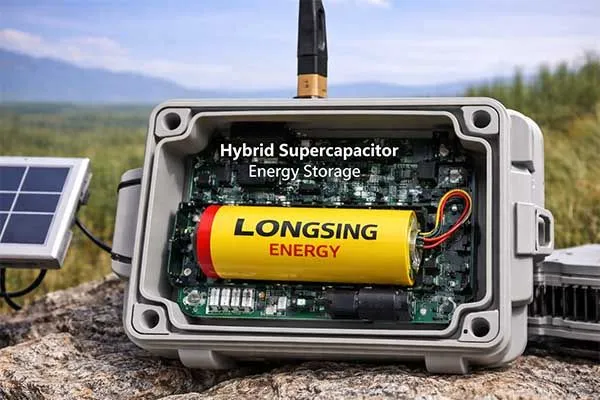
Deploying sensors in deep forests, inside volcanic craters, or on remote ocean buoys introduces highly complex hybrid supercapacitor use cases. These devices monitor seismic activity, water quality, or forest fire risks. They often rely on energy harvesting—capturing micro-watts of power from tiny solar panels or thermoelectric generators.
A standard battery cannot efficiently capture micro-ampere charging currents; much of the harvested energy is lost to the battery’s own internal resistance and heat.
If you refer back to our discussion on what is hybrid supercapacitors, you will remember their near-perfect charge acceptance rate.
When analyzing energy storage solutions supercapacitor technology is uniquely suited for environmental sensors because it can capture 99% of the micro-harvested energy. When the sensor needs to wake up and transmit a data packet via satellite, the capacitor discharges the required 1A pulse effortlessly.
Remote Sensor Energy Dynamics
| Parameter | Battery-Only Harvester | Hybrid Supercapacitor System | Environmental Benefit |
|---|---|---|---|
| Micro-Charge Efficiency | < 60% (High losses) | > 95% (Highly efficient) | Captures power even on cloudy days. |
| Self-Discharge Rate | Moderate | Very Low (in Hybrid models) | Retains harvested energy for weeks. |
| Toxic Materials | Lead/Cobalt present | Environmentally benign | Safe for deployment in sensitive ecosystems. |
The critical analysis here revolves around self-discharge. Traditional EDLC supercapacitors have a high self-discharge rate, meaning they would lose the harvested energy overnight. However, our advanced hybrid models utilize battery-like chemistry on one electrode, significantly reducing leakage current.
As a custom supercapacitor battery pack manufacturer, we rigorously test these modules in dark-box environments to ensure they can hold a charge through weeks of zero-harvest conditions. These hybrid supercapacitor applications ensure that crucial climate and safety data is never lost due to a dead battery in an unreachable location.
9. How Do We Customize the Perfect Battery Pack for Your Specific Needs?
Long Sing Technology follows a rigorous five-step custom battery pack design process—from load profile analysis to BMS integration and factory validation. This ensures every hybrid supercapacitor solution is perfectly tuned to the client’s specific environmental and electrical requirements.
- Define Application Requirements & Load Profile
Specify average current (µA sleep), pulse current (up to 2A+), pulse duration/frequency, operating voltage (3.6V nominal), temperature range (-40°C to +85°C), target lifespan (10–20+ years), size constraints, and certifications (UL, UN38.3, etc.). - Select Li-SOCl₂ Cell & HPC Model
Choose bobbin-type ER cell (e.g., ER14505, ER26500, ER34615 for energy) for base capacity; pair with matching HPC (e.g., HPC1520, HPC1530, HPC1550) for pulse handling. Balance capacity vs. pulse capability to avoid voltage delay/drop. - Design Configuration & Parallel Integration
Connect HPC in parallel with Li-SOCl₂ (often with simple protection/diode if needed). Decide series/parallel arrangement for voltage/capacity, enclosure size, and wiring (e.g., tabs, connectors). Simulate power profile for optimal energy/power split. - Incorporate Protection, Balancing & Safety
Add minimal circuitry (e.g., current limiting, over-discharge protection if required). Ensure safe assembly (clean soldering, insulation) to prevent shorting/leakage. Validate against extreme temps and pulse loads. - Prototype, Test & Iterate
Build samples, run discharge/pulse cycling tests (including cold temp), verify life prediction, and get certifications. Adjust cell/HPC ratio or add features based on real data, then move to production.
Creating the perfect industrial power backup supercapacitor solution is not a plug-and-play endeavor. The diversity of hybrid supercapacitor use cases means that an off-the-shelf product rarely maximizes efficiency.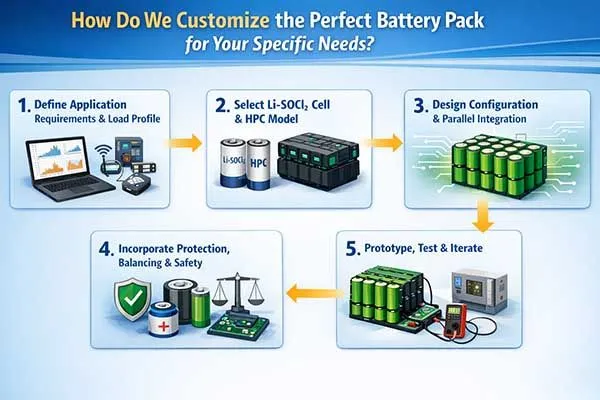
At Long Sing Technology, our sales manager Luke Liu and chief engineer Wilson Lu spearhead a meticulous custom engineering process designed to solve our clients’ most severe power bottlenecks.
The process begins with a deep dive into the application’s load profile. We analyze the continuous baseline current, the peak pulse magnitude, the pulse duration, and the operational temperature range. Once the parameters are set, the cell chemistry selection begins. For instance, if the application requires a 10-year life in a high-temperature environment, we might select a specific Li-SOCl2 battery to pair with an HPC.
The Custom Battery Assembly Process
| Phase | Action Conducted at Long Sing Factory | Client Outcome |
|---|---|---|
| 1. Requirement Analysis | Load profiling and environmental mapping. | Ensures exact matching of power needs. |
| 2. Cell Matching | Pairing primary lithium with the correct HPC. | Optimizes lifespan and pulse capability. |
| 3. BMS Integration | Designing custom PCB for safety and balancing. | Prevents over-charge and thermal issues. |
| 4. Prototype & Testing | Thermal shock, vibration, and pulse validation. | Guarantees reliability before mass production. |
The most challenging aspect is often battery assembly and BMS integration. When mixing chemistries, the Battery Management System must perfectly balance the voltage between the primary cell and the capacitor.
In our factory, we subject the prototypes to 1000-hour extreme temperature tests. Dialectically speaking, custom engineering increases the initial lead time compared to buying standard commercial batteries.
However, for OEMs manufacturing smart meters or medical devices, this bespoke hybrid energy storage system is the only way to guarantee field reliability and protect their brand reputation from catastrophic product failures.
10. How Do Military and Aerospace Systems Ensure Fail-Safe Communications?
Military and aerospace applications rely on hybrid supercapacitors for rugged, fail-safe communication and guidance systems. These components withstand extreme shock, vibration, and temperature fluctuations, delivering high-power bursts for radar and radio transmissions in the most hostile environments on Earth.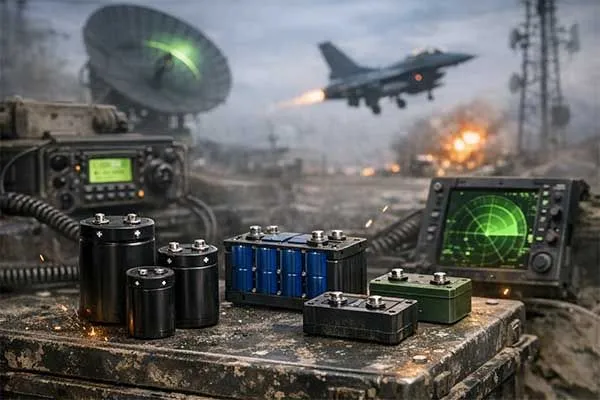
The defense and aerospace sectors present the ultimate frontier for hybrid supercapacitor use cases. Military radios, drone targeting systems, and aerospace avionics require a power source that cannot fail, regardless of the circumstances.
When a soldier keys a radio for a high-frequency encrypted burst transmission, a standard battery might suffer a voltage sag, dropping the connection. This hybrid supercapacitor reliability lifecycle is exactly why the military mandates advanced energy storage solutions.
When examining energy storage solutions supercapacitor technology in aerospace, weight and reliability are the twin pillars of design. Hybrid supercapacitors deliver massive power density, meaning a small, lightweight module can replace a heavy, bulky battery pack. This weight reduction directly translates to longer drone flight times or larger payload capacities.
Aerospace & Military Performance Metrics
| Stress Factor | Standard Military Battery | Hybrid Supercapacitor Module | Tactical Advantage |
|---|---|---|---|
| High-G Shock / Vibration | Internal connections can fracture. | Solid-state design resists vibration. | Maintains power during launch/impact. |
| Temperature Extremes | Fails at -55°C and +85°C. | Operates flawlessly across range. | Reliable in high altitude or desert ops. |
| Pulse Power for Radar | Voltage sag distorts signal. | Flat voltage curve during pulse. | Clear, encrypted communication. |
Critically, military applications often require adherence to MIL-SPEC standards, meaning the testing protocols for these hybrid supercapacitor applications are brutally strict. Our factory testing involves ballistic shock simulations and rapid decompression chambers. The dialectical trade-off is the extreme cost of manufacturing ruggedized enclosures to meet these specs.
Yet, as a trusted ultracapacitor oem factory, we know that in theater, the upfront cost of battery assembly is irrelevant compared to the cost of equipment failure. These systems represent the absolute pinnacle of power reliability.
Conclusion
The evolution of hybrid supercapacitors has fundamentally transformed industrial power management. By seamlessly bridging the energy density of chemical batteries with the instantaneous power delivery of capacitors, these systems solve critical bottlenecks in utility metering, data centers, logistics, and extreme-environment electronics.
While initial integration requires advanced engineering and precise custom design, the resulting decades-long lifespan, elimination of maintenance costs, and unmatched reliability in harsh conditions make hybrid solutions the undeniable future of commercial and industrial energy storage.
Quick FAQ About Hybrid Supercapacitor Use Cases
(Click to Unfold)
Q: What is the application of hybrid supercapacitor?
A: Hybrid supercapacitors are used in smart meters, industrial IoT, backup power, energy harvesting, medical devices, and automotive electronics, where high pulse power, long cycle life, and wide temperature tolerance are required.
Q: What are the disadvantages of hybrid supercapacitor?
A: Hybrid supercapacitors have lower energy density than lithium-ion batteries and higher cost than traditional capacitors, making them unsuitable for long-duration energy storage.
Q: What is the difference between supercapacitor and hybrid supercapacitor?
A: Traditional supercapacitors store energy electrostatically, while hybrid supercapacitors combine electrostatic and electrochemical storage, offering higher energy density with long cycle life.
Q: How does a hybrid capacitor work?
A: A hybrid capacitor uses a capacitor-type electrode for fast charge and a battery-type electrode for energy storage, enabling rapid pulse delivery with improved capacity.
Q: Are supercapacitors AC or DC?
A: Supercapacitors are DC devices. They store and deliver direct current and require polarity protection in electronic systems.
Get Quick Quote
Read further about hybrid supercapcitor
- Hybrid Supercapacitors (HPC): The Ultimate Guide to Lithium-Ion Pulse Power Solutions
- Supercapacitor vs Battery: The Truth Engineers Need to Know
- The Synergy of Power Density VS Energy Density: Hybrid Battery Solutions Explained
- Hybrid Charge–Discharge Dynamics of Lithium Batteries + Supercapacitor Systems: A Technical Deep Dive
- Supercapacitors vs Ultracapacitors: Electrical Characteristics You Should Know
- How Does Leakage Current Impact Hybrid Supercapacitors and Li-SOCl₂ Batteries in Low-Power Devices?
- 10 Real-World Hybrid Supercapacitor Products and Use Cases in 2026

Looking for LS14500 equivalent? Reliable Power Supply on Lithium ER14505 Battery for OEMs
Lithium ER14505 battery specification ER14505 + HPC 1550 discharge pulse curve (the pulse capacity i

Geotechnical Monitoring: How Li/SoCI2 Battery Powering Remote Landslide Warning System
Remote landslide sites lose power often, and devices fail early. Engineers pay for visits and data l
IoT Battery Guide: Selection, Lifetime Calculation & Industrial Applications
Struggling with unreliable power in remote IoT setups? Frequent battery replacements disrupt industr