

Supercapacitor vs Battery: Performance, Applications & Selection
Key Takeaways
- Comparison between supercapacitor vs battery should be considered during load profiling, architecture selection, design reviews, or when pulsed power, cycle life, or temperature issues arise.
- Batteries store more energy(higher energy), while supercapacitors deliver and absorb power much faster. Supercapacitors are better suited for short-duration, high-power, and high-frequency cycling applications.
- Batteries are typically the better choice for long-duration energy storage(longer runtime) and sustained power delivery. Supercapacitors can withstand significantly more charge-discharge cycles than conventional batteries.
- Hybrid battery-supercapacitor systems can combine high energy storage with fast pulse power when a single technology cannot meet both requirements.
Devices struggling with slow charging or short lifespans? The wrong choice causes voltage sag, short runtime, or higher lifecycle costs. The supercapacitor vs battery debate centers on fundamental trade-offs between power density[1] and energy density.
Supercapacitors excel at delivering rapid bursts of power with virtually unlimited cycle life, while batteries provide sustained energy over extended periods.
Traditional batteries fail when you need rapid charge-discharge cycles, while supercapacitors struggle with long-term energy storage.
The correct choice depends on peak current, pulse duration, repetition rate, minimum operating voltage, temperature and service-life requirements. Some systems benefit from combining a battery with a supercapacitor or hybrid pulse capacitor.
This article breaks down real performance data that helps you choose the right technology. You will discover when each solution delivers maximum value for industrial applications.
Table of Contents
- What Distinguishes Supercapacitor Batteries from Traditional Battery Technologies?
- How Do Supercapacitor Batteries Deliver High Pulse Power?
- When Should Engineers Choose a Capacitor vs Battery Configuration?
- Which Metrics Matter in a Supercapacitor vs Battery Selection?
1. What Distinguishes Supercapacitor Batteries from Traditional Battery Technologies?
Supercapacitors store energy through electrostatic charge[2] separation at electrode surfaces, while batteries rely on electrochemical reactions. This fundamental difference gives supercapacitors charge times under 10 seconds and cycle life exceeding one million cycles.
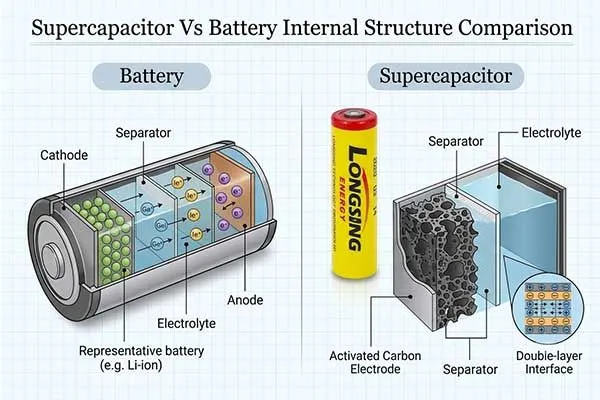
Batteries provide higher energy density measured in watt-hours per kilogram, typically 10-100 times greater than supercapacitors, making them suitable for applications requiring sustained power over hours rather than seconds.
The physical mechanisms behind energy storage reveal why these technologies serve different purposes.
Supercapacitors use activated carbon electrodes with extremely high surface areas, sometimes exceeding 2,000 square meters per gram.
When voltage applies across these electrodes, ions accumulate at the electrode-electrolyte interface without chemical bonds forming. This process happens almost instantly because no atoms must rearrange their molecular structure.
Batteries operate through oxidation-reduction reactions[3], they store energy through chemistry-specific electrochemical reactions. These chemical transformations take time and create compounds that change the internal structure of the battery.
The chemical nature of this storage method explains why batteries can hold more total energy in the same volume.
Temperature behavior separates these technologies dramatically. Supercapacitors maintain consistent performance from -40°C to +70°C because electrostatic attraction does not depend on reaction kinetics.
Primary lithium batteries show reduced capacity at temperature extremes because chemical reactions slow down in cold conditions and accelerate with heat, sometimes leading to thermal runaway.
Comparative Analysis of Storage Mechanisms
| Parameter | Supercapacitor | Battery |
|---|---|---|
| Energy Storage Method | Electrostatic charge | Chemical reaction |
| Charge Time | 1-10 seconds | 1-10 hours |
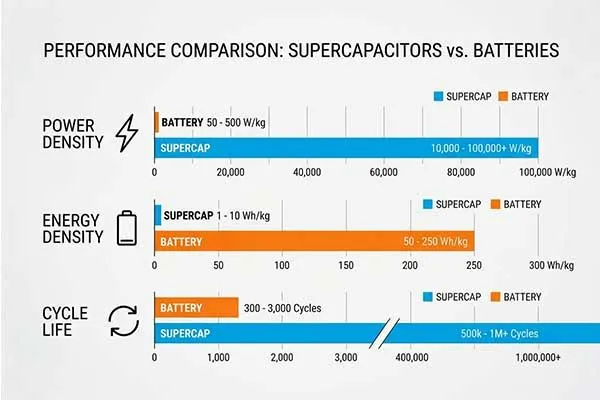
| Cycle Life | 500,000-1,000,000+ cycles | 300-3,000 cycles |
| Energy Density | 1-10 Wh/kg | 50-250 Wh/kg |
| Power Density | 10,000-100,000 W/kg | 50-500 W/kg |
| Operating Temperature | -40°C to +70°C | -20°C to +60°C |
Self-discharge characteristics present another critical distinction.
Supercapacitors can lose 20-40% of stored charge within 30 days because the electrostatic field gradually dissipates through internal resistance.
Batteries exhibit much slower self-discharge rates, typically 2-5% per month for lithium chemistries, because chemical potential energy remains relatively stable until the reaction initiates.
Cost considerations affect deployment decisions significantly.
Supercapacitors cost more per kilowatt-hour of energy stored, sometimes 10-20 times the cost of batteries. However, when you calculate the total cost of ownership over millions of cycles, supercapacitors often prove more economical.
A battery replacement every 2-3 years accumulates costs that exceed the initial investment in supercapacitor technology.
Safety profiles differ based on failure modes.
Supercapacitors generally fail by gradually losing capacitance, creating predictable degradation patterns. Batteries can fail catastrophically if internal shorts develop or thermal runaway occurs.
The absence of flammable organic electrolytes in many supercapacitor designs reduces fire risk in safety-critical applications.
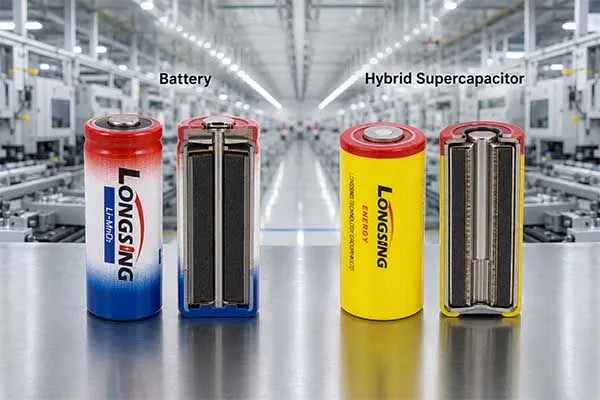
Manufacturing companies like Long Sing Technology now offer hybrid pulse capacitors that combine battery and supercapacitor principles.
These hybrid devices layer activated carbon electrodes with lithium-ion materials to achieve energy densities of 15-25 Wh/kg while maintaining power capabilities above conventional batteries. This hybrid approach addresses the supercapacitor vs battery limitation by offering intermediate performance characteristics.
2. How Do Supercapacitor Batteries Deliver High Pulse Power?
Supercapacitor batteries deliver high pulse power because they store charge electrostatically and often have lower internal resistance than batteries.
They can release energy in seconds, limiting voltage sag during wireless transmissions, regenerative braking, or emergency actuation. In a supercap battery system, the battery supports the average load while the capacitor supplies current peaks[4], avoiding the need to size the battery for each surge.
Power Delivery Comparison Across Discharge Rates
| Discharge Duration | Supercapacitor Performance | Battery Performance | Optimal Choice |
|---|---|---|---|
| 0.01-1 second | Excellent – no voltage sag | Poor – severe voltage drop | Supercapacitor |
| 1-60 seconds | Very good – stable output | Moderate – acceptable | Supercapacitor |
| 1-10 minutes | Good – limited capacity | Good – efficient delivery | Hybrid or Battery |
| 10 minutes – 1 hour | Limited – size prohibitive | Excellent – optimal range | Battery |
| 1+ hours | Not practical | Excellent – designed range | Battery |
Supercapacitors typically exhibit equivalent series resistance below 10 milliohms, allowing current to flow with minimal voltage drop.
Batteries have internal resistance ranging from 50-500 milliohms depending on chemistry and state of charge. This resistance converts electrical energy to heat during discharge, limiting the current that batteries can safely provide.
The voltage behavior during discharge reveals fundamental differences.
The supercapacitor vs battery power-delivery difference starts with internal resistance. When a load step occurs, the immediate voltage drop is approximately current multiplied by ESR or DC internal resistance. A low-ESR supercapacitor can therefore support a brief high-current load with less voltage sag, while battery resistance varies with chemistry, state of charge, temperature, and age.
A Real-World Test Failure Case: High ESR-Induced Voltage Collapse at -40°C Cold Start(Click to see all)
- Country: German
- Application: ESR
- Product: Hybrid Pulse Supercapacitor(HPC) with primary lithium batteries
- Temperature: -40°C
- Target current burst: 500–800 mA for 100–500 ms
- Process that we met failure:
Initial room-temperature tests showed acceptable performance: ESR measured ~15–25 mΩ, with voltage drop (IR drop) under 0.3 V during pulse.
However, after 24-hour stabilization at -40°C in a climate chamber, the effective ESR surged dramatically—often 3–8× higher (reaching 80–200 mΩ in some cells) due to electrolyte viscosity increase and reduced ionic mobility in the organic electrolyte system.
During the first cold pulse discharge:
- Initial open-circuit voltage: ~3.8 V (fully charged hybrid cell)
- Peak current draw: 600 mA
- Instantaneous voltage sag: >1.2 V within 50 ms (far exceeding the acceptable <0.5 V threshold)
- System-level result: The connected microcontroller reset repeatedly due to brownout detection triggering at ~2.6 V, failing the “cold start reliability” criterion.
Root cause analysis revealed the hybrid supercapacitor‘s temperature-sensitive ESR as the primary culprit—unlike pure EDLCs, lithium-ion capacitors (LICs) or hybrid designs can exhibit even sharper degradation below -30°C if not specifically engineered for polar conditions.
The module failed MIL-STD-810G Method 501.5 (low-temp operational) and IEC 60068-2-1 standards for the application.
This failure delayed certification by 4 months and required a redesign: switching to a lower-ESR formulation with advanced electrolyte additives and better electrode wetting.
From our perspective at Long Sing Technology, we’ve seen similar patterns in client prototypes from northern Europe and Canada. By contrast, pairing our lithium thionyl chloride cells (like ER14505) with properly temperature-optimized hybrid pulse capacitors avoids such pitfalls — our HPC variants maintain ESR stability better at -40°C, ensuring voltage remains above critical thresholds during pulses.
This hybrid approach has proven reliable in field deployments across cold-climate regions like Scandinavia, Russia, and northern US states.
Pulse capability should be judged from the minimum voltage reached during the actual load, not from capacitance or battery capacity alone.
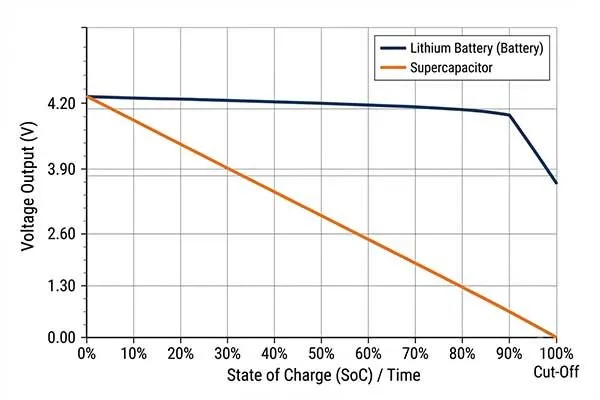
Supercapacitor voltage decreases as it discharges, so designers must define the maximum voltage, minimum system voltage, pulse current, pulse duration, and converter efficiency. A DC-DC converter may be required when the load cannot accept a wide input-voltage range. Terms such as ultra capacitor batteries are often used informally, but an EDLC is not a chemical battery.
| Factor | Supercapacitor | Battery |
|---|---|---|
| Pulse load | Brief high current | Sustained load |
| Resistance | Low ESR; less pulse sag | DCIR varies with temperature |
| Voltage | Declines during discharge | Flatter output |
| Best fit | Repeated bursts | Longer runtime |
For wireless sensors, meters, and motor-start circuits, a practical supercapacitor vs battery architecture lets the battery supply standby and average current while the capacitor supplies the pulse. The battery then recharges the capacitor between events.
Engineers should verify worst-case ESR at temperature, connector resistance, pulse repetition, heat rise, capacitance tolerance, and end-of-life degradation before approving the design.
3. When Should Engineers Choose a Capacitor vs Battery Configuration?
Engineers should select capacitor vs battery configurations based on the power-to-energy ratio of their application.
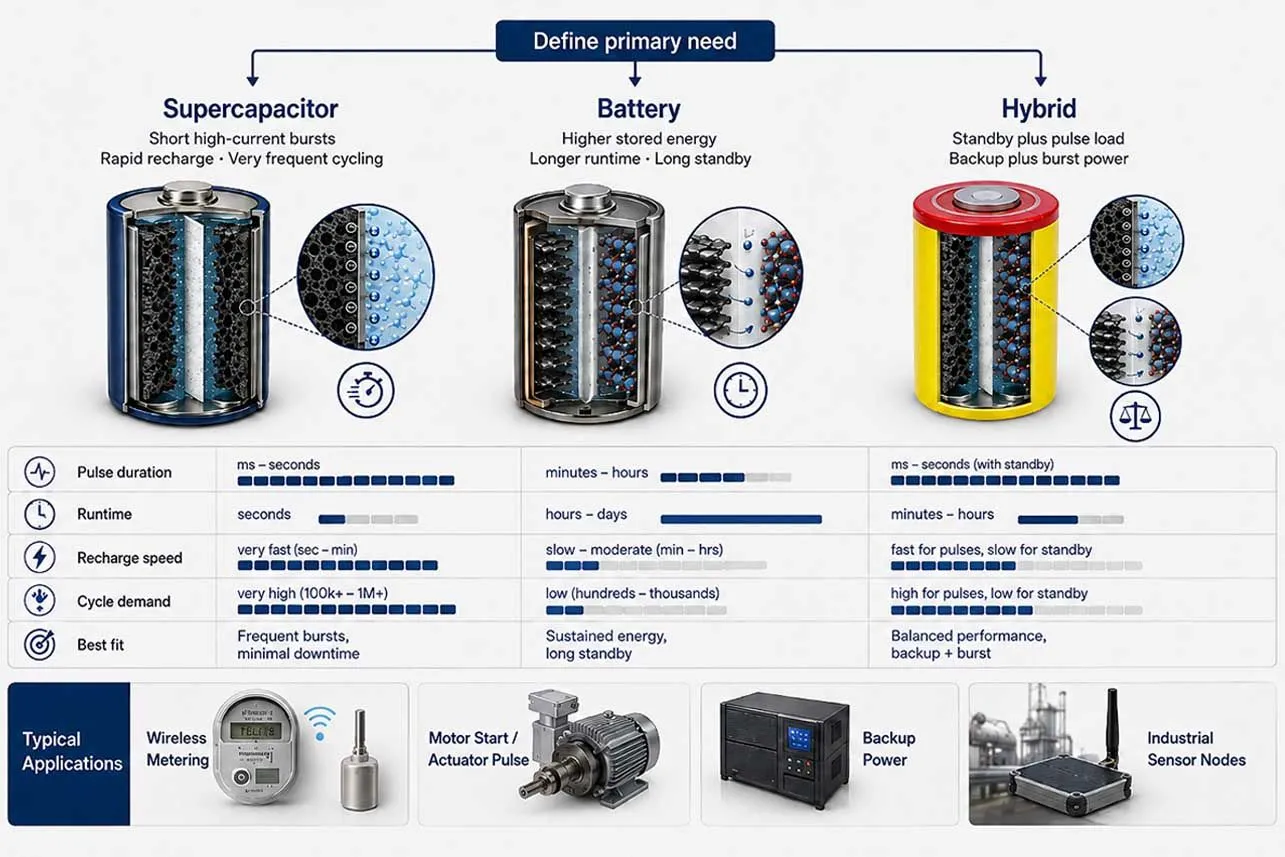
Applications requiring power delivery under 60 seconds with frequent cycling favor supercapacitors. Systems needing sustained operation beyond 10 minutes with infrequent discharge cycles work better with batteries.
For mixed requirements, hybrid architectures combining both technologies optimize performance, with batteries handling base load and supercapacitors managing peak demands.
Application analysis starts with defining the load profile.
A smart water meter transmitting data once daily for 200 milliseconds requires a battery for the 99.99% idle time and potentially a supercapacitor for the transmission pulse.
An emergency backup system powering equipment for 30 minutes during outages needs battery technology because energy storage requirements overwhelm supercapacitor size constraints.
The power and energy requirements must both factor into the decision matrix.
Cycle life expectations drive technology selection for long-term deployments.
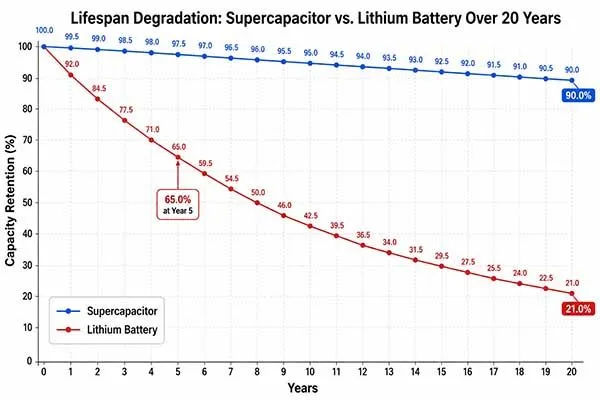
Equipment designed for 20-year service life with daily cycling reaches 7,300 cycles over its lifetime. Standard batteries would require 2-3 replacements during this period, creating maintenance costs and reliability risks.
Supercapacitors handle this cycle count easily, making them more suitable despite higher initial costs.
Applications with annual or monthly cycling work well with batteries because the limited cycle count stays well within battery capabilities.
Environmental conditions constrain technology choices significantly.
Outdoor utility equipment faces temperature extremes from -40°C in northern winters to +70°C in direct sun exposure. Lithium thionyl chloride batteries handle this range but with reduced capacity at temperature extremes.
Supercapacitors maintain full performance across this range, making them preferable for temperature-critical applications.
Indoor applications with controlled environments allow more flexibility in technology selection.
Application Suitability Decision Matrix
| Application Type | Primary Requirement | Recommended Solution | Justification |
|---|---|---|---|
| Wireless sensor nodes | Pulse transmission power | Hybrid configuration | Battery for base + capacitor for pulses |
| Utility meters | 20-year maintenance-free | Primary lithium battery | Low self-discharge + adequate energy |
| Regenerative braking | High power capture/release | Supercapacitor bank | Unlimited cycle life + power density |
| Memory backup | Minutes of runtime | Supercapacitor | Fast charge + sufficient duration |
| Medical implants | Long-term energy storage | Primary lithium battery | Energy density + reliability |
| Grid stabilization | Frequency regulation | Supercapacitor array | Response time + cycle life |
Size and weight constraints influence the battery vs capacitor choice.
Aerospace applications where every gram matters often choose batteries despite lower power density because the energy-to-weight ratio determines flight time.
Stationary applications like telecommunications backup power accept larger supercapacitor installations because floor space costs less than battery replacement cycles. The designer must weigh these physical constraints against performance requirements.
Cost analysis requires lifecycle evaluation rather than just initial purchase price.
A supercapacitor system costing three times more than a battery solution might prove more economical over 15 years when you account for replacement costs, maintenance visits, and disposal fees.
Industrial applications with difficult access points especially benefit from maintenance-free supercapacitor installations. Consumer products with expected 3-5 year lifespans generally justify battery selection because replacement cost never factors into the initial purchase decision.
Safety requirements sometimes dictate technology selection.
Medical devices and aircraft systems must meet stringent safety standards that favor proven battery technologies despite performance limitations.
The regulatory approval process for new energy storage technologies can take years, making batteries the practical choice even when supercapacitors offer technical advantages.
Some applications mandate intrinsically safe designs that limit energy storage to levels below supercapacitor capabilities. Hybrid architectures combine strengths of both technologies for demanding applications.
Long Sing Technology manufactures hybrid pulse capacitor modules that integrate supercapacitor and battery elements in single packages. These systems use batteries for sustained base loads while supercapacitors buffer peak demands.
This configuration optimizes both energy density and power density, solving the fundamental supercapacitor vs battery trade-off that otherwise forces engineers to choose between competing requirements.
4. Which Metrics Matter in a Supercapacitor vs Battery Selection?
A reliable supercapacitor vs battery selection starts with the load profile: peak current, pulse duration, repetition rate, average power, required runtime, minimum voltage[5], temperature, and service life.
Specific power favors supercapacitors; specific energy and standby retention favor batteries. For supercapacitors vs lithium ion batteries, engineers should also compare ESR, voltage decay, charging limits, cycle life, self-discharge, converter requirements, and end-of-life performance under actual operating conditions.
Key Performance Metrics Comparison
| Performance Metric | Supercapacitor Value | Battery Value | Impact on Selection |
|---|---|---|---|
| Specific Power (W/kg) | 10,000-100,000 | 50-500 | Critical for pulse applications |
| Specific Energy (Wh/kg) | 1-10 | 50-250 | Determines runtime duration |
| Cycle Life (cycles) | 500,000-1,000,000+ | 300-3,000 | Affects maintenance needs |
| Self-discharge (%/month) | 20-40 | 2-5 | Important for standby time |
| Charge Time | 1-10 seconds | 1-10 hours | Affects system availability |
| Voltage | Declines continuously | Flatter plateau | Converter need |
| Operating Temp Range | -40°C to +70°C | -20°C to +60°C | Defines environmental limits |
| Cost per kWh | $10,000-$30,000 | $100-$500 | Influences economics |
The supercapacitor vs battery decision should not rely on one headline value. Specific power shows how quickly energy can be delivered, while specific energy shows how much energy can be stored per unit mass. A Ragone plot[6] helps visualize this trade-off, but the final choice still depends on the load profile and the usable voltage window.
In a supercapacitor vs li battery comparison, calculate both immediate voltage sag and pulse-duration voltage loss. Check ESR or DCIR at the coldest operating temperature and at end of life.
For supercapacitors, also account for capacitance tolerance, leakage, balancing requirements in series stacks, and the falling terminal voltage. For batteries, review state-of-charge limits, charge rate, protection, thermal behavior, and allowable pulse current.
Cycle life and self-discharge answer different questions. Frequent charge-discharge events can favor a supercapacitor, while long unattended standby often favors a battery. Cost should therefore be compared at system level, including converters, balancing, protection, replacement labor, maintenance access, and expected service life.
Where high energy and short peak power are both required, a hybrid configuration may provide the best fit. Use model-specific datasheets and test the complete power path under the real pulse, temperature, and aging conditions.
Conclusion
The supercapacitor vs battery decision requires careful analysis of power requirements, energy needs, cycle life expectations, and operating environment.
Supercapacitors excel at delivering high power for short durations with exceptional cycle life, while batteries provide sustained energy storage with lower self-discharge rates.
Engineers achieve optimal results by matching technology strengths to application requirements – using supercapacitors for pulse loads and rapid cycling, batteries for long-duration energy storage, or hybrid configurations that combine both advantages.
Understanding these performance trade-offs allows designers to specify power systems that meet functional requirements while optimizing cost and reliability over the product lifecycle.
Frequent Asked Question
(Click to Unfold)
Q: Is a supercapacitor better than a battery?
A: No absolute better—application-dependent. Supercapacitors shine in power density (up to 10-100x batteries, e.g., 7 kW/L), rapid charge/discharge (seconds), and cycle life (>1M cycles).
Primary lithium batteries excel in energy density (up to 700 Wh/kg), long shelf life (10-20 years), and low self-discharge, ideal for reliable, non-rechargeable uses like medical devices.
Q: How much does a supercapacitor cost compared to a battery?
A: Supercapacitors: $5,000-10,000/kWh (2025). Lithium batteries: $100-150/kWh for Li-ion; primary lithium even lower per use case (~$195/kWh for storage tech). Supercaps 10-50x pricier per kWh.
Q: How long can a supercapacitor hold a charge?
A: Hours to days due to high self-discharge rate (e.g., 36% in 8 hours; full loss in weeks if idle). Primary lithium batteries hold charge for 10-20 years with minimal loss.
Q: What’s better, a capacitor or a battery?
A: Batteries for energy density and cost-effectiveness; supercapacitors for power bursts. Primary lithium batteries superior for long-term, reliable storage without recharge needs.
Q: What’s the difference between capacitors and batteries?
A: Storage: Supercaps electrostatic (fast, high power density 10-100x batteries); batteries chemical (high energy density 100-700 Wh/kg).
Charge Time: Supercaps seconds; batteries hours.
Life: Supercaps millions cycles; primary lithium 10-20 years shelf.
Drawbacks: Supercaps high self-discharge/cost; batteries limited cycles but better retention.
Q: How much power can a supercapacitor store?
A: Energy density: 5-30 Wh/kg; power density: Up to 10,000 W/kg or 7 kW/L (10-100x batteries). Primary lithium: 300-700 Wh/kg energy, lower power but sustained.
Note:
[1]Learn about power density to understand how quickly energy can be delivered in applications.↪
[2]Understanding electrostatic charge helps in grasping how supercapacitors function.↪
[3]These reactions are fundamental to battery operation and efficiency.↪
[6]Explains how a Ragone plot compares energy–power performance and how to apply it consistently.↪
Also read about more battery comparison blogs:
- What is the difference between industrial batteries and regular batteries?
- 14500 battery vs AA: Is a 14500 battery the same as an AA?
- Lithium Primary vs Lithium ion: What is the difference between lithium ion and lithium primary battery?
- CR2025 VS CR2032: Practical Differences Between Coin-Shaped Batteries
- Alkaline vs. Lithium Batteries: The Ultimate Showdown!
- How to Choose Between Lithium Metal vs Lithium Ion?
- Bobbin Type vs Spiral Type Battery Long-Life Applications
- Survival in -40°C: Li-SOCl2 vs. Li-Po battery for Outdoor Monitoring
- Primary Lithium vs. NiMH Batteries Engineering Trade-Offs for Long-Term Power Applications
- Battery Selection Guide: Primary vs Secondary Lithium Batteries for Industrial Projects?
- Solid state batteries vs lithium metal batteries: Which One Elevates Your Product Performance?
- What is the difference between polymer and hybrid capacitors: ESR, Lifetime & ROI Guide

The Silent Shelf-Life Secret: Why Battery Passivation is Actually a Good Thing
Are you worried about your batteries dying on the shelf before you even use them? Many industrial us
How Lithium Ion Capacitors Bridge the Gap Between Batteries and EDLCs
Struggling with power backups that either drain too fast or lack burst energy? Standard batteries de
4 Proven Ways for Your Smart Parking Sensor Battery
Smart parking sensor battery guide covering Li-SOCl2, LoRaWAN and NB-IoT pulse loads, passivation, l