

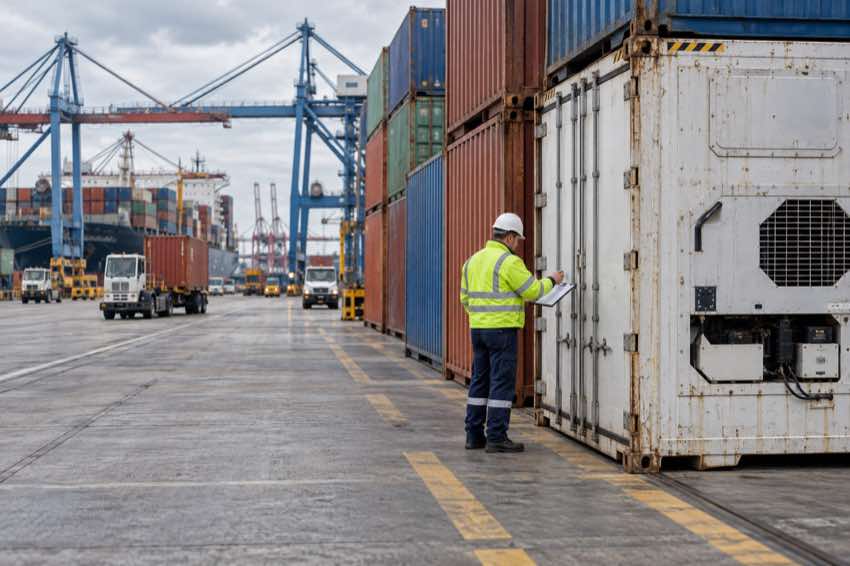
How to Choose the Best Smart Container Tracker Battery
A container tracker is an awkward load for a battery.
For most of the day, the electronics may sit in a low-power state. Then the unit wakes, reads its sensors, starts GNSS and sends a report over LTE-M or NB-IoT. A door alarm, temperature exception or poor network connection may keep the system active for longer than expected.
That creates two separate requirements for a smart container tracker battery: enough stored energy for the intended deployment period, and enough pulse capability to keep the tracker above its minimum operating voltage during communication.
The distinction is becoming more relevant as container visibility expands beyond location alone. DCSA’s Track & Trace 3.0.0 adds IoT and reefer events such as geolocation, geofence crossing, door status, temperature, power status and alarms. [1]
For battery selection, the practical consequence is simple: the load profile of a modern container tracker can vary considerably depending on what it measures, how often it reports and what happens when communication conditions are poor.
Table of Contents
- 1. Why Smart Container Trackers Create a Difficult Battery Load Profile
- 2. Li-SOCl2 vs ER + HPC for Container Tracking
- 3. What Actually Determines Smart Container Tracker Battery Life?
- 4. How to Select a Battery for a Smart Container Tracker
- 5. Frequently Asked Questions
- 6. Selecting the Battery From the Tracker Duty Cycle
- References
1. Why Smart Container Trackers Create a Difficult Battery Load Profile
A typical operating cycle might look like this:
Sleep → Wake → Sensor Reading → GNSS Fix → Data Processing → Transmission → Sleep
The exact sequence depends on the hardware and firmware, but it shows why one average-current number does not tell the whole story.
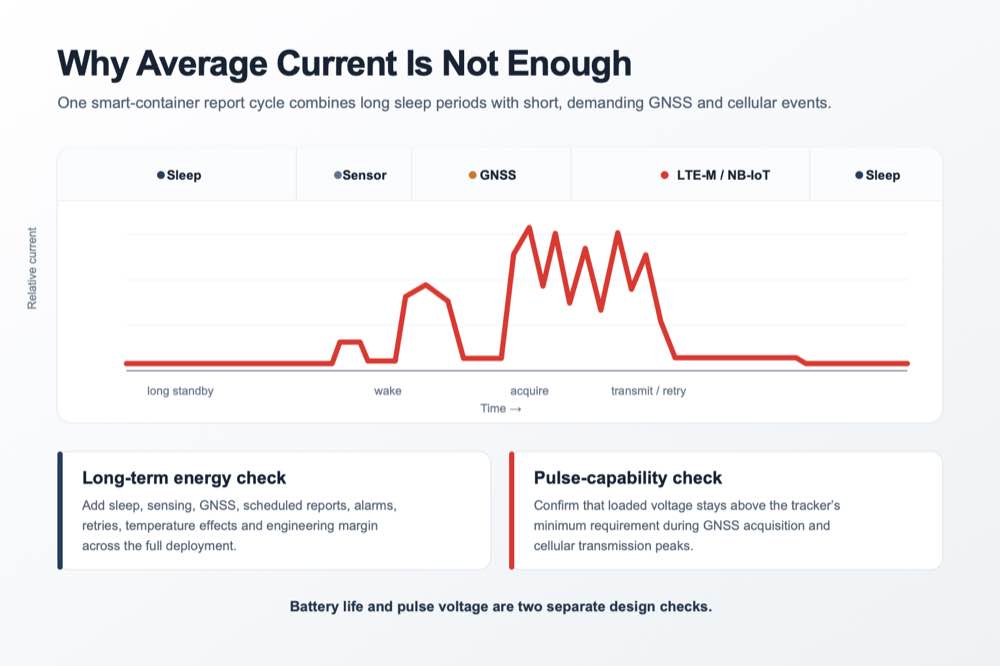
During sleep, the controller, sensors and communication module can be configured for very low power consumption. LTE-M and NB-IoT also support power-saving mechanisms such as PSM and eDRX, which allow compatible devices to spend long periods in reduced-power states. [2]
The situation changes once the tracker wakes.
GNSS acquisition, network registration and cellular transmission can create short loads that are much heavier than the standby load. The battery has to support those events without allowing the system voltage to fall below the level required by the modem, MCU or power circuitry.
Scheduled reports are only part of the duty cycle
A normal report may include a temperature reading, a position update and a short data transmission.
Field operation is less predictable.
A tracker may also wake because of:
- a door or tamper event;
- a geofence crossing;
- shock or movement;
- a temperature alarm;
- a location exception.
Network conditions matter as well. If registration takes longer than expected or a transmission has to be repeated, the modem remains active for longer and the energy cost of that report increases.
For container applications, this deserves attention. Devices move between ports, vessels, warehouses, roads and different mobile networks. The clean communication cycle measured on a laboratory bench may not represent every deployment condition.

Energy and pulse capability need separate checks
Long-term energy determines whether the battery can support months or years of sleep, sensing and reporting.
Pulse capability determines whether the power system can handle a particular active event without excessive voltage drop.
A battery can therefore have enough nominal capacity for the theoretical lifetime calculation and still be unsuitable if its loaded voltage falls too far during GNSS or cellular activity.
For a long-life tracker, the lifetime calculation and the pulse-current check should be treated as two separate design tasks.
2. Li-SOCl2 vs ER + HPC for Container Tracking
Li-SOCl2 cells are often considered for remote monitoring and asset-tracking equipment because the chemistry is well suited to applications that spend long periods at low current.
That does not mean every Li-SOCl2 cell behaves the same way under a tracker load.
Cell construction, size, temperature, state of charge, storage history and the duration of the load all affect the result.
When a bobbin Li-SOCl2 cell may be enough
If the tracker sleeps for long periods and sends only occasional short reports, a bobbin-type ER cell may be a reasonable starting point.
The engineering check is not simply whether the cell contains enough capacity. The selected cell also has to maintain an acceptable voltage during the heaviest part of the reporting cycle.
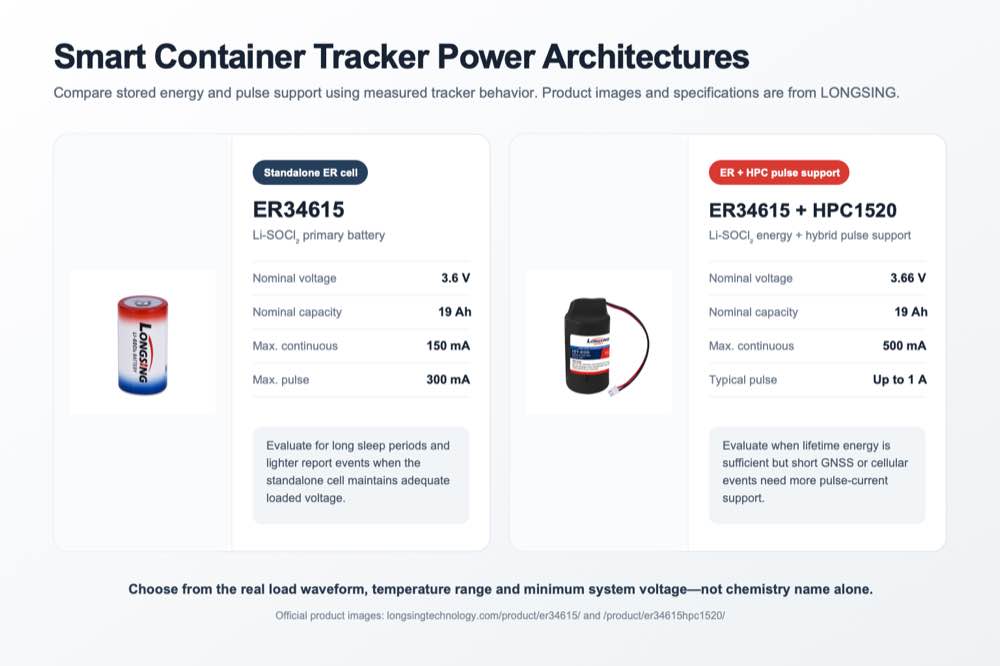
This distinction is visible even in published ER-cell data: nominal capacity, continuous-current capability and pulse-current capability are specified separately.
For a low-duty-cycle tracker, a standalone ER cell may therefore work well if its real load has been characterized and the voltage margin is sufficient.
When higher current capability becomes relevant
Some tracker designs wake more frequently, spend longer acquiring GNSS or place a heavier load on the battery during communication.
A higher-rate Li-SOCl2 construction may be more appropriate in those cases.
That decision still involves a trade-off. Higher current capability should not automatically be interpreted as a better battery. The useful question is whether the cell matches the actual combination of stored-energy requirement and load profile.
When ER + HPC should be considered
A hybrid arrangement becomes relevant when the project needs the long-term energy of an ER cell but the transient load is difficult for the selected cell to support on its own.
The roles are then separated:
ER cell → long-term energy
HPC → short-duration pulse support
During a transmission event, the pulse-support element can help supply the temporary high load and reduce the voltage drop seen by the electronics. Between events, the system returns to its much lower background load.
LONGSING uses this type of architecture in IoT applications involving LTE-M, NB-IoT and other wireless communication loads.
Relevant Website A pages include:
- Transport & Logistics — smart container monitoring, GPS asset tracking and cold-chain monitoring
- ER34615 Li-SOCl2 Battery
- ER34615 + HPC1520
An HPC is not required simply because a tracker contains a cellular modem. If the standalone ER cell maintains the required voltage through the worst communication event, adding another power element may provide little benefit.
The decision should come from the waveform.
Engineering comparison
| Power Architecture | Typical Fit | Main Advantage | Main Limitation | When to Consider |
|---|---|---|---|---|
| Bobbin Li-SOCl2 | Long sleep periods, low average load and relatively light communication events | High stored energy with low self-discharge | Pulse capability may become limiting under heavier loads | Infrequent reporting and low-duty-cycle monitoring |
| Spiral Li-SOCl2 | Primary-powered equipment with higher current demand | Better current delivery than typical bobbin construction | Different capacity and energy trade-offs | More frequent or heavier active loads |
| ER + HPC | Long-life GNSS/cellular IoT devices with intermittent high-current events | Combines long-term energy with pulse support | Adds components and design complexity | When the selected ER cell cannot maintain sufficient loaded voltage |
Reefer monitoring needs a temperature check, not just a capacity check
Cold-chain trackers add another variable.

A reefer monitoring device may sample temperature frequently and generate additional transmissions when an alarm occurs. At the same time, the battery may be operating under colder conditions than a tracker installed in a normal ambient environment.
Low temperature can change cell impedance and the voltage response under load. A communication pulse that works comfortably at room temperature may produce a different result in a cold test.
Li-SOCl2 systems also have a known passivation mechanism. A protective layer forms on the lithium surface during storage and is associated with the initial voltage-delay behavior seen in the chemistry. [3]
For a reefer tracker, battery validation should therefore include the expected thermal conditions and the real active-current waveform rather than relying only on room-temperature nominal capacity.
3. What Actually Determines Smart Container Tracker Battery Life?
The familiar calculation:
Battery Capacity ÷ Average Current = Operating Time
is useful for a first estimate.
It should not be treated as the final answer for a smart container tracker.
A more realistic model needs to account for how the device actually spends its energy.
1. Standby consumption
Because the tracker may spend most of its deployment asleep, small background loads accumulate.
The measurement should include the assembled device, not just the MCU sleep-current specification. Regulators, sensors, protection circuits and leakage paths can all contribute to the standby load.
2. GNSS, sensing and reporting frequency
The number of wake cycles has a direct effect on the energy budget.
A device reporting several times per hour behaves very differently from one sending only a few scheduled updates per day.
The same applies to sensing.
A reefer tracker, for example, may measure temperature frequently but transmit the accumulated data less often. Those two intervals should not automatically be treated as the same event.
GNSS should also be evaluated by energy per acquisition. Acquisition time can vary with antenna conditions and satellite visibility, particularly when the tracker is operating around large metal structures or stacked containers.
3. Cellular network behavior
LTE-M and NB-IoT can support low-power operation through PSM, eDRX and related network features. [2]
But the communication budget is still application-dependent.
The useful measurement is the complete reporting cycle:
modem wake → registration → connection → data transfer → release → return to sleep
Poor coverage, roaming conditions or retransmissions can make that cycle longer.
A battery-life model based only on the modem’s lowest sleep-current figure will miss this part of the load.
4. Temperature and loaded voltage
Temperature changes both electrochemical performance and the voltage behavior seen by the electronics.
This matters during pulse loads.
In practice, tracker end of life may be determined by minimum operating voltage before the nominal battery capacity has been completely used.
A useful validation condition is therefore:
low temperature + aged battery + communication event + minimum system voltage
If the tracker remains stable under that combination, the design has a much more meaningful voltage margin than one tested only with a fresh cell at room temperature.
Studies of Li-SOCl2 cells have also shown that operating voltage depends on current and state of charge, reinforcing the need to treat available system energy as more than a nominal-capacity figure. [4]
5. Aging, events and engineering margin
A long-duration calculation should include self-discharge and changes that occur during storage and service.
It should also leave room for activity that does not happen on a fixed schedule.
Door alarms, temperature exceptions, shock events and extra communication attempts all consume energy outside the normal reporting plan.
A practical energy model can be expressed as:
Total requirement = standby + sensing + GNSS + scheduled communication + expected event traffic + communication retries + long-term losses + design margin
The exact margin should come from the project requirements rather than from a universal percentage.
4. How to Select a Battery for a Smart Container Tracker
A useful selection process starts with measurements from the tracker rather than a search for the largest cell that fits the enclosure.
Step 1 — Measure the complete sleep load
Measure the assembled device in its intended low-power state.
Include the controller, sensor interfaces, regulators and any circuitry that remains connected during sleep.
This gives a realistic baseline for the long-term energy calculation.
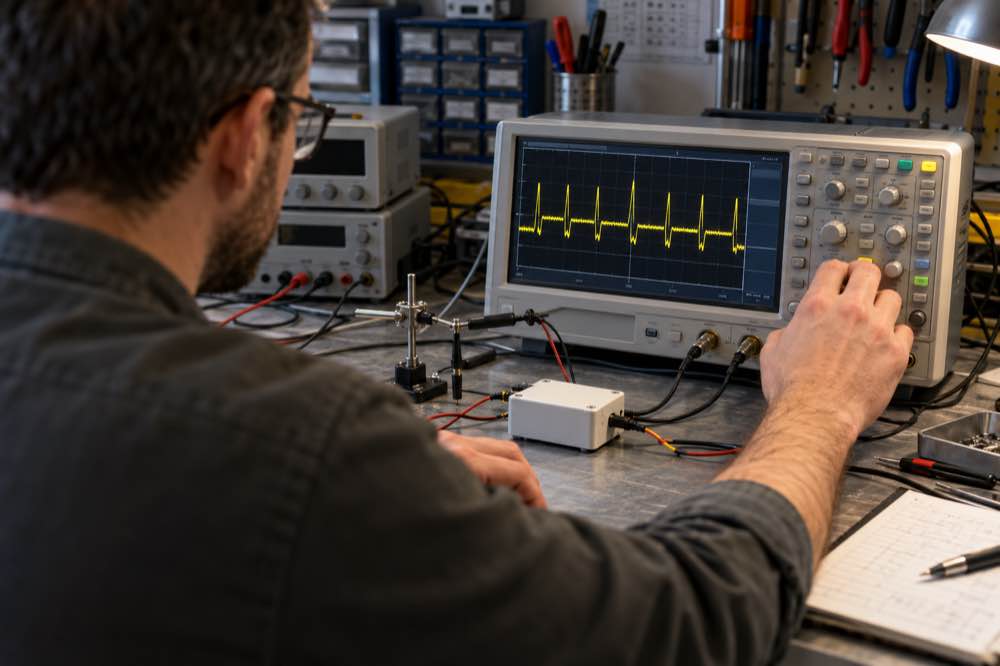
Step 2 — Characterize one complete reporting cycle
Capture the current waveform from wake-up until the tracker returns to sleep.
The cycle should include:
sensor reading → GNSS → processing → network registration → transmission → sleep
Measure the energy per event as well as the highest current and lowest loaded voltage.
This provides far more useful battery-selection data than a single average-current figure.
Step 3 — Test the abnormal cases
Repeat the measurement under less favorable conditions.
Examples include:
- slower GNSS acquisition;
- weak mobile coverage;
- network registration delay;
- retransmission;
- repeated alarm reporting.
A design based only on the cleanest communication cycle will usually underestimate field energy consumption.
Step 4 — Build the lifetime energy budget
Combine the measured events with their expected frequency.
The calculation should include standby operation, sensor sampling, GNSS fixes, scheduled transmissions and expected exception traffic.
Long-term losses and an engineering margin should also be included.
At this stage, candidate ER cell sizes such as ER14505, ER26500 or ER34615 can be screened against the required energy and available space.
Step 5 — Check pulse voltage separately
Once a candidate battery has enough energy, test whether it can support the heaviest active event.
Look at the voltage waveform, not just the current rating.
If the voltage margin is insufficient, the next step may be a different cell construction or an ER + HPC architecture rather than simply selecting a larger nominal capacity.
Step 6 — Validate the selected architecture under realistic conditions
A fresh battery at room temperature represents an easy test case.
The design should also be checked under the conditions that are more likely to expose a power problem:
- lower temperature;
- reduced state of charge;
- high-current communication;
- repeated events;
- less favorable network conditions.
For a long-life IoT device, this final system-level validation is more informative than the capacity figure alone.
5. Frequently Asked Questions
Click to explore more information about smart container tracker batteries
1. What battery is used in a smart container tracker?
There is no single battery type used by every tracker. Li-SOCl2 primary cells are often considered for long-life, low-power tracking applications. The correct cell or hybrid architecture depends on energy requirement, pulse load, temperature, enclosure space and reporting behavior.
2. Why is Li-SOCl2 suitable for container tracking devices?
Li-SOCl2 is well suited to devices that spend long periods at low current and need substantial stored energy. Pulse capability still needs to be checked against GNSS and cellular communication loads.
3. When does a smart container tracker need an HPC?
An HPC may be useful when the ER cell provides enough long-term energy but cannot maintain the required voltage during short high-current events. The decision should be based on the measured load waveform.
4. How long can a container tracker battery last?
Service life depends on the complete duty cycle: sleep current, sensing, GNSS, reporting frequency, network behavior, alarm events, temperature and system end-of-life voltage. Nominal capacity alone is not enough to give a reliable lifetime figure.
5. How does cold temperature affect a reefer monitoring battery?
Cold conditions can change battery impedance and loaded-voltage behavior. A reefer tracker should therefore be tested at the expected operating temperature, especially during its highest-current communication events.
6. How should engineers calculate battery life for a container tracker?
Start with measured energy for each operating state, then multiply by the expected number of events over the deployment period. Add standby consumption, communication retries, event-driven reports, long-term losses and an appropriate engineering margin.
6. Selecting the Battery From the Tracker Duty Cycle
A good smart container tracker battery is not simply the cell with the highest capacity that fits the enclosure.
The design has to satisfy two different requirements: enough usable energy for the intended deployment period and enough pulse capability to keep the tracker operating through GNSS and wireless communication events.
For reefer and logistics monitoring, temperature and network behavior should be part of the same evaluation.
If you are developing a smart container, cold-chain monitoring or logistics tracking device, LONGSING can review the expected duty cycle, communication load and operating environment to help evaluate a suitable Li-SOCl2 ER cell or ER + HPC power architecture.
References
[1] Digital Container Shipping Association (DCSA) — DCSA Publishes Track & Trace 3.0.0: IoT and Reefer Visibility, September 30, 2026. ↵
Covers the addition of IoT and reefer events including geolocation, geofence crossing, door status, temperature, power status and alarms.
[2] GSMA — Mobile IoT Deployment Guidelines / LTE-M and NB-IoT Power-Saving Guidance. ↵
Technical guidance covering PSM, eDRX and Mobile IoT network configuration relevant to long-life LTE-M and NB-IoT devices.
[3] NASA Technical Reports Server — Lithium / Thionyl Chloride Cell Passivation and Voltage-Delay Research. ↵
Technical material describing formation of the lithium-chloride passivation layer and its relationship with voltage delay in Li-SOCl2 cells.
[4] NASA / Jet Propulsion Laboratory — Evaluation of High-Energy Lithium Thionyl Chloride Primary Cells. ↵
Reports the relationship between operating voltage, discharge current and state of charge in Li-SOCl2 primary cells.

Waterproof Batteries for Wastewater Flow Meters: Why Sealing and Corrosion Resistance Matter?
Waterproof Batteries are engineered power sources featuring hermetic seals[1], stainless steel enclo

Mechanical Robustness: Designing Robust Battery That Survive Shock, Vibration, and Long-Term Stress
Many industrial devices fail early because their power source breaks under stress. This creates down
Why Smart Gas Meter Shut-Off Valves Need Pulse-Support Batteries: Li-SOCl₂ + HPC Design Guide
Learn why smart gas meter shut-off valves need Li-SOCl₂ + HPC batteries, and how engineers size pu