

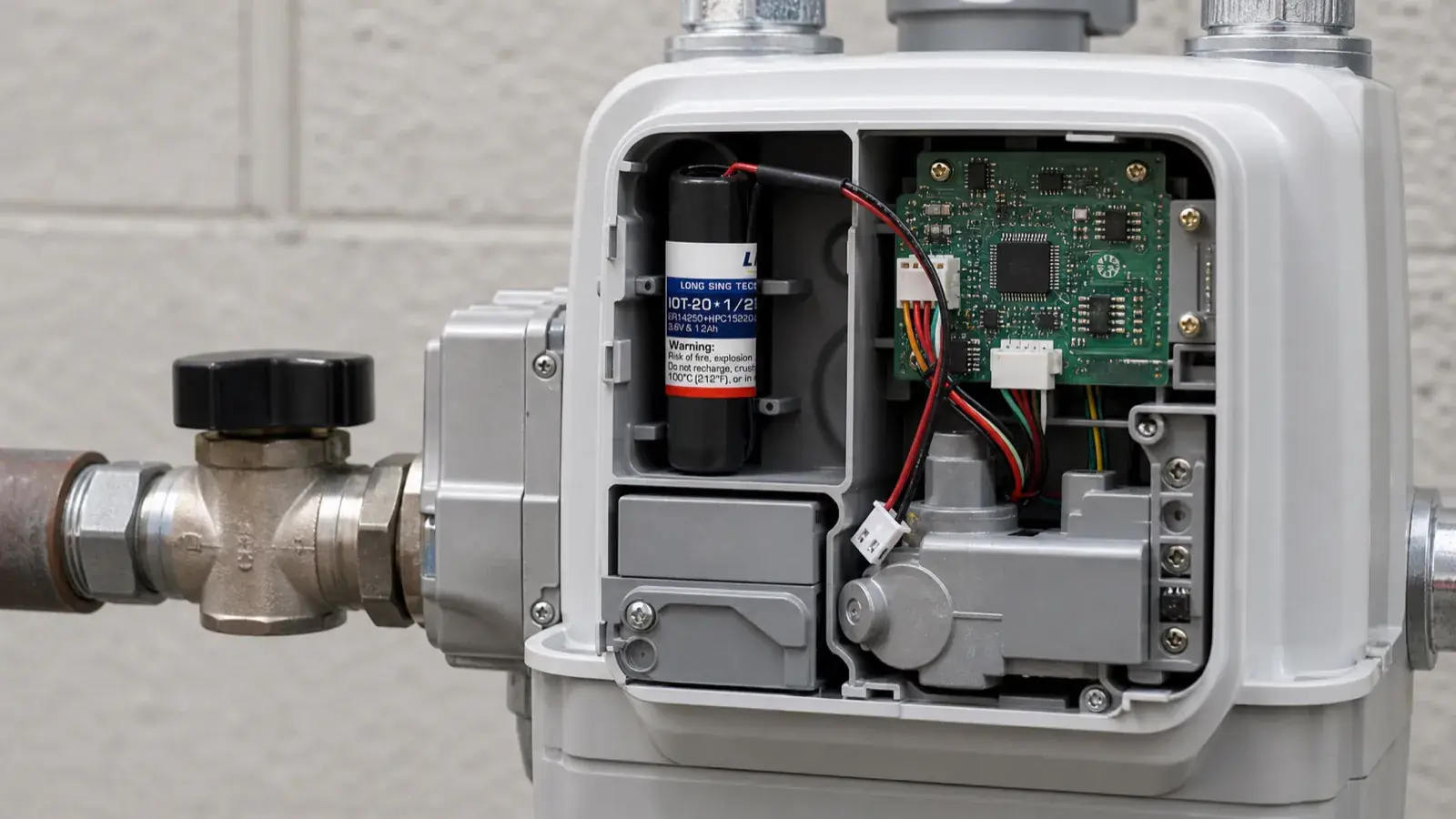
Why Smart Gas Meter Shut-Off Valves Need Pulse-Support Batteries: Li-SOCl₂ + HPC Design Guide
A smart gas meter may consume very little power during normal operation, yet its shut-off valve can suddenly demand much more current than the metering electronics. If the battery is selected only by amp-hour capacity and average current, the valve may still experience excessive voltage drop during actuation.
A smart gas meter shut-off valve battery must satisfy two different requirements: long-term energy and short-duration power. Li-SOCl₂ cells provide the long-term energy reserve, while an HPC can support higher transient loads during valve actuation. The correct ER + HPC design depends on the valve current waveform, actuation duration, minimum system voltage, temperature, battery condition and recovery time.
The key question is therefore not only how many amp-hours the meter needs, but whether enough voltage and pulse energy remain available during the most demanding valve event.
Table of Contents
1. Why Does a Smart Gas Meter Shut-Off Valve Change the Battery Requirement?
A shut-off valve changes the battery requirement because a smart gas meter combines a long-duration, low-average-power application with a comparatively demanding electromechanical load. Battery design must therefore account for both the energy consumed throughout the meter’s service life and the power required when the valve operates. [1]
Remote shut-off is an important function in some smart gas-meter architectures. From the battery perspective, this means the meter must still be capable of operating the valve after spending years primarily in low-current measurement, standby and communication modes.
The Meter Has Two Very Different Load Profiles
During normal operation, a smart gas meter may need power for:
- Flow measurement and sensing
- MCU processing
- Data logging
- Sleep and standby operation
- Scheduled wireless communication
- Diagnostics and status monitoring
These functions typically define much of the meter’s long-term energy budget.
A motorized shut-off valve creates a different load.
The actuator must produce enough mechanical torque to move the valve mechanism. Its electrical profile can include:
- Motor startup current
- Running current
- Changes in current as mechanical load changes
- Motor-driver consumption
- Total valve-actuation time
- Current near the mechanical end position
It is therefore important not to treat a gas-valve event as if it were simply another short wireless-transmission pulse.
Wireless communication may create a relatively short current burst, while a motorized gas valve may remain energized for several seconds. Commercial smart-valve documentation provides examples of gear-motor valve operations occurring over a seconds-scale interval. [2]
The exact current and duration, however, are application-specific.
A battery engineer should work from the measured current waveform of the actual valve or complete meter, rather than assuming that all gas valves produce the same pulse profile.
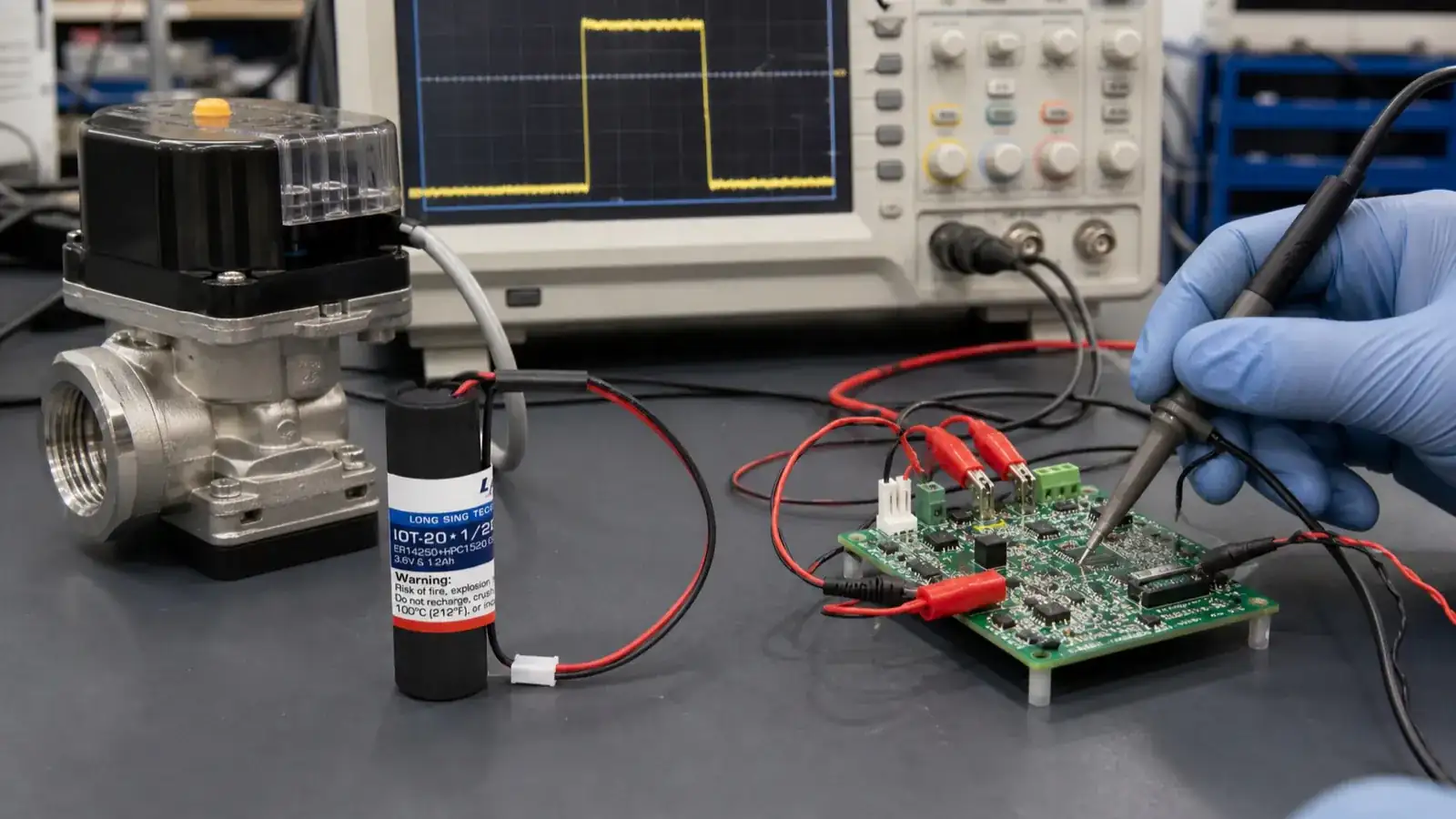
Why Average Current and Ah Capacity Are Not Enough
Amp-hour capacity helps answer:
How much total energy does the meter need over its service life?
It does not fully answer:
Can the power source keep the system voltage high enough while the valve is moving?
These are different engineering questions.
A battery can still contain considerable chemical energy while its terminal voltage temporarily falls below the operating threshold of the MCU, motor driver or valve-control electronics under a high-current load.
This distinction can be seen in LONGSING’s current standalone Li-SOCl₂ ER-cell range.
| LONGSING ER Cell | Nominal Voltage | Nominal Capacity | Published Max. Continuous Current | Published Max. Pulse Current |
|---|---|---|---|---|
| ER14505 | 3.6 V | 2.6 Ah | 50 mA | 100 mA |
| ER26500 | 3.6 V | 8.5 Ah | 100 mA | 200 mA |
| ER34615 | 3.6 V | 19 Ah | 150 mA | 300 mA |
These figures are LONGSING’s published cell specifications under stated product conditions. They are not gas-valve load requirements and should not be used as a substitute for application testing. [3]
The important engineering principle is:
A high-capacity primary lithium cell is not automatically a high-pulse-power source.
The battery must satisfy both the meter’s lifetime energy budget and the electrical demands of the valve event.
Evaluate the Valve Load Before Selecting the Battery
Before fixing the ER cell or HPC configuration, define the valve startup current, running-current profile, actuation time and minimum allowable system voltage.
A battery model should follow the load requirement—not the other way around.
2. Why Can a Standalone Li-SOCl₂ Battery Struggle During Valve Actuation?
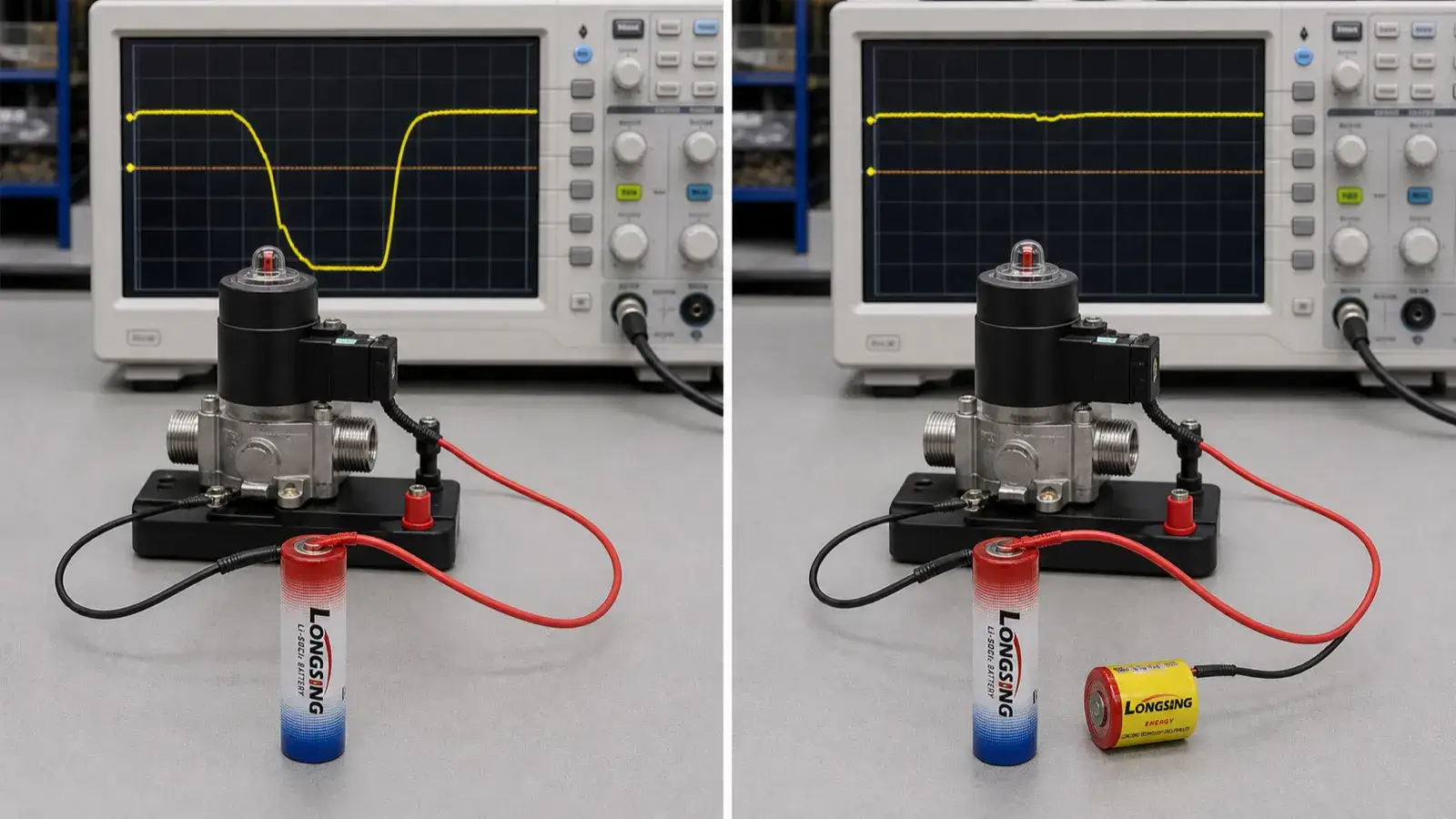
A standalone Li-SOCl₂ battery can experience significant voltage drop when a valve suddenly demands much more current than the meter normally consumes. Effective source impedance, passivation, temperature, discharge condition and wiring resistance can all reduce the available voltage margin.
This does not make Li-SOCl₂ unsuitable for smart gas meters.
Its long shelf life, low self-discharge characteristics and suitability for low-average-current applications are precisely why it is widely considered for long-life unattended devices.
The critical point is that:
Long-term energy capability and high-load response must be evaluated separately.
How Passivation Can Cause Voltage Delay
Li-SOCl₂ cells naturally develop a passivation layer on the lithium surface.
This layer helps reduce unwanted chemical reactions during storage and long periods of low-current operation, supporting the chemistry’s low self-discharge behavior.
However, the same mechanism can influence the cell’s response when a much larger current is suddenly required.
After extended storage or low-load operation, the initial effective resistance may be higher. When the valve load is applied, the terminal voltage can initially drop before recovering as the electrochemical system responds.
This behavior is commonly described as voltage delay.
Peer-reviewed research on bobbin-type Li/SOCl₂ cells connected with electrochemical capacitors has examined the use of the capacitor as a high-current buffer and as a means of suppressing voltage-delay effects during higher-rate discharge. [4]
For a smart gas meter, this creates an important engineering situation:
The battery can still contain usable energy while the voltage available during valve actuation is temporarily insufficient for the complete system.
Remaining capacity and load capability should therefore not be treated as the same parameter.
Why Low Temperature and End-of-Life Conditions Matter
A smart gas-meter battery should not be qualified only using:
new battery + room temperature + one valve operation
That represents only one point in the product’s operating envelope.
The meter may eventually need to perform a shut-off operation after:
- Years of field deployment
- Extended low-current standby
- Low-temperature exposure
- Partial battery depletion
- Increased effective source impedance
- Connector and harness aging
- Multiple previous valve operations
Temperature can influence the electrochemical response of the Li-SOCl₂ cell and the available voltage under load. Mechanical actuator behavior may also change with environmental conditions.
Gas-meter test guidance further demonstrates why minimum battery voltage and source impedance should be considered together when evaluating battery-powered meter performance. [5]
A useful worst-case design review can therefore include:
- Low operating temperature
- Reduced remaining battery energy
- Increased source impedance
- Extended low-load standby
- Passivation state
- Maximum expected valve mechanical load
- Connector and cable resistance
- Simultaneous wireless communication, where applicable
The most meaningful design question is not:
Can a new battery close the valve?
It is:
Can the meter still execute the required shut-off action under the specified worst-case battery, temperature and operating condition?
Design for the Worst Valve Event
A prototype that closes the valve successfully at room temperature is an important first test, but it does not establish long-term field reliability.
The design should preserve sufficient voltage margin under the conditions that are most difficult for the complete system.
3. How Does a Li-SOCl₂ + HPC System Support the Shut-Off Valve?
A Li-SOCl₂ + HPC system separates the long-term energy function from the high-power transient function. The ER cell provides the meter’s stored energy over years of operation, while the Hybrid Pulse Capacitor provides low-impedance pulse support when the valve requires substantially more current. [6]
After the high-load event, the ER cell can gradually replenish the energy removed from the HPC.
This architecture is particularly useful for applications characterized by:
long periods of low current + occasional high-power events
which closely matches many long-life smart-meter power profiles.
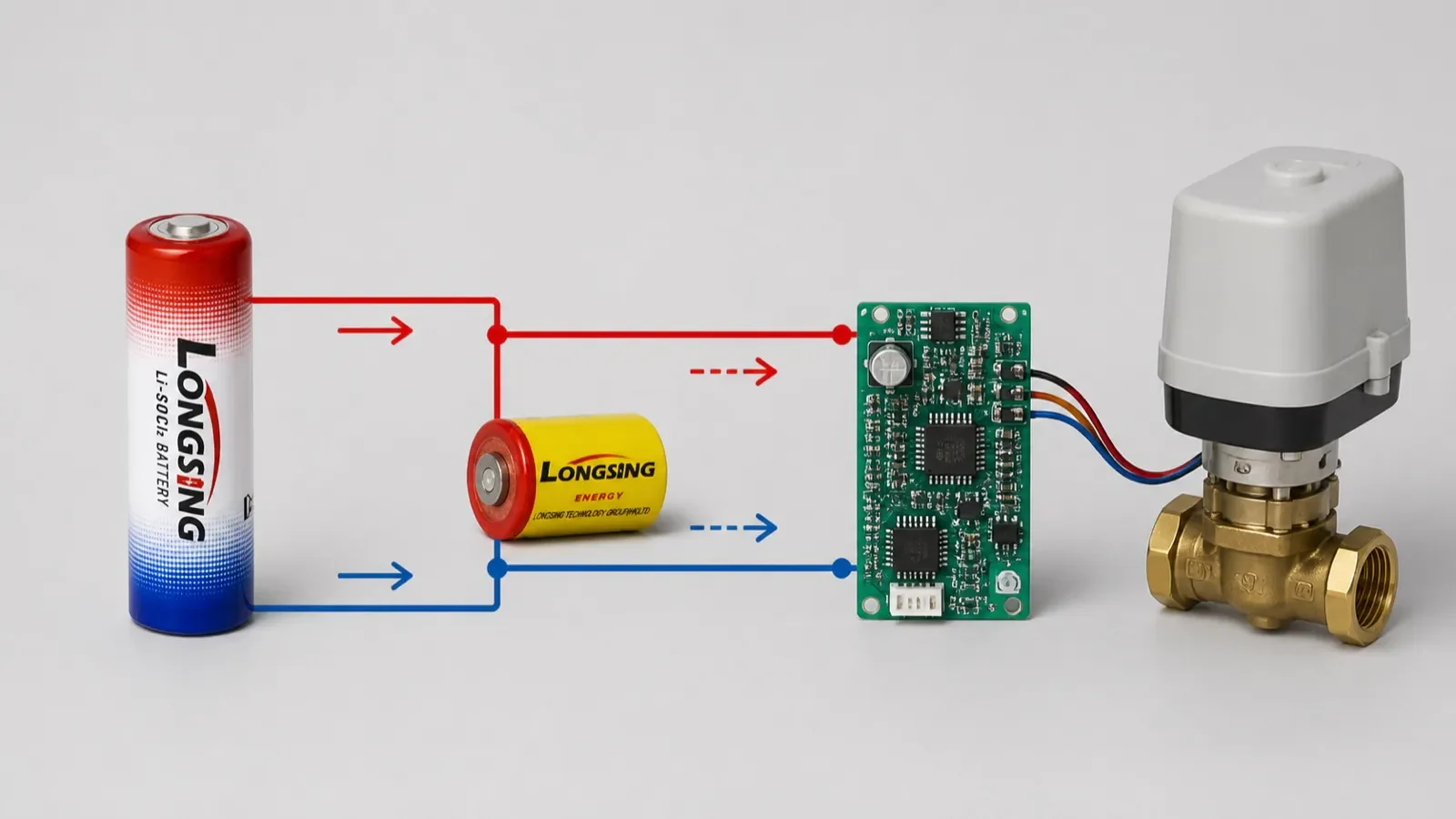
What Happens During Normal Operation, Valve Actuation and Recovery?
The system can be understood in three operating stages.
1. Normal Meter Operation
During normal operation, the Li-SOCl₂ cell supplies the low-average-current load associated with:
- Metering
- MCU operation
- Standby
- Logging
- Diagnostics
- Other low-power functions
The HPC remains available as the pulse-support element.
2. Valve Actuation
When the shut-off valve starts operating, current demand rises.
The HPC can supply a significant portion of the transient current, reducing the immediate high-current burden on the ER cell.
A properly designed pulse-support system can therefore help limit voltage sag at the system bus during the valve event.
This is important because successful valve operation depends not only on current availability but also on maintaining the voltage required by the motor driver, MCU and control electronics.
3. Recovery
After the valve stops and the system returns to a lower load, the ER cell replenishes the energy removed from the HPC.
Recovery time therefore becomes an engineering variable.
For example, the meter may need to support:
- More than one valve command
- Valve retries
- Commissioning operations
- Maintenance commands
- Radio communication soon after valve actuation
The presence of an HPC does not mean unlimited pulse capability.
The system must have enough stored energy and sufficient recovery time for the required operating sequence.
Why HPC Sizing Is More Than a Peak-Current Rating
An HPC should not be selected simply by asking:
How many amps does the valve need?
Current is only one part of the problem.
For an ideal capacitor, a useful first-order relationship is:
ΔV ≈ (I × t) / C
where:
- I = current supplied by the capacitor
- t = pulse-support duration
- C = effective capacitance
- ΔV = capacitive voltage drop
Equivalent series resistance also causes an immediate voltage drop:
ΔVESR ≈ I × ESR
This means that two valve events with the same peak current can require very different pulse-support designs.
For example:
1 A for 200 ms
and
1 A for 5 seconds
are not equivalent energy requirements.
Motor-drive capacitor-sizing guidance similarly treats current variation, load duration and allowable voltage deviation as interconnected parameters. [7]
A practical gas-meter calculation must also account for factors such as:
- ER-cell contribution during the event
- HPC effective capacitance
- HPC ESR
- Valve-current variation
- Mechanical torque changes
- Wiring resistance
- Connector resistance
- Electronics load
- Temperature
- Simultaneous RF transmission
Therefore:
HPC sizing is a pulse-energy and voltage-margin problem—not only a current-rating problem.
Standalone Li-SOCl₂ vs Li-SOCl₂ + HPC
| Design Factor | Standalone Li-SOCl₂ | Li-SOCl₂ + HPC |
| Long-term energy storage | Primary design strength | ER cell retains this role |
| Low-average-current operation | Well suited when correctly selected | Well suited when correctly selected |
| High-current transient | Limited by cell and system impedance | HPC can support transient current |
| Valve-start voltage sag | Requires careful validation | Can be reduced with a properly sized HPC |
| Passivation-related voltage delay | May affect initial high-load response | HPC can buffer the initial load |
| Several-second valve event | Must be validated against actual cell capability | Must be sized for pulse energy and voltage margin |
| Recovery after event | Cell recovers directly | ER cell replenishes HPC |
| System complexity | Lower | Higher |
| Selection basis | Lifetime energy + actual load validation | Lifetime energy + pulse waveform + voltage margin |
LONGSING currently provides ER + HPC configurations using different ER cells and Hybrid Pulse Capacitors.
However, published pulse-current ratings are defined under specific test conditions. A rating based on a one-second pulse, for example, cannot automatically establish performance for a valve event that lasts several seconds. [8]
The actual gas-valve waveform must remain the final design input.
Evaluate the Complete Pulse Event
Do not select an HPC from peak current alone.
Evaluate:
current waveform + actuation duration + minimum voltage + ESR + capacitance + temperature + recovery time
as one complete power event.
4. How Should Engineers Size and Validate a Smart Gas Meter Shut-Off Valve Battery?
Engineers should size the ER cell from the meter’s lifetime energy requirement, then evaluate the HPC from the valve’s current waveform, actuation duration and required voltage margin. Temperature, passivation, recovery behavior and end-of-life conditions should then be included in validation.
A useful design rule is:
ER size is primarily an energy decision. HPC size is primarily a pulse-power and voltage-margin decision.
How to Choose Between ER14505, ER26500 and ER34615
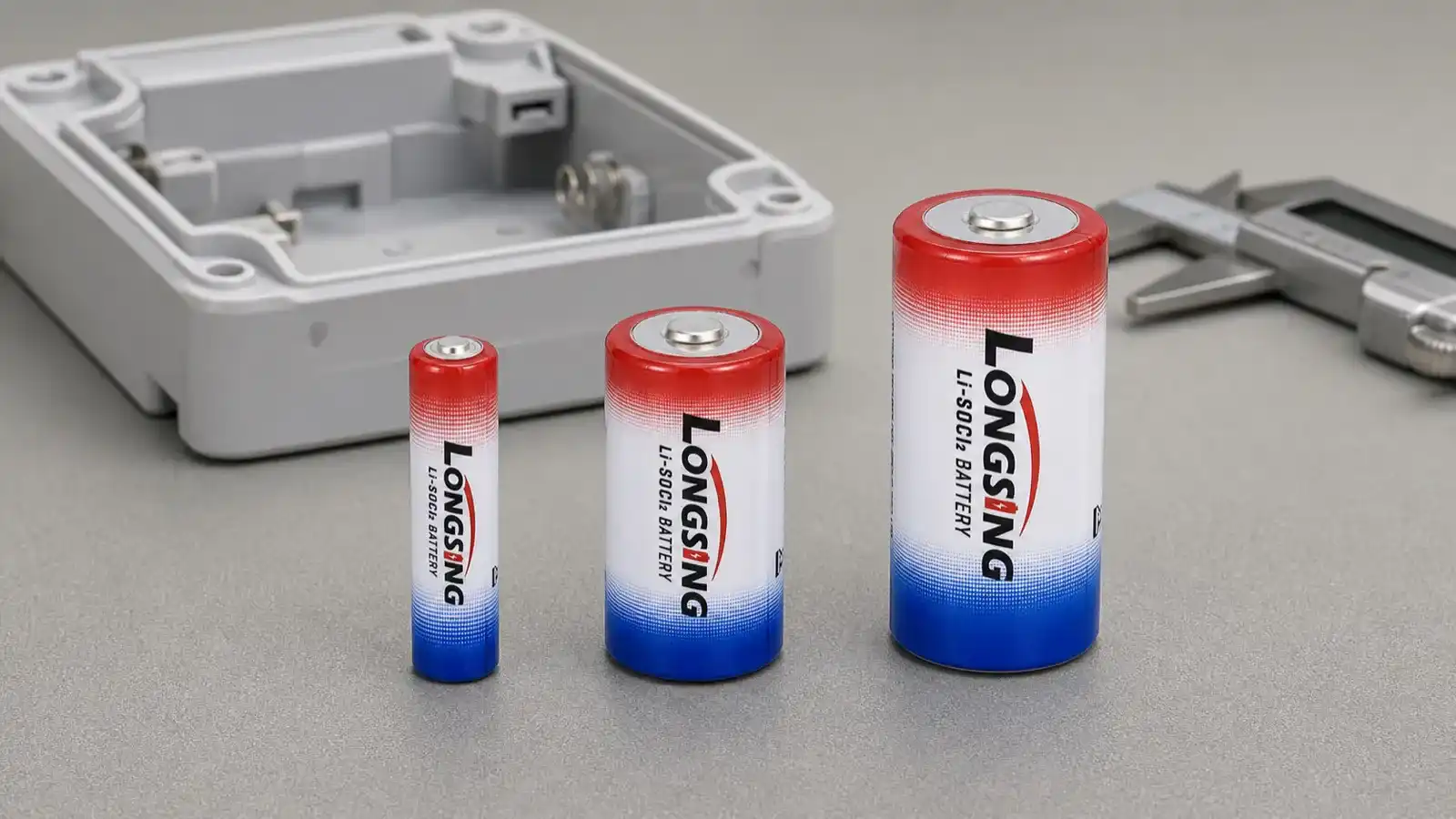
ER14505, ER26500 and ER34615 should not automatically be treated as batteries for “small,” “medium” and “large” gas meters.
The correct ER size should come from the application’s energy calculation.
LONGSING currently publishes nominal capacities of:
- ER14505 — 2.6 Ah
- ER26500 — 8.5 Ah
- ER34615 — 19 Ah
The lifetime energy calculation should consider relevant loads such as:
- Metering electronics
- MCU standby consumption
- Active processing
- Data logging
- Wireless communication
- Diagnostic operations
- Valve-operation energy
- Supporting electronics
- Required engineering margin
Mechanical space is another constraint.
A higher-capacity cell may provide more stored energy, but it also occupies more space. Battery selection therefore needs to balance service-life energy requirements with the available meter enclosure.
Only after the lifetime energy requirement is understood should the designer evaluate whether the standalone ER cell provides enough transient capability for the valve.
If it does not provide sufficient voltage margin under the required conditions, an ER + HPC pulse-support system can then be evaluated.
LONGSING currently provides multiple combinations based on ER14505, ER26500 and ER34615 with different HPC options.
These product configurations can provide useful starting points, but they should not be selected only from a published pulse-current number.
The shut-off valve’s actual electrical profile still determines compatibility.
What Data Should the Meter OEM Give the Battery Supplier?
A battery supplier can evaluate the system more effectively when the OEM provides the actual power requirement instead of only requesting a particular cell model.
| Design Variable | Why It Matters |
| Valve startup current | Determines initial transient demand and voltage sag |
| Valve running current | Defines the sustained actuator load |
| Complete current waveform | Shows how the electrical load changes during movement |
| Actuation duration | Determines pulse-energy requirement |
| Minimum system voltage | Defines the allowable voltage drop |
| Consecutive valve operations | Determines required stored pulse energy |
| Recovery interval | Determines how much time the ER cell has to replenish the HPC |
| Expected lifetime valve operations | Contributes to the total energy budget |
| Meter standby current | Drives long-term ER energy consumption |
| Wireless communication profile | Identifies additional transient loads |
| Operating temperature range | Affects the cell, HPC and actuator |
| Required service life | Determines the total long-term energy requirement |
| Available battery dimensions | Constrains ER and HPC selection |
| Connector and harness resistance | Adds additional voltage drop under load |
It is also important to determine whether the valve and communication subsystem can operate simultaneously.
A gas meter may pass individual tests for:
- Radio transmission
- Valve operation
yet create a different electrical requirement if both loads can occur at the same time.
This is why an RFQ such as:
“Need ER34615 + HPC for gas meter.”
provides relatively little engineering information.
A more useful specification is:
“Here is the meter standby load, valve-current waveform, actuation duration, minimum system voltage, communication profile, temperature range, lifetime target, available space and required number of consecutive valve operations.”
The second approach allows the battery system to be designed around the meter rather than forcing the meter around a predefined battery.
What Should Be Tested Before the Battery Design Is Frozen?
Battery validation should reproduce the operating conditions most likely to challenge successful valve actuation.
Depending on the meter’s own product specification and regulatory requirements, useful engineering tests may include:
- Fresh-cell valve actuation
- Minimum-temperature valve operation
- Operation after extended low-current standby
- Increased source-impedance simulation
- End-of-life battery simulation
- Minimum supply-voltage testing
- Repeated valve cycles
- Consecutive operations with limited recovery time
- Valve operation combined with radio transmission, where applicable
- Minimum bus-voltage measurement throughout valve movement
- HPC recharge-time measurement
- Relevant storage-condition testing
The engineering team should monitor more than whether the valve eventually moves.
Useful measurements can include:
- Minimum supply voltage
- Valve current
- Valve actuation time
- Motor-driver state
- MCU reset behavior
- HPC voltage before the pulse
- HPC voltage after the pulse
- Recovery time
The acceptance criteria should come from the gas-meter OEM’s complete system requirements.
A battery that closes the valve once at room temperature is therefore only an early prototype result.
A stronger validation question is:
Does the power system maintain enough voltage and pulse energy to perform the required shut-off operation under the specified temperature, end-of-life and worst-case operating conditions?
Define the Load Before Freezing the Battery Design
For a custom ER + HPC evaluation, provide the battery supplier with:
lifetime energy requirement + valve waveform + actuation time + minimum voltage + temperature range + recovery requirements + mechanical space
before the battery architecture is finalized.
That information gives the battery engineer a much stronger basis for evaluating ER14505, ER26500, ER34615 and the appropriate HPC configuration.
Conclusion
A reliable smart gas meter shut-off valve battery cannot be selected from amp-hour capacity alone. The ER cell must supply the meter’s lifetime energy, while the shut-off valve introduces a separate pulse-power requirement involving current, actuation duration, voltage margin, temperature and end-of-life conditions.
A properly engineered Li-SOCl₂ + HPC system can separate long-term energy storage from pulse-power delivery, but the final ER and HPC configuration should always be validated against the actual gas-valve load profile.
Frequent Asked Questions about Smart Gas Meter Shut-Off Valve Batteries
Click to explore more information about Smart Gas Meter Shut-Off Valve Batteries
Q: Why does a smart gas meter shut-off valve need a pulse-support battery?
A: A motorized shut-off valve can require substantially more current than the meter’s normal electronics. The battery system must therefore provide enough transient power while keeping the supply voltage above the operating threshold of the meter, motor driver and valve-control circuit.
Q: Can a Li-SOCl₂ battery power a gas meter valve without an HPC?
A: Potentially, but this must be verified using the actual ER cell and valve load. Valve current, actuation duration, minimum operating voltage, temperature, cell condition and wiring resistance all affect whether a standalone Li-SOCl₂ cell provides sufficient voltage margin.
Q: Why can a gas meter battery still have capacity but fail to close the valve?
A: Remaining chemical capacity does not guarantee sufficient voltage under a high-current load. Passivation, source impedance, temperature, discharge state and wiring resistance can cause terminal voltage to fall during valve actuation even while usable energy remains in the battery.
Q: What does an HPC do in a Li-SOCl₂ battery system?
A: An HPC acts as a pulse-support energy buffer. During valve actuation it can supply a substantial portion of the transient current, reducing the immediate high-current demand on the Li-SOCl₂ cell. After the event, the ER cell replenishes the HPC during a lower-load period.
Q: How should an HPC be sized for a smart gas meter shut-off valve?
A: HPC sizing should consider the complete valve-current waveform, actuation duration, effective capacitance, ESR, minimum system voltage, ER-cell contribution, operating temperature, recovery time and required number of consecutive valve operations. Peak current alone is not enough.
Q: Which is better for a smart gas meter: ER14505, ER26500 or ER34615?
A: There is no universal best model. ER14505, ER26500 and ER34615 provide different capacities and physical sizes. The ER cell should primarily be selected from the meter’s lifetime energy requirement and available space, while valve pulse-power requirements should be evaluated separately.
Q: Why should valve testing include low temperature and end-of-life battery conditions?
A: A fresh battery at room temperature may have more voltage margin than the same system after years of operation or at low temperature. Validation should therefore include the specified worst-case battery and environmental conditions to confirm that the valve can still operate reliably.
Q: What information should I provide for a custom ER + HPC smart gas-meter battery?
A: Provide the meter voltage requirement, standby current, communication profile, valve startup and running current, complete valve-current waveform, actuation duration, minimum system voltage, temperature range, required service life, expected valve operations, recovery interval, available battery dimensions and connector requirements.
Reference

IoT in Agriculture: Sustainable High Energy Density Battery for Smart Farming Devices
High energy density battery is energy storage device characterized by their ability to store a large

Lithium Metal Batteries for Long-Life Industrial Applications: Design and Performance Insights
Industrial applications devices often work for years without service, yet power failure still causes

Battery Performance in Extreme Conditions: Li-SOCl₂ vs LiPo in Harsh Industrial Environments
Cold kills batteries fast, and outdoor monitoring at -40°C pushes most chemistries to their limits.