

Li-SOCI2 Battery
Showing all 6 resultsSorted by latest
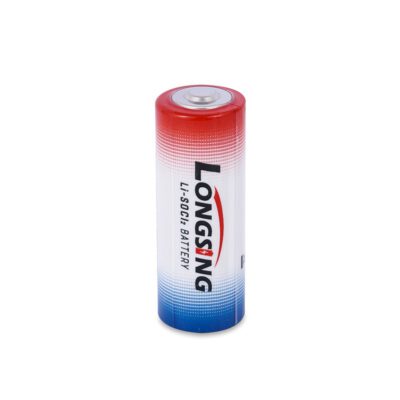
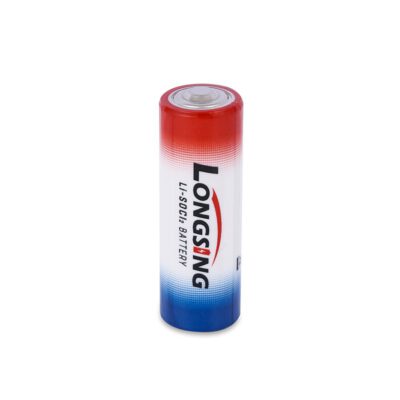
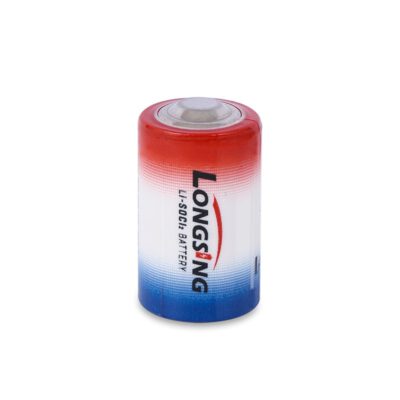
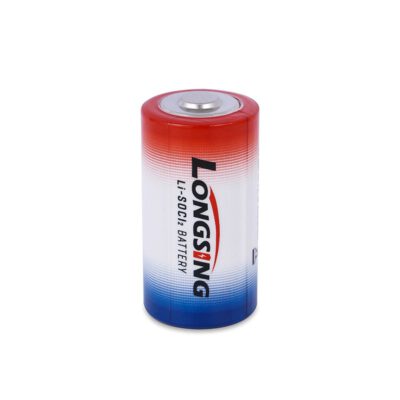
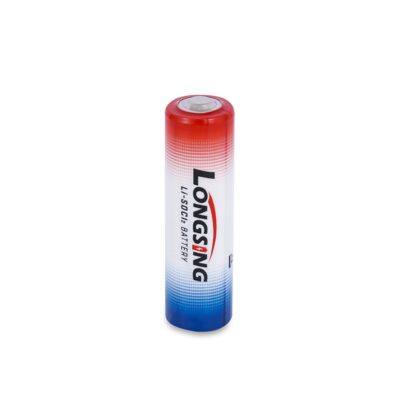
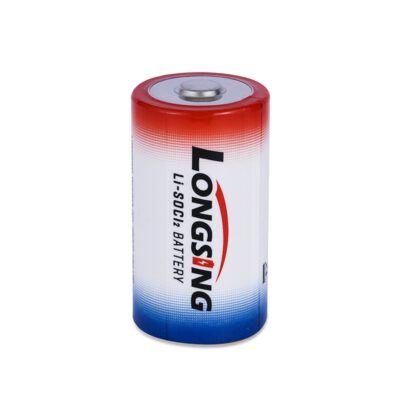
Leading Li-SOCl2 battery manufacturer offering 3.6V primary lithium solutions for smart gas meters and IoT sensors. Long-life, reliable performance, and industrial-grade safety. Request engineering support today.
Li-SOCl2 Battery Manufacturer, Long-Life 3.6V Primary Lithium Solutions
As a trusted Li-SOCl2 battery manufacturer, Long Sing Technology specializes in delivering reliable, long-duration energy systems for critical industrial environments.
Leading lithium thionyl chloride battery manufacturers must prioritize chemical stability and precise passivation control to guarantee performance in mission-critical applications.
Acting as both a Li-SOCl2 manufacturer and a global lithium thionyl chloride battery supplier, our factory integrates advanced automation, strict quality control, and scalable production.
As an industrial lithium battery factory, we provide stable supply of li socl2 battery solutions designed for meters, sensors, and remote monitoring devices where reliability is non-negotiable.
1. What Is a Li-SOCl2 Battery and Why It Is Widely Used in Industrial Systems
A li socl2 battery is a primary lithium chemistry , widely recognized for its ultra-high energy density and durability. As an experienced Li-SOCl2 battery manufacturer, we engineer cells with extremely low self-discharge, enabling a true low self-discharge battery 10+ years performance in field deployments.
Basic Chemical Principle
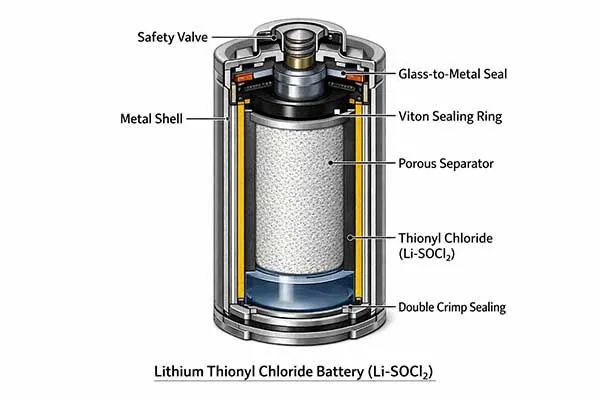
Li-SoCl2 battery system delivers a high open-circuit voltage (3.6V) and very stable output over time.
- Anode: Lithium (Li)
- Cathode: Thionyl chloride (SOCl₂)
- Electrolyte: Lithium tetrachloroaluminate (LiAlCl₄)
Why It Is Ideal for IoT Applications
Lithium thionyl chloride batteries are a favorite choice for IoT devices.
Our Li-SoCl2 battery is widely used because of its long-term, low-power operation in remote environments, it particularly suits for IoT device as a “marathon runner”.
- Exceptional Energy Density: These Li-SoCl2 batteries possess one of the highest energy densities(>500 Wh/kg) than any other primary battery chemistry.
- Unrivaled Shelf Life and Low Self-Discharge: Our exclusive passivation layer(LiCl) on the lithium chloride performs as better protective barrier from energy loss, giving <1% self-discharge rate for 15~20 years.
Example of Passivation Disadvantage
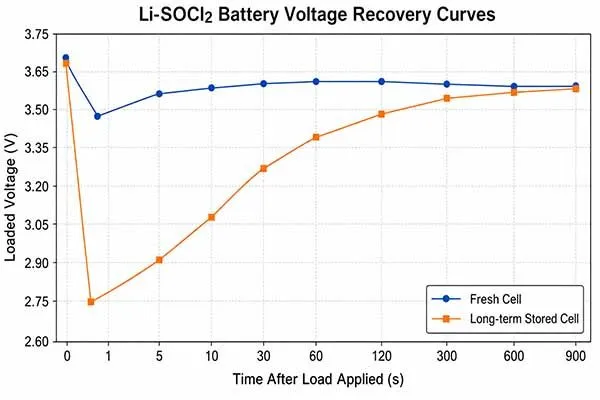
After long-term storage of lithium thionyl chloride batteries, battery passivation will reduce the high current pulse output capability, so that the instantaneous minimum voltage of the battery may be lower than the application cut-off voltage.

Instantaneous voltage curve (set 3.0V as cut-off voltage):
- A. Small current: no voltage delay;
- B. Medium current: The operating voltage is greater than the cut off voltage; the equipment application is not affected
- C. Large current: The operating voltage instantly drops below the cut-off voltage, causing voltage delay. The performance is more prominent at low temperatures
After being stored for 3–6 months, lithium thionyl chloride batteries should be activated by applying a model-specific depassivation discharge current. For example, the ER14505 model is typically activated with a continuous load of 20 mA for 30 minutes, while the ER34615 requires 80 mA for 30 minutes.
Battery passivation is inevitable, but its effects can be effectively minimized to meet application requirements. To eliminate the voltage delay of lithium thionyl chloride batteries, deliver high-current pulses, and enhance low-temperature discharge performance, we recommend the LONGSING ER+HPC battery-capacitor hybrid solution.
- Extreme Temperature Resilience: The battery promises to operate steadily under wide temperature range between -55°C and +85°C.
- Flat Discharge Voltage: Your device will receive the same 3.6V on day one as it odes in year ten, yet get a sharply voltage drop at the end of its life.
Supply Continuity & Certificate
Long Sing Technology has mature and standardized technology to offer you widely available formats (ER series), ensuring stable long-term supply for industrial projects
As a lithium thionyl chloride battery supplier, we ensure compliance with global certifications and maintain long-term supply continuity for OEM customers.

UL
IEC

UN38.3

RoHs/Reach
2. Applications of Li-SOCl2 Batteries in Industrial and Smart Systems
As a leading Li-SOCl2 battery manufacturer, our products power a wide range of industrial IoT applications, delivering stable energy for LPWAN technologies such as NB-IoT and LoRa.
For customers seeking alternatives, we also provide Li-MnO2 battery pack OEM services for lower pulse or cost-sensitive applications.
| Smart Utility Metering | Industrial IoT (IIoT) & Remote Sensing | Automotive & Transportation | Medical Devices | Security & Safety | Military & Aerospace | Oil & Gas Industry |
|---|---|---|---|---|---|---|
|
|
|
|
|
|
|
3. Technical Specifications and Model-Based Engineering Support
We provide detailed engineering data to support system integration:
- Nominal voltage: 3.6V Primary Lithium battery
- Capacity: up to 19Ah (ER34615)
- Max pulse current: enhanced with HPC solutions
- Operating temperature: -55°C to +85°C
- Self-discharge rate: ≤1% per year
- Dimensions: standard IEC cylindrical formats
Typical models include ER14505, widely used in compact IoT sensors, and ER34615, designed for high-capacity applications like utility metering. We also supply ER26500 battery for water meter systems requiring long service life and stable voltage output.
For high pulse demands, our ER14505 battery with HPC configuration ensures reliable communication bursts.
Why Connecting Li-SoCl2 Battery with Hybrid Supercapacitor?
The combination of a Lithium Thionyl Chloride (Li-SOCl2) battery and a Hybrid Supercapacitor (HPC) is a specialized solution designed to overcome the inherent limitations of primary lithium chemistry, specifically passivation and voltage delay.
The hybrid supercapacitor doesn’t add more “fuel” (milliamp-hours) to the tank, but it ensures that the “engine” can access every last drop of fuel in the tank, even after years of sitting idle in harsh conditions.
When using a model like the Long Sing Technology ER26500 + HPC1520 solution, the system functions as a “dual-engine” power source where each component plays a distinct role.
1. Minimizing Passivation and Extending Storage Life
The primary chemical challenge with Li-SOCl2 batteries is the formation of a lithium chloride (LiCl) film on the lithium anode. While this film is necessary for the battery’s incredibly low self-discharge rate (allowing 10-20 years of shelf life), it also creates high internal resistance.
- The Problem: In a standalone battery, a high-current pulse requires breaking through this “passivation layer.” This causes a sharp voltage drop that can cause a device to shut down before the battery is actually empty.
- The HPC Solution: The HPC1520 acts as a buffer. Because the capacitor has extremely low internal resistance and no passivation layer, it handles the “heavy lifting” of the pulse current.
- Storage Benefit: Since the battery only needs to provide a tiny “trickle” current to keep the HPC charged, the passivation layer remains thin and manageable. This ensures the battery remains “active” and reliable throughout its 10+ year lifespan without requiring periodic high-current maintenance pulses that would otherwise waste energy.
2. Increasing Effective Capacity
It may seem counterintuitive that adding a component increases capacity, but in high-pulse applications (like NB-IoT, LoRa, or smart meters), it significantly increases usable capacity.
Avoiding the “Cut-off” Waste
A standard Li-SOCl2 battery might have a nominal capacity of 9000mAh, but if a 200mA pulse causes the voltage to drop below 2.5V, the device will shut down even if 70% of the chemical energy is still inside the battery.
The Long Sing HPC1520 Mechanism
In the ER + HPC parallel system:
- Pulse Phase: The HPC1520 delivers the high-current burst (e.g., 2A max pulse) required for wireless transmission.
- Recharge Phase: During the device’s “sleep” mode, the ER battery slowly recharges the HPC at a micro-ampere level.
- Efficiency: This prevents the battery’s voltage from ever dipping below the device’s cut-off threshold. By keeping the operating voltage stable, you can extract nearly 100% of the theoretical capacity from the lithium chemistry.
Real-World Comparison: Long Sing ER26500 + HPC1520
| Feature | Standalone ER26500 | ER26500 + HPC1520 |
|---|---|---|
| Max Pulse Current | Low (≈ 200mA) | High (2000mA) |
| Voltage Delay | Significant after long storage | Practically Zero |
| Operating Temp | Performance drops at -40℃ | Robust at -40℃ due to HPC |
| Usable Life | Limited by passivation/voltage drops | Optimized for the full chemical life |
Product List (Main Models & Datasheets)
| Model | Size Type | Nominal Voltage | Typical Capacity | Key Features | Download Datasheet |
|---|---|---|---|---|---|
| ER14505 | AA | 3.6V | 2400 mAh | Compact, widely used in smart meters | |
| ER26500 | C | 3.6V | 8500 mAh | Higher capacity for longer runtime | |
| ER34615 | D | 3.6V | 19000 mAh | High energy for industrial systems | |
| ER18505 | A | 3.6V | 4000 mAh | Balanced size and capacity |
Take our German case as example: High Pulse Gas Meter (with capacitor)
- Cell Model: ER14505 + HPC1520 (HPC)
- Configuration: 1S + HPC (parallel pulse assist)
- Effective Capacity: 2400 mAh + 5000mAh(pulse)
- Advantage: Handles GSM/NB-IoT bursts (100–500 mA)
4.Why Choose Long Sing Technology as Your Li-SOCl2 Battery Manufacturer
As a proven Li-SOCl2 battery manufacturer, Long Sing Technology combines engineering expertise with manufacturing excellence. Our solutions are designed to achieve 10–20 years of operational life through precise electrolyte formulation and hermetic sealing. By maintaining a self-discharge rate below 1% annually, we ensure consistent voltage output over time.
Long Sing Advantages:
- Almost 20-year Reliability
- Ultra-low self-discharge
- Stable voltage output
- Great equipment compatibility promise
How Long Sing Achieves to 10+ years Lifespan Through Production Control
Long Sing Technology achieves ultra-long-life performance in Li-SOCl₂ batteries by tightly controlling every critical step of materials selection, cell design, and manufacturing execution:
1. High-purity raw materials and electrolyte control
The foundation is ultra-low impurity lithium metal and high-purity thionyl chloride (SOCl₂). Moisture and metallic contaminants are strictly controlled at ppm levels to suppress parasitic reactions, which directly reduces self-discharge and preserves long-term voltage stability.
2. Optimized cathode structure and carbon formulation
The porous carbon cathode is engineered with controlled surface area and pore distribution. This ensures a stable electrochemical interface, minimizes polarization, and maintains a flat discharge voltage plateau over extended periods.
3. Advanced passivation layer management
A precisely controlled lithium chloride (LiCl) passivation film forms on the lithium anode during production and storage. Long Sing tunes electrolyte composition and formation conditions to achieve a uniform, thin, and stable passivation layer—critical for achieving ≤1%/year self-discharge while still enabling reliable activation under load.
4. Hermetic sealing and moisture isolation
Cells are assembled in ultra-dry environments and sealed using laser welding or glass-to-metal sealing technologies. This prevents ingress of moisture or air over decades, which is essential for maintaining chemical stability and preventing internal degradation.
5. Precision electrolyte filling and ratio control
Electrolyte volume and lithium-to-cathode ratios are tightly controlled to balance capacity utilization and long-term stability, avoiding overreaction or depletion effects that could impact voltage plateau consistency.
6. Stringent process control and aging verification
Each batch undergoes controlled aging, voltage screening, and impedance testing to ensure consistency in passivation behavior and discharge characteristics. Statistical process control (SPC) ensures minimal cell-to-cell variation.
7. Application-specific design (ER + HPC hybrid systems)
For pulse-demand applications, Long Sing integrates hybrid capacitor (HPC) solutions with Li-SOCl₂ cells, ensuring stable voltage output even under intermittent high current loads without compromising long-term storage performance.
Long Sing delivers ultra-low self-discharge + 20-year reliability + stable voltage output through precision-controlled chemistry and manufacturing—engineered specifically for mission-critical, long-duration applications.
We optimize battery performance for NB-IoT and LoRa communication by integrating pulse capacitors, enabling stable energy delivery during transmission peaks. As an industrial lithium battery factory, we operate high-capacity automated production lines, ensuring both quality and scalability.
In addition to standard cells, we provide customized battery packs with connectors, wires, and terminals tailored to specific device requirements.
Custom Li-SOCl2 Battery Solutions and Technical Support
We go beyond standard products to deliver tailored energy solutions.
Our high-energy 3.6V solutions provide the ultimate battery for IoT devices, ensuring decade-long reliability for smart sensors and remote monitoring systems.
Long Sing Technology ensures Long-Life 3.6V Primary Lithium Solutions maintain peak readiness even after extended storage. The graph below illustrates the recovery transition for cells under different storage conditions:
Whether you need a high energy density battery wholesale option or a customized pack design, our engineering team supports your project from concept to mass production.
We provide full technical consultation, including pulse optimization, thermal design, and connector integration, ensuring seamless compatibility with your devices. Reducing maintenance costs and improve system reliability are really unnegotiable.
Let’s partner with a proven Li-SOCl2 battery manufacturer to power your next-generation IoT deployment with unmatched longevity, stability, and engineering support.
Frequent Asked Questions
(Click to Unfold)
Q: Can lithium thionyl chloride battery replace lithium ions?
A: Not directly. A thionyl chloride lithium battery is a primary, non-rechargeable cell designed for long standby life, while lithium-ion batteries are rechargeable and better for frequent cycling.
Q: Is the lifespan of Li-SOCl2 battery real?
A: Yes. Properly designed chloride batteries can support very long service life in low-drain applications, depending on temperature, pulse load, storage conditions, and device power design.
Q: What is passivation in lithium batteries?
A: Passivation is a protective film formed on the lithium anode. It helps reduce self-discharge during storage but may cause temporary voltage delay under sudden pulse loads.
Q: What’s the advantage of passivation?
A: The key advantage is longer storage and operating life. Passivation helps maintain capacity over time, making Li-SOCl₂ cells suitable for meters, IoT sensors, alarms, and remote devices.
Q: When should I choose Li-SOCl₂ instead of rechargeable lithium-ion batteries?
A: Choose Li-SOCl₂ when your device needs long standby life, low self-discharge, wide temperature tolerance, and no regular charging. It is often searched as a lithium chloride battery solution.
Q: How to choose the right Li-SOCl₂ battery?
A: Check operating voltage, capacity, pulse current, temperature range, size, connector, and certification needs. Reliable lithium thionyl chloride battery manufacturers can match the cell to your device profile.
Q: What customization options are available for Li-SOCl₂ batteries?
A: Options include cell size, battery packs, wires, connectors, tabs, PCM design, housing, waterproof enclosure, labels, and packaging based on your device structure and power requirements.
Q: Are customized Li-SOCl₂ batteries safe? What safety features are included?
A: Yes, when properly engineered. Safety features may include protection circuits, fuses, PTC devices, insulation, pressure relief design, secure welding, and application-specific testing.
Q: What is the typical lead time for a custom Li-SOCl₂ battery solution?
A: Lead time depends on cell availability, pack complexity, sample testing, tooling, certification, and order volume. Simple samples are usually faster than fully customized battery packs, about 3~7 days.
Q: What is the minimum order quantity (MOQ) for customized Li-SOCl₂ projects?
A: MOQ depends on customization level, materials, connector type, enclosure design, and production process. Standard cells usually have lower MOQ than fully customized battery assemblies, started from 1 piece.
Q: Do you provide engineering support and samples for custom designs?
A: Yes. Long Sing Technology can support requirement review, cell selection, pack design, sample development, testing advice, and optimization before mass production.
Q: How do I start a custom Li-SOCl₂ battery project with your team?
A: Share your device power profile, voltage, current, size limits, operating environment, certification needs, and expected order quantity. Our team will review and suggest a suitable design.
Q: Do you offer hermetic sealing or IP67/IP68 waterproof battery enclosures?
A: Yes. As a lithium thionyl chloride battery supplier, Long Sing Technology can support sealed packs, waterproof housings, cable exits, and enclosure designs for outdoor or harsh environments.
Keep reading:
- Types of Battery: A Guide to LiSoCl₂ Vs LiMnO₂
- Bobbin Type vs Spiral Type Battery Long-Life Applications
- Survival in -40°C: Li-SOCl2 vs. Li-Po battery for Outdoor Monitoring
- What Makes the Science Behind Lithium Thionyl Chloride Battery So Unique?
- Beyond 500 Wh/kg: Lithium Metal Battery Energy Density Under Real IoT Load Conditions
- The Science of the Plateau: Why Voltage Stability is the Lifeline of in Power System
- Operating Temperature Range: How temperature affects lithium metal battery performance
- The Real Cost of Cheap Batteries: How High Self Discharge Rate Increase Your TCO
- The Silent Shelf-Life Secret: Why Battery Passivation is Actually a Good Thing
- Mechanical Robustness: Designing Robust Battery That Survive Shock, Vibration, and Long-Term Stress
- Thermal Runaway Prevention: Why Factory-Level Testing is Non-Negotiable for Lithium Battery Safety
- Lithium D Batteries for Industrial Applications: Specifications, Lifespan, and OEM Solutions
- LoRa Battery Life: Power Consumption Analysis of Wireless SHM Protocols