

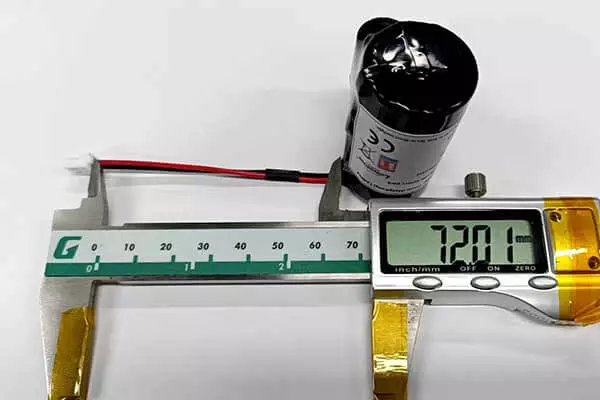
Can a Supercapacitor Replace a Battery?
Key Takeaways
- A supercapacitor can replace a battery when runtime is short, recharge is available, and the load accepts a declining source voltage.
- It usually cannot replace a battery for hours or years of unattended operation because stored energy and charge retention are lower.
- Power capability, ESR, voltage window, and end-of-life capacitance matter as much as nominal farads.
- A DC-DC converter can stabilize load voltage and recover more usable capacitor energy.
- Hybrid systems let the battery supply energy while the supercapacitor handles pulses.
A battery may be oversized, slow to recharge, or worn by repeated power bursts. Replacing it blindly with a supercapacitor can create a worse problem: insufficient runtime.
The solution is to match storage technology to load duration, voltage limits, pulse demand, and recharge availability.
The following checks show where replacement works, where it fails, and when a combined architecture provides a more reliable answer.
Table of Contents
- When Can a Supercapacitor Replace a Battery?
- Why Can’t a Supercapacitor Replace Every Battery?
- How Should Engineers Size a Supercapacitor Replacement?
- Is a Hybrid Supercapacitor System Often Better?
When Can a Supercapacitor Replace a Battery?
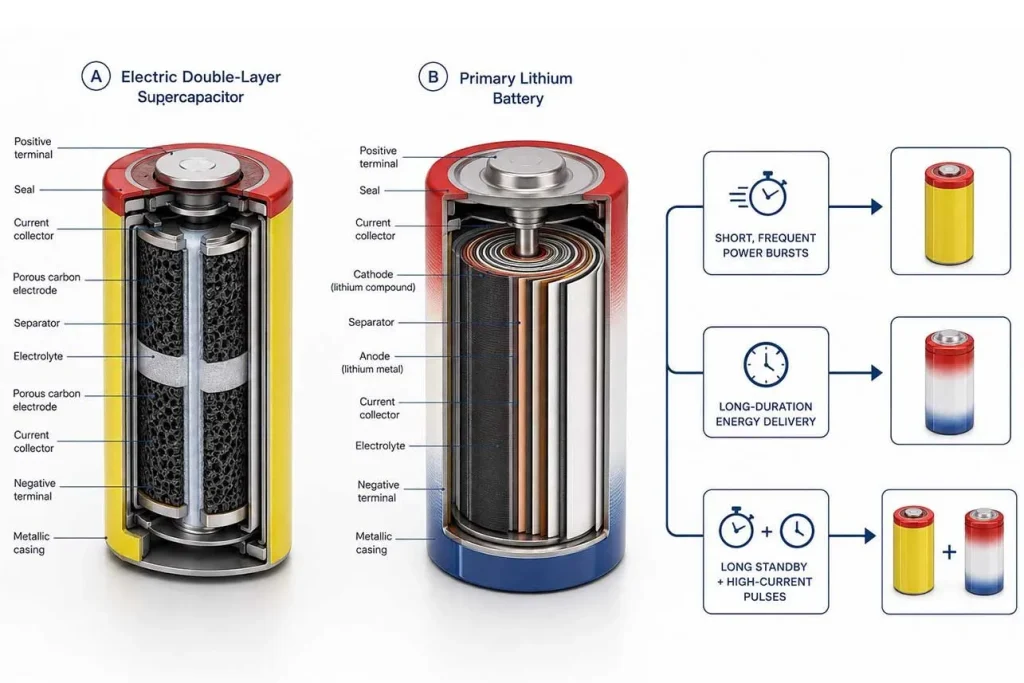
A supercapacitor can replace a battery when the device needs high power for seconds or minutes, cycles frequently, has a dependable recharge source, and tolerates changing capacitor voltage.
Suitable duties include ride-through, actuator pulses, regenerative capture, data-save shutdown, and short backup intervals. The replacement depends on the duty cycle.
The decisive issue is whether usable energy, peak power, recharge time, and voltage behavior match the load. Supercapacitors can recharge rapidly and support very high cycle counts, making them suitable for repeated short events. Their stored-energy state is proportional to the square of their voltage.
| Load profile | Fit | Reason |
|---|---|---|
| 20 W for 5 seconds | Strong | Short, high-power event |
| 10 mW for several years | Poor | Retention and leakage dominate |
| Repeated energy recovery | Strong | Fast charge acceptance |
Why Can’t a Supercapacitor Replace Every Battery?
It cannot replace every battery because batteries generally store more energy for a given size and retain that energy longer. A supercapacitor also experiences continuous voltage decline, leakage, and ESR loss, so long-duration or unattended systems may become impractically large.
A supercapacitor vs battery comparison must separate power from energy. A capacitor can release energy rapidly, but its voltage falls during discharge; regulated loads therefore need a converter and minimum input voltage. Primary Li-SOCl2 batteries are designed for low continuous currents and long unattended service, so they remain better suited to metering and remote sensors.
How Should Engineers Size a Supercapacitor Replacement?
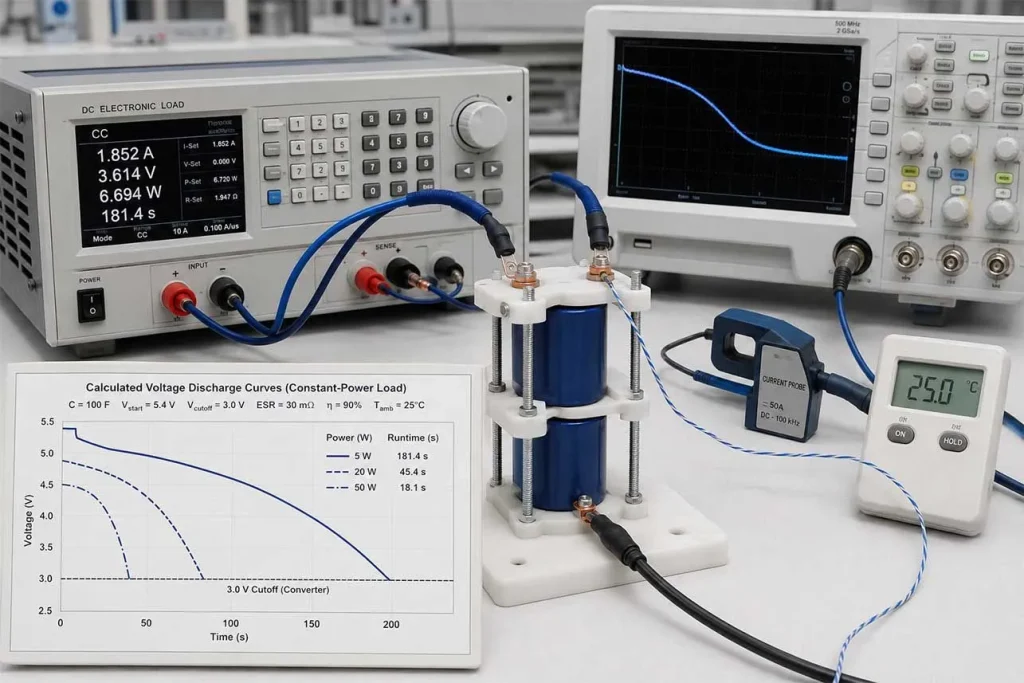
Size the replacement from required power, duration, maximum and minimum stack voltage, converter efficiency, ESR, temperature, leakage, and end-of-life limits. Nominal capacitance alone is insufficient because only energy between the permitted voltage limits is usable.
Use Usable Energy and End-of-Life Values
For an ideal constant-power load, start with C ≥ 2Pt ÷ [η(Vmax² − Vmin²)]. For 20 W over 10 seconds, 5.4 V maximum, 3.0 V cutoff, and 90% efficiency, the result is about 22 F. Treating end-of-life capacitance as 70% raises the starting value above 31 F before ESR, temperature, tolerance, and design margin.
| Illustrative input | Value | Implication |
|---|---|---|
| Power and duration | 20 W, 10 s | 200 J at the load |
| Voltage window | 5.4 V to 3.0 V | Limits extractable energy |
| Efficiency | 90% | Raises stored energy |
| Ideal capacitance | 22 F | Not a production selection |
| EOL-adjusted minimum | >31 F | Verify ESR and add margin |
Qualification should use consistent capacitance, ESR, and efficiency measurements. IEC 62391-1:2022 establishes generic terminology, inspection procedures, and test methods for fixed electric double-layer capacitors.
Is a Hybrid Supercapacitor System Often Better?
Yes. When a system needs long standby energy plus brief high-current pulses, a battery-supercapacitor hybrid is often more practical than replacing either device. The battery supplies average energy, while the supercapacitor supplies transient power and absorbs rapid recharge events.
This division can reduce battery voltage sag and peak-current stress without asking the capacitor to provide years of energy. A hybrid supercapacitor may offer higher energy density and lower leakage than a symmetric EDLC, although minimum-voltage limits and balancing still require attention.
Engineers evaluating a hybrid supercapacitor manufacturer should request measured pulse current, ESR, leakage, minimum voltage, cycle life, and temperature data. We would begin with the measured load profile because architecture should follow duty cycle.
| Element | Role | Key check |
|---|---|---|
| Battery | Long-duration energy | Average current and self-discharge |
| Supercapacitor | Short-duration power | ESR and voltage droop |
| Power and control | Routing and protection | Efficiency, balancing, cutoff |
Conclusion
Supercapacitors can replace batteries when loads need brief, frequent, high-power delivery and tolerate falling voltage. Batteries remain better for long runtime and storage. Define the load profile, calculate usable energy, include ESR and aging, then validate the architecture under conditions.

Geotechnical Monitoring: How Li/SoCI2 Battery Powering Remote Landslide Warning System
Remote landslide sites lose power often, and devices fail early. Engineers pay for visits and data l

Lithium Primary Batteries: Types, Performance, and Selection Guide
Lithium primary batteries serve as the critical power backbone for long-term autonomous systems wher
Subsea Primary Battery Solutions for AUVs, ROVs, and Oceanographic Sensors
Selecting a subsea battery for an AUV, ROV, or oceanographic sensor requires more than capacity and