

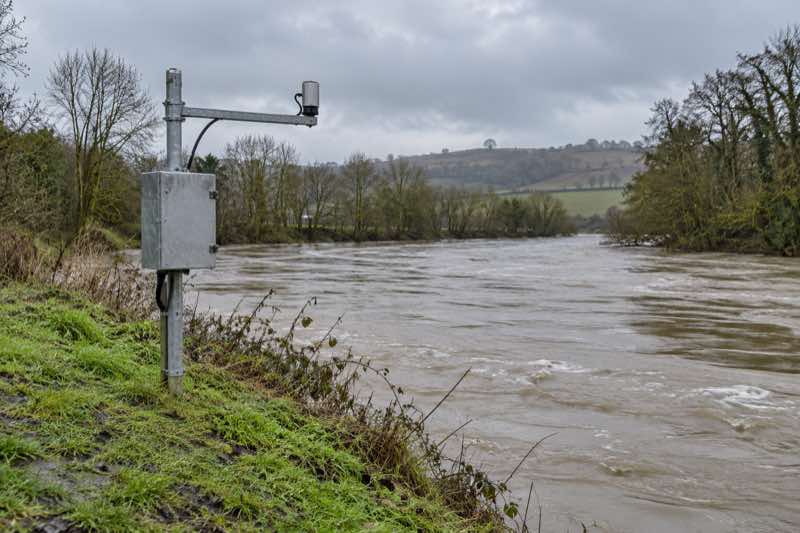
How to Prevent Flood Detection Sensor Battery Failure Now
A flood-monitoring station can spend most of its life doing almost nothing electrically.
It sleeps, wakes up to take a water-level reading, processes the result, sends a short packet, then goes back to sleep.
That profile looks easy on a battery.
The difficult part starts when the water rises.
Sampling intervals may shorten. The radio may transmit repeatedly. Alarm messages may be added to routine reporting. At the same time, outdoor temperature can be low and a primary lithium cell may have spent months operating at very light load.
A battery that looks comfortable on an average-current spreadsheet can therefore run into voltage problems during the exact period when the monitoring system matters most.
For a flood detection sensor battery, capacity is only one part of the design.
The other part is whether the power source can still support the real measurement and communication waveform after years in the field.
Table of Contents
- 1. Why Flood Monitoring Sensors Create an Uneven Battery Load
- 2. Average Current Does Not Tell You Whether the Radio Will Stay Online
- 3. Flood Conditions Change the Duty Cycle
- 4. Why Li-SOCl2 Is Often Considered for Remote Monitoring
- 5. When ER + HPC Becomes Relevant
- 6. Low Temperature Makes the Same Transmission Harder
- 7. Battery Sizing Should Start with the Device State Machine
- 8. What Information Should Be Included in a Flood-Sensor Battery Specification?
- 9. Choosing Between ER and ER + HPC
1. Why Flood Monitoring Sensors Create an Uneven Battery Load
Most remote flood and water-level nodes operate through a repeating state sequence:
Deep Sleep → Measurement → MCU Processing → Wireless Transmission → Sleep
The measurement stage varies with the application. Installations may use radar, ultrasonic, pressure-based or other level-sensing methods.
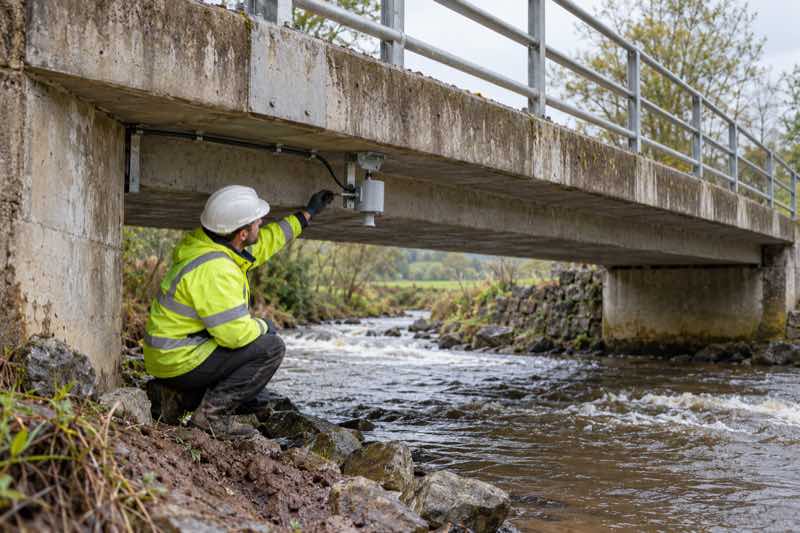
Radar is common where a non-contact measurement method is useful. Hydrological agencies, including the U.S. Geological Survey, have evaluated radar water-level sensors for streamgaging applications. [1]
The electrical behavior of the communications section is quite different from that of the sensor during sleep.
A LoRaWAN Class A device, for example, can remain asleep for long periods and wake according to the application’s reporting schedule. After an uplink, the device opens defined receive windows before returning to its low-power state. [2]
NB-IoT devices can also spend long periods in low-power states. Features such as Power Saving Mode (PSM) and eDRX are designed to reduce the amount of time the modem remains fully active. [3]
But sleep behavior does not remove the transmission load.
Once the modem wakes, registers or resumes communication and sends data, current demand rises sharply compared with standby operation.
That difference between sleep current and active current is where many apparently low-power applications become more complicated.
A flood sensor may have a very low daily average current while still imposing a demanding short-duration load on its battery.
2. Average Current Does Not Tell You Whether the Radio Will Stay Online
Average consumption is useful for estimating stored energy.
It does not tell you what happens to the supply voltage during transmission.
When a modem or radio starts transmitting, current passing through the battery and the rest of the power path produces a voltage drop.
A simplified expression is:
Vload ≈ Voc − I × Rtotal
where:
- Voc is the cell’s open-circuit voltage;
- I is the instantaneous load current;
- Rtotal represents the combined resistance and impedance of the cell, wiring, connectors and other series elements.
The actual behavior of a lithium cell is more complicated than this simple equation, but it makes one point clear:
a cell can contain useful remaining capacity and still fail to maintain the voltage required by the electronics during a pulse.
That distinction matters in a remote flood station.
If the modem resets during transmission, the problem does not look like a gradually depleted battery. From the system’s point of view, communication simply becomes unreliable.
That may trigger another connection attempt, another radio transmission and another load pulse.
The battery should therefore be checked against the minimum operating voltage of the complete device, not only against its nominal voltage or rated capacity.
3. Flood Conditions Change the Duty Cycle
A normal-day power model is not enough for this application because its duty cycle can change sharply during an event.
Under stable water conditions, a monitoring node might spend most of its time in this pattern:
Sleep → Measure → Report → Sleep
During a flood event, firmware may switch to something closer to:
Measure → Report → Measure → Alarm → Report → Measure → Report
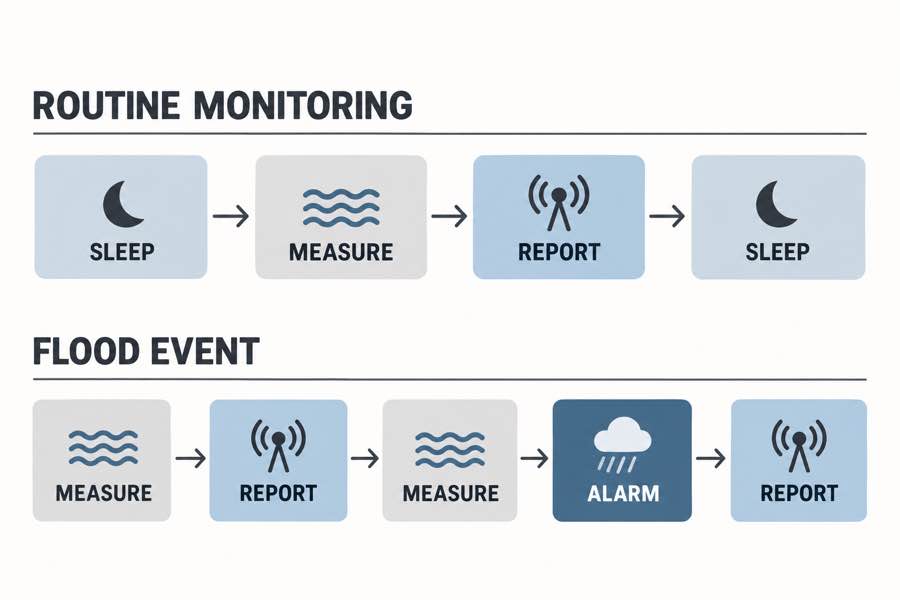
The exact sequence is product-specific, but the principle is common to event-driven monitoring.
The same normal-to-alarm load shift also appears in LONGSING’s wildfire detection sensor battery guide.
USGS streamgages, for example, can take measurements more frequently during flooding than during routine conditions. [4]
Experimental remote streamgaging systems have also demonstrated the ability to change sampling and transmission intervals around storm events. [5]
This changes two parts of the battery calculation.
First, the device consumes more energy because sensors and radios are active more often.
Second, the battery may see several demanding pulses with much less recovery time between them.
The second point is easy to miss.
One successful transmission on a laboratory bench does not necessarily prove that a battery can support a flood-alarm sequence.
A useful design model should therefore contain at least two operating profiles.
Normal Monitoring
Long sleep intervals, scheduled measurements and routine telemetry.
Flood or Alarm Operation
Shorter measurement intervals, increased radio activity, alarms and any expected retransmissions.
For cellular devices, another condition may need to be included:
Poor-Coverage Operation
Repeated network access or message retries can create a different power profile from a successful transmission under good signal conditions.
The battery should be tested against the worst credible sequence, rather than only the average day.
4. Why Li-SOCl2 Is Often Considered for Remote Monitoring
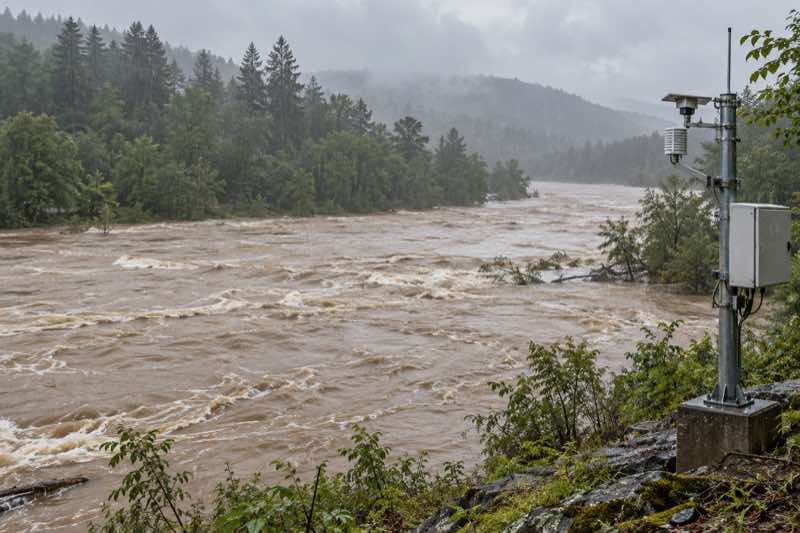
Lithium thionyl chloride, commonly written as Li-SOCl2, is frequently used in equipment that combines long standby periods with difficult maintenance access.
Its attraction comes mainly from its ability to store a large amount of energy for a relatively long period while maintaining low self-discharge.
That makes the chemistry relevant to equipment installed beside rivers, reservoirs, drainage infrastructure or remote water channels where regular battery replacement is expensive or inconvenient.
For flood monitoring, however, the chemistry should not be selected only because the specification says “long life.”
The load profile still has to be checked.
One characteristic that deserves particular attention is passivation.
During storage and very light discharge, a lithium-chloride layer forms on the lithium surface. This layer is part of the reason Li-SOCl2 cells can have good storage characteristics, but it can also contribute to temporary voltage delay when a substantial load is suddenly applied.
Electrochemical studies of Li/SOCl2 cells have documented the relationship between LiCl film formation and voltage-delay behavior. [6]
That creates a realistic flood-sensor test condition:
the node has spent a long period at light load, then wakes and immediately asks the radio to transmit.
The useful test is not simply to measure the battery’s open-circuit voltage before transmission.
Record the minimum voltage reached during the actual modem waveform.
If the voltage remains safely above the system cutoff, the cell may be suitable.
If it falls too far even though the cell still contains sufficient stored energy, the design has a pulse-power problem rather than a capacity problem.
5. When ER + HPC Becomes Relevant
An ER + HPC architecture is one way to separate long-term energy storage from short-duration power delivery.
The ER Li-SOCl2 cell acts as the primary energy reservoir.
The Hybrid Pulse Capacitor supports short, higher-current events and then recovers during the lower-load period that follows.
For a remote water-level node, the operating behavior can be thought of like this:
Sleep period
The ER cell supports the low background load and restores charge to the HPC.
Radio transmission
The HPC helps supply the short-duration current demand.
Recovery period
The device returns to a lighter load and the pulse-support element recovers before the next demanding event.
Published work on Li/SOCl2 cells combined with electrochemical capacitors has shown how the capacitor can act as a current buffer and reduce voltage-delay effects during high-rate discharge. [7]
That does not mean every LoRaWAN or NB-IoT node needs an HPC.
If a standalone ER cell keeps the device above its minimum voltage across the full temperature range and expected lifetime, adding another component provides little value.
An ER + HPC solution becomes more relevant when energy capacity is already sufficient but transient voltage margin is not.
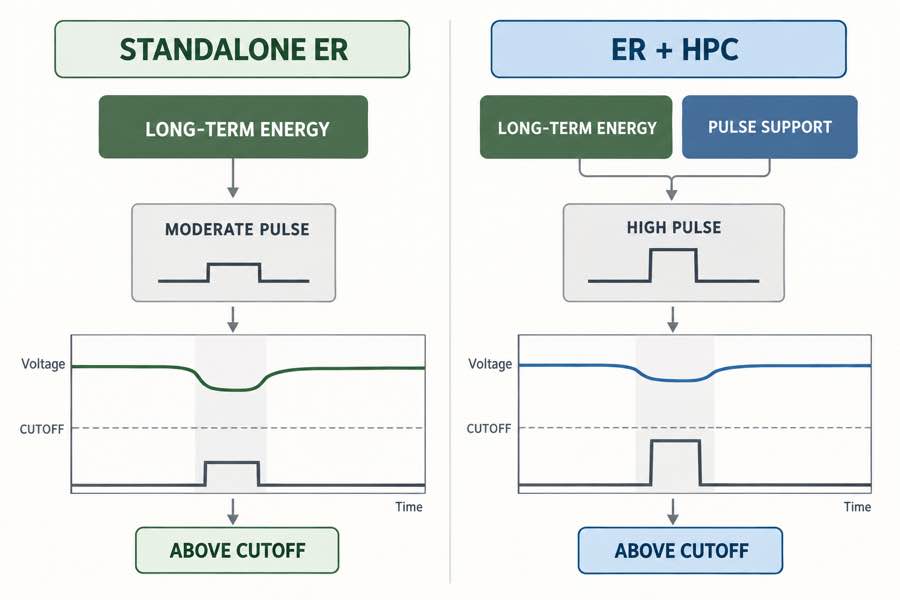
Standard Li-SOCl2 vs Li-SOCl2 + HPC in Flood Monitoring
| Design consideration | Standalone Li-SOCl2 ER cell | Li-SOCl2 ER + HPC |
|---|---|---|
| Long-term energy requirement | Supplied by ER cell | Supplied primarily by ER cell |
| Very low standby load | Suitable when properly selected | Suitable |
| Communication pulse capability | Depends strongly on cell design and load | HPC provides additional transient support |
| Voltage sag during TX | Must remain within system margin | Can be reduced with suitable pulse support |
| Long-idle first transmission | Passivation behavior should be checked | HPC can help buffer the first demanding pulse |
| Repeated alarm messages | Limited by actual cell pulse behavior | Must consider HPC recovery between pulses |
| Design complexity | Lower | Higher |
| Main validation | Energy + loaded voltage | Energy + pulse waveform + recovery |
| Typical reason to select | Adequate energy and adequate pulse margin | Adequate energy but insufficient pulse margin |
For flood monitoring, the last row is the useful dividing line.
Do not choose ER + HPC because NB-IoT appears in the device specification. Choose it because measured pulse behavior shows that extra transient support is needed.
6. Low Temperature Makes the Same Transmission Harder
Outdoor flood sensors rarely operate at a constant laboratory temperature.
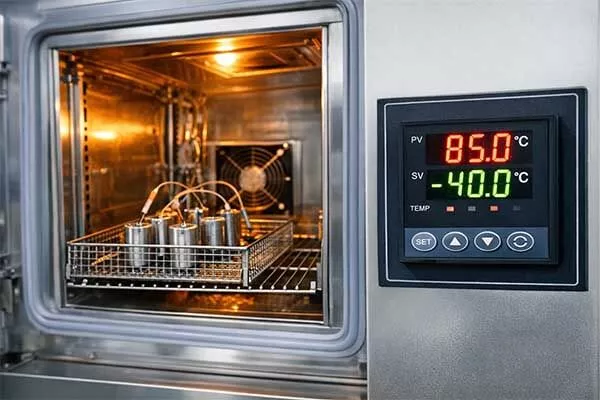
At lower temperature, electrochemical reaction rates slow and cell impedance rises. Under load, the additional impedance produces greater voltage drop.
Li/SOCl2 research has also shown that low temperature and aging can reduce loaded-voltage performance. [8]
For a field device, one of the more useful qualification tests is therefore:
cold cell + extended standby + immediate radio transmission
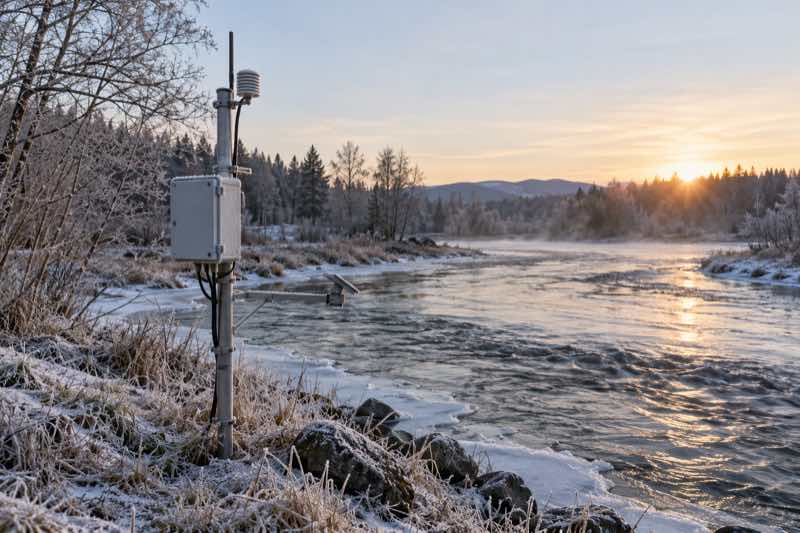
This combines three conditions that can occur together in practice.
A cell that performs comfortably during a room-temperature pulse test may have noticeably less voltage margin when it has been sitting outdoors at low temperature.
The test should use the real electronics where possible.
Include:
- the actual modem startup sequence;
- real TX and RX activity;
- the intended DC/DC converter;
- production-equivalent wiring and connectors;
- representative end-of-life cell condition;
- repeated alarm transmissions.
The objective is not to prove that the cell still has capacity.
It is to confirm that the entire power path stays above the minimum voltage required by the electronics.
7. Battery Sizing Should Start with the Device State Machine
A practical energy model begins with each electrical state.
For one operating state:
Qstate = I × t × N / 3600
where:
- I = current in mA;
- t = duration in seconds;
- N = number of occurrences per day.
A flood-monitoring design might calculate separate contributions from:
- MCU sleep;
- water-level measurement;
- sensor warm-up;
- local processing;
- modem startup;
- data transmission;
- receive windows;
- alarms;
- diagnostics.
Daily consumption then becomes the sum of those states:
Qday = Qsleep + Qmeasurement + Qprocessing + Qcommunication + Qother
That number is only the starting point.
Real field operation also has to allow for:
- self-discharge;
- temperature;
- cell aging;
- converter losses;
- leakage current;
- communication retries;
- additional flood-event activity;
- engineering reserve.
There is no universal percentage that can simply be added to every application.
The margin should reflect the actual reliability target and the uncertainty in the device’s operating profile.
Keep Energy and Pulse Calculations Separate
For long-life primary batteries, it helps to treat these as two different checks.
Energy check
Does the battery contain enough usable energy for the required deployment interval?
Power check
Does the supply voltage remain above the device minimum during the worst communication or alarm event?
An ER + HPC design introduces one more question:
How much recovery time exists before the next pulse?
That matters during flood alarms because the device may not return to several hours of sleep after each transmission.
The real sequence could be several transmissions only minutes apart.
For a broader design workflow that separates usable capacity from pulse validation, see LONGSING’s guide to choosing a long-life battery for remote monitoring.
8. What Information Should Be Included in a Flood-Sensor Battery Specification?
“NB-IoT sensor, long-life battery required” does not give a battery engineer enough information.
A more useful specification includes the actual electrical and environmental conditions.
Electrical Load
- Required operating-voltage range
- Minimum system voltage
- Sleep current
- Measurement current and duration
- MCU active current
- Modem startup waveform
- TX/RX waveform
- Maximum pulse duration
- DC/DC converter characteristics
Communication Profile
- NB-IoT, LoRaWAN or other radio protocol
- Normal reporting interval
- Flood-event reporting interval
- Maximum expected consecutive transmissions
- Retry behavior
- Poor-signal operating mode
Sensor Operation
- Radar, ultrasonic, pressure or other sensing method
- Sensor warm-up time
- Measurement duration
- Normal sampling rate
- Flood-state sampling rate
Environment
- Minimum operating temperature
- Maximum operating temperature
- Storage duration before installation
- Outdoor installation conditions
Maintenance Requirement
- Target field-service interval
- Accessibility of the sensor
- Expected alarm activity
- Required end-of-life voltage margin
Mechanical Constraints
- Available battery volume
- Connector type
- Wire length
- Mounting arrangement
This information usually matters more than starting with a particular battery model.
A flood-monitoring station is often installed in a location where a battery replacement means arranging site access, sending a technician and checking that telemetry has been restored afterwards.
Battery selection therefore affects the maintenance model of the monitoring network, not only the bill of materials.
9. Choosing Between ER and ER + HPC
For a remote water-level sensor with very low average consumption, Li-SOCl2 is a sensible chemistry to evaluate.
What comes next depends on the actual waveform.
If a standalone ER cell maintains adequate voltage during measurement, modem startup, transmission, receive windows and repeated alarm events at the required temperature and state of life, the simpler architecture may be enough.
If lifetime energy is sufficient but the supply falls below the device threshold during those events, the design needs more transient support. An ER + HPC arrangement may then be evaluated, with particular attention to recovery between repeated flood reports.
The same distinction appears in other cellular monitoring equipment. LONGSING’s NB-IoT water meter battery guide applies the energy-versus-pulse method to a different water-monitoring load.
The final choice should be confirmed in the complete device, not inferred from chemistry name, nominal capacity or one room-temperature pulse.
Frequently Asked Questions
Click to explore more information about flood detection sensor batteries
1. What type of battery is used in flood monitoring sensors?
There is no single battery for every flood sensor. Long-life primary lithium batteries, including Li-SOCl2, are often evaluated for low-average-current nodes in remote locations. The correct choice depends on deployment life, radio waveform, minimum device voltage, temperature, available space and maintenance constraints.
2. Why are Li-SOCl2 batteries considered for remote monitoring?
Li-SOCl2 combines high stored energy with low self-discharge, which can suit equipment that spends long periods asleep. Its passivation behavior and loaded voltage during communication still need application-level testing.
3. Why can NB-IoT cause battery voltage drop?
An NB-IoT modem draws much more current while starting, accessing the network and transmitting than it does in sleep. Current through the impedance of the cell and power path creates voltage sag, which may reset the electronics even when the battery still contains capacity.
4. What is Li-SOCl2 passivation?
Passivation is the formation of a protective lithium-chloride layer on the lithium surface. It helps limit self-discharge during storage, but after a long idle period it can also contribute to temporary voltage delay when a substantial load is applied.
5. Why might a flood sensor use an ER + HPC solution?
The ER cell can supply long-term energy while the HPC supports short, higher-current events. This architecture is worth evaluating when the ER cell meets the energy target but cannot maintain sufficient voltage during the real radio or alarm waveform.
6. How does low temperature affect a remote sensor battery?
Low temperature generally increases impedance and reduces loaded-voltage margin. A transmission that works at room temperature may pull the supply below the device cutoff when the battery is cold, aged or strongly passivated.
7. How should battery life be calculated for a flood monitoring device?
Calculate current, duration and frequency for every device state, then add justified allowances for temperature, aging, self-discharge, conversion losses, retries and design reserve. Validate pulse voltage separately; an amp-hour calculation cannot prove that the radio will stay online.
8. Why does flood-event reporting frequency matter for battery sizing?
During a flood, the device may measure and transmit more often. That raises energy use and shortens the recovery time between load pulses, so the alarm sequence may be harder on the battery than routine monitoring.
References
[1] U.S. Geological Survey — Testing and Use of Radar Water Level Sensors by the U.S. Geological Survey. ↪
Supports the use of non-contact radar water-level sensing in streamgaging applications.
[2] LoRa Alliance — LoRaWAN Device Classes and Class A Communication. ↪
Supports the Class A uplink and receive-window sequence used to describe duty-cycled LoRaWAN operation.
[3] GSMA — IoT Development Guide for NB-IoT, including PSM and eDRX. ↪
Supports the explanation of PSM and eDRX as low-power operating features for NB-IoT devices.
[4] U.S. Geological Survey — What Is a Streamgage? ↪
Supports the point that measurements can be taken more frequently during flood conditions.
[5] U.S. Geological Survey — Next Generation Stream Gaging. ↪
Supports adaptive sampling and transmission intervals around storm events.
[6] A. N. Dey, Electrochimica Acta — S.E.M. Studies of the Li-Film Growth and the Voltage-Delay Phenomenon Associated with the Lithium-Thionyl Chloride Inorganic Electrolyte System. ↪
Supports the relationship between LiCl film formation, passivation and voltage-delay behavior in Li/SOCl2 cells.
[7] K. Chung, J. Lee and Y. Ko, Journal of Power Sources — Electrical Analysis of Li/SOCl2 Cell Connected with Electrochemical Capacitor. ↪
Supports the use of an electrochemical capacitor as a current buffer during high-rate discharge.
[8] Energies — The Impact of Temperature on the Performance and Reliability of Li/SOCl2 Batteries. ↪
Supports the effect of low temperature and aging on loaded-voltage performance.
LONGSING can support OEM and ODM primary-lithium battery development for remote monitoring devices, including Li-SOCl2 and ER + HPC configurations where long standby life and pulse-current capability must be considered together. Candidate batteries should be validated against the equipment’s measured load profile and environmental requirements.

Pulse Power: Why Does A Smart Meter Need Supercapacitor for Communication?
Pulse power refers to the delivery of energy in short, high-intensity bursts rather than a continuou

What Is a Button Cell Battery? Types, Manufacturing & Selection
Designing compact industrial IoT devices often fails due to erratic power delivery from substandard
Key Advantages: Design Considerations for Li-SOCl₂ Military Battery
Li-SOCl₂ military battery technology serves as the tactical energy backbone for modern defense sys