


What Is a Button Cell Battery? Types, Manufacturing & Selection
Designing compact industrial IoT devices often fails due to erratic power delivery from substandard micro-power sources.
Choosing the wrong micro-battery leads to early voltage drops, costly field replacements, and damaged brand reputation. This guide unpacks what actually differentiates a button cell battery from its alternatives, so you specify correctly from day one.
A button cell battery is a compact, disc-shaped primary or rechargeable cell typically ranging from 5 mm to 30 mm in diameter and 1 mm to 8 mm in height.
Lithium button batteries deliver 3 V with energy densities exceeding 500 Wh/L; silver oxide coin cells output a stable 1.55 V suited for precision instruments; alkaline button cell batteries provide 1.5 V at lower cost but with steeper voltage curves.
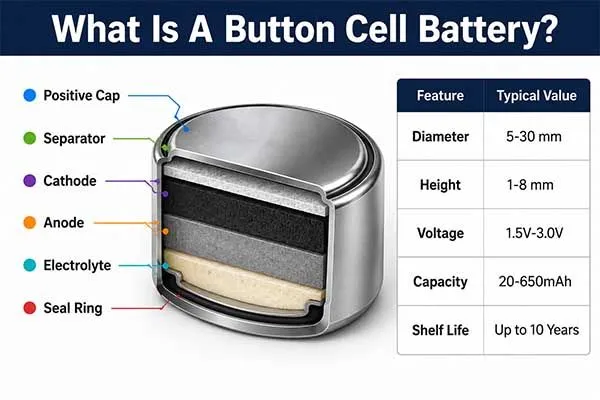
No coin cell battery or button battery should be selected without first completing a load current analysis. Chemistry selection determines runtime, temperature range, and shelf life.
Understanding those distinctions is not academic — it directly affects whether your IoT sensor lasts three years or three months. Keep reading to see how manufacturing process and application context complete the picture.
Table of Contents
- Button Cell Chemistry: Lithium vs. Silver Oxide vs. Alkaline
- Core Manufacturing Technology: Stacked vs. Winding Process
- Application-Based Battery Selection
1. Button Cell Chemistry: Lithium vs. Silver Oxide vs. Alkaline
Lithium primary cells operate at 3 V with a flat discharge curve and a shelf life of 10+ years. Silver oxide cells maintain a near-flat 1.55 V plateau ideal for analog instruments. A 1.5 volt alkaline button cell battery such as equivalent LR44 cells offers the lowest upfront cost but suffers capacity loss at temperature extremes and has a steeper self-discharge rate — typically 2–3% per year versus under 1% for lithium.
Chemistry Deep-Dive: Voltage, Capacity, and Temperature
The three dominant chemistries each occupy a distinct performance band.
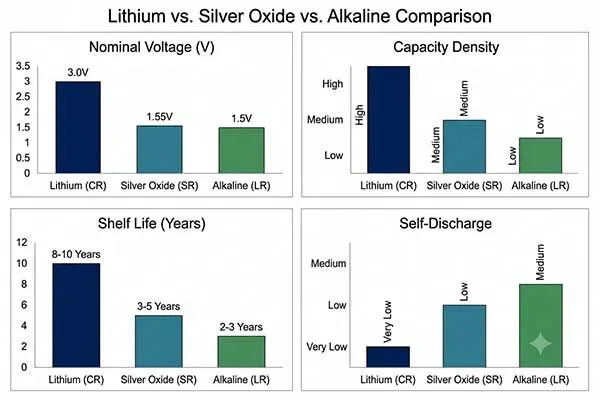
Lithium primary cells — specifically LiMnO₂ chemistry in standard coin formats — hold their 3 V output across 90% of their discharge cycle, which simplifies power circuit design considerably.
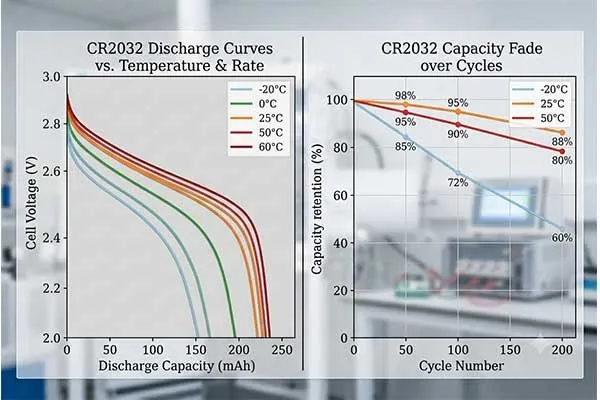
A CR2032 button cell battery, the most widely deployed coin cell globally, delivers nominally 225 mAh at room temperature.
Silver oxide cells[1], found in watch battery and hearing aid batteries applications, use zinc as the anode and silver oxide as the cathode. Their exceptional voltage stability (±0.02 V throughout discharge) makes them irreplaceable in precision devices where voltage sag would corrupt a reading.
Alkaline small round batteries rely on zinc-manganese dioxide chemistry. While cost-effective and widely stocked, these small round batteries perform noticeably worse below 0 °C and above 60 °C — a range that disqualifies small round batteries from most industrial deployments.
| Chemistry | Nominal Voltage | Typical Capacity (CR2032 equiv.) | Operating Temp. | Shelf Life |
|---|---|---|---|---|
| Lithium (LiMnO₂) | 3.0 V | 220–240 mAh | −40 °C to +85 °C | 10+ years |
| Silver Oxide (Zn/AgO) | 1.55 V | 150–200 mAh | −10 °C to +60 °C | 5–8 years |
| Alkaline (Zn/MnO₂) | 1.5 V | 120–190 mAh | −20 °C to +54 °C | 3–5 years |
From a sourcing perspective, 3V lithium coin cell battery types — encompassing the full range of lithium coin cell batteries from CR1220 to CR2477 — dominate industrial designs for good reason: a single chemistry covers most voltage rails, tolerates harsh environments, and avoids scheduled replacement.
Demystifying Naming Conventions & Size Charts
Coin cell sizes follow the IEC naming standard[2]: the letter prefix identifies chemistry (CR = lithium manganese dioxide, SR = silver oxide, LR = alkaline), and the numeric suffix encodes physical dimensions.
For CR-type cells, the first two digits are diameter in millimeters and the last two are height in tenths of a millimeter. A CR2032 is therefore 20 mm diameter × 3.2 mm height. Coin battery sizes range from CR1025 (10 mm × 2.5 mm) to CR2477 (24 mm × 7.7 mm).
| IEC Code | Diameter (mm) | Height (mm) | Nominal Capacity | Common Application |
|---|---|---|---|---|
| CR1220 | 12.0 | 2.0 | 35 mAh | Car key fob, PCB RTC |
| CR2016 | 20.0 | 1.6 | 90 mAh | Thin wearable devices |
| CR2032 | 20.0 | 3.2 | 225 mAh | Meters, IoT nodes, BIOS |
| CR2450 | 24.5 | 5.0 | 540 mAh | Smart locks, trackers |
| CR2477 | 24.5 | 7.7 | 1000 mAh | BLE devices, gas meters |
Engineers often conflate button cell battery and coin cell battery terminology. Strictly speaking, button cells include all flat, round cells—coin cells are the subset with a diameter significantly larger than their height.
In everyday engineering usage the terms are interchangeable, but procurement teams should be aware that some datasheets use them distinctly.
Coin battery types outside the CR family include ML (rechargeable lithium manganese), VL (rechargeable vanadium lithium), and the common BR series (lithium polycarbon monofluoride, rated to 125 °C). When a small coin cell battery must survive reflow soldering or under-hood automotive temperatures, BR chemistry is the correct pick—not CR.


3V Button Cell Batteries
A practical note on the coin cell battery CR2032: it is the world's highest-volume lithium primary cell. Its 3 V output and 225 mAh capacity fit a remarkable range of designs, which is why it appears as the default recommendation in many reference schematics.
However, defaulting to the CR2032 without a load analysis is a common engineering error — high-pulse BLE[3] applications routinely exhaust the cell within months.
2. Core Manufacturing Technology: Stacked vs. Winding Process
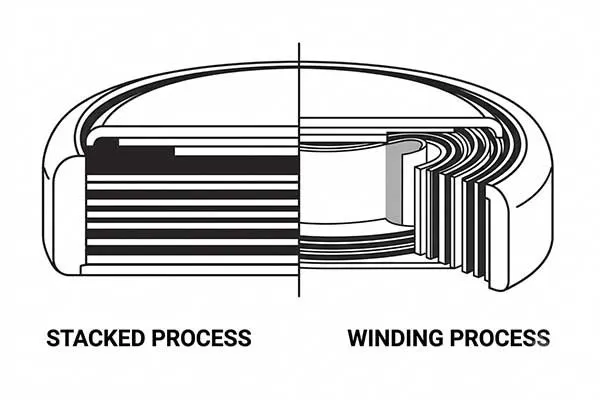
Coin cell batteries are manufactured using either a stacking (bobbin) process or a winding (jelly-roll[4]) process.
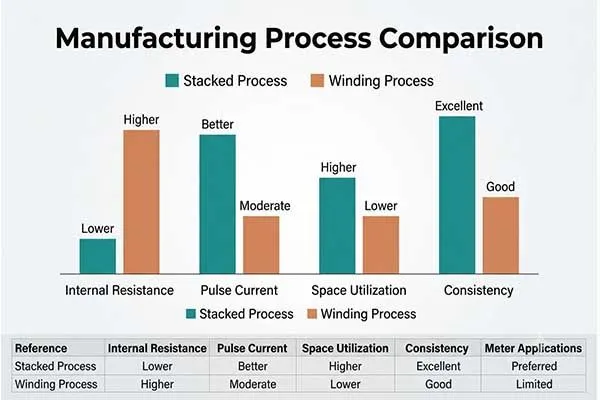
For a coin cell battery in low-drain applications, the stacking process layers flat anode and cathode discs separated by a membrane, maximizing volumetric energy density(+5%) and internal resistance stability(+15~30%).
Winding coils electrodes into a cylinder before housing, enabling higher pulse currents at the cost of slightly reduced capacity-to-volume ratio.
Stacking Process: Why It Matters for Industrial Coin Cells
For button cell batteries serving utility metering, asset tracking, and medical sensors — all low-drain, decade-long deployments — the stacked bobbin architecture is structurally superior.
Stacking aligns electrode surfaces in parallel planes, keeping the current path uniform and internal resistance low across the entire service life. This directly translates into the flat discharge curve these primary cells are known for.
Long Sing Technology, an OEM lithium primary battery supplier, uses a controlled stacking process combined with a dry-room assembly environment (dew point ≤ −40 °C) for its coin and cylindrical lithium primary lines. Wilson Lu, chief engineer for custom battery solutions, notes that electrode alignment tolerances within ±0.1 mm measurably reduce internal resistance variance batch-to-batch.
Factory Quality Control: What Proper Tests Look Like
Before a button cell battery leaves the production line, four core validation tests gate release:
Capacity Retention Test — Cells are discharged to the cutoff voltage at 20 °C. Capacity must be ≥98% of rated value on initial test. A secondary test at −40 °C and +85 °C verifies thermal derating stays within spec.
Leakage Test — Cells are held at 70 °C and 90% RH for 30 days. Any visible electrolyte migration at the crimp seal constitutes a failure. Leakage in lithium button batteries is particularly problematic because the electrolyte is corrosive to PCB traces.
High Temperature Storage Test — Cells stored at 85 °C for 72 hours. Post-storage capacity and open-circuit voltage are measured against baseline. This simulates worst-case warehouse or transit conditions in equatorial climates.
Shelf Life Validation — Accelerated aging at 60 °C for 90 days, with a post-test capacity check. Results are extrapolated against Arrhenius kinetics[5] to validate the 10-year shelf life claim typical of a lithium battery button cell in the CR series.
To properly test a button battery at incoming inspection, engineers should measure open-circuit voltage (≥2.95 V for fresh CR-series), load voltage under a 15 kΩ resistance at 23 °C (should be ≥2.80 V), and check the crimp for deformation or electrolyte residue visually.
Accepting a button battery without these checks risks latent capacity defects entering production. Any lot where more than 0.5% of sampled cells fail the load voltage threshold should be quarantined for root-cause analysis.
3. Application-Based Battery Selection
Selecting the right coin cell battery for an application requires matching three variables: energy capacity to the calculated lifetime current budget, peak pulse capability to the device's maximum instantaneous draw, and operating temperature range to the deployment environment.
A correct button cell battery specification includes a conservative 20% capacity margin and internal resistance headroom of at least 30% above worst-case pulse demand—both industry-standard design rules.
A Real-World Upgrade Case: Smart Lock BLE Drain
Two years ago, a UK-based smart lock manufacturer discovered that their product's frequent Bluetooth communication cycle was exhausting the originally specified CR2450 in roughly eight months — far short of the 18-month design target.
Post-retrieval testing revealed that recovered cells had fallen to 430 mAh (72% of the nominal 600 mAh), while internal resistance had climbed from 15 Ω to 38 Ω. That resistance increase—153% — directly degraded BLE transmission reliability, triggering customer complaints about connectivity drops rather than simple dead-battery events.
The engineering team re-specified the device to accept CR2477 cells and implemented firmware-level internal resistance monitoring to trigger low-battery alerts at 22% above baseline resistance (approximately 18.3 Ω). At the time of writing the product has been in normal service for 17 months with no field failures attributable to power supply degradation.
The key lesson: for any design with frequent high-drain pulse loads, coin cell battery selection must account for internal resistance growth rate over the service life—not just initial capacity.
| Application | Recommended Cell | Key Requirement |
|---|---|---|
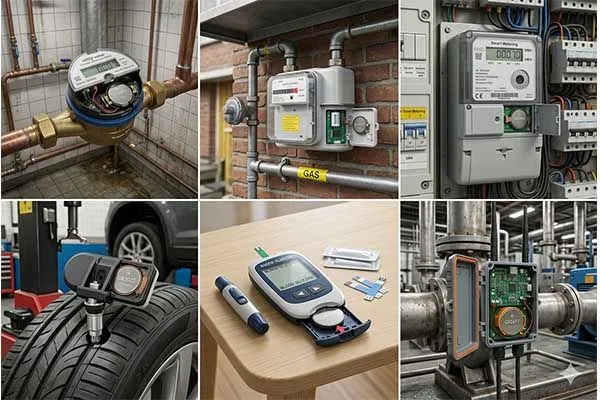
| Utility gas/water meters | CR2032 / CR2450 | 10+ year shelf life, low self-discharge |
| BLE smart locks / trackers | CR2477 | High pulse capacity, low IR growth |
| Hearing aids / audiological devices | Silver oxide (PR44) | Flat 1.55 V curve, compact form |
| Medical implant memory backup | Bespoke lithium primary packs | Biocompatible seal, ultra-low drain |
| PCB real-time clock[6] | CR1220 / CR2016 | Minimal footprint, reflow-compatible (BR) |
Long Sing Technology provides custom lithium coin cell battery packs and hybrid supercapacitor solutions engineered around specific load profiles. Our team — including sales manager Luke Liu — works with OEM customers across North America, Western Europe, and Asia to validate designs before production commitment. The company earned an R&D 100 Award in 2022, a recognition that reflects the depth of their lithium primary battery engineering capability.
For teams developing safety, healthcare, or high-reliability backup power applications, engaging a qualified button cell battery manufacturer early in the design cycle — before PCB layout is frozen — avoids the costly re-spin the UK smart lock team experienced.
In practice, cells used in safety-critical roles should be revalidated whenever the firmware duty cycle changes by more than 15%. Both button cell batteries for grid-connected metering and lithium primaries for portable medical devices benefit from this approach.
Conclusion
A button cell battery is far more than a commodity component. Chemistry determines voltage, temperature range, and shelf life. The stacking manufacturing process governs energy density and long-term internal resistance stability.
Cell dimensions must be matched to actual load profiles, not default reference designs. And factory validation—capacity retention, leakage, high-temperature, and shelf life testing—separates reliable lithium button batteries from field failures. Specifying correctly from the start is always cheaper than a field retrofit.
Frequent Asked Questions about Button Cell Battery
(Click to Unfold)
Q:What is a coin cell battery?
A:A coin cell battery (also called button cell) is a small, round, single-cell battery commonly used in watches, calculators, hearing aids, and small electronic devices. It features a compact cylindrical design with metal casing, providing reliable power in miniature applications.
Q:How long do button cell batteries last?
A:Battery life varies by type and usage—typically 1-5 years in low-drain devices like watches, or months in high-power applications. Long Sing’s lithium thionyl chloride batteries offer extended shelf life up to 10 years with minimal self-discharge.
Q:What is the Reese’s law warning?
A:Reese’s Law (U.S. federal regulation) requires child-resistant packaging for button/coin cell batteries to prevent accidental ingestion by children under 3. This safety mandate followed tragic incidents of children swallowing these hazardous batteries.
Q:How do I know if my child swallowed a button battery?
A:Watch for sudden fever, difficulty breathing, vomiting, chest pain, coughing, drooling, or refusal to eat. If ingestion is suspected, seek emergency medical care immediately—button batteries can cause severe internal burns within hours.
Q:Are all button cell batteries the same?
A:No—they differ in chemistry (alkaline, silver oxide, lithium), voltage (1.2V–3.6V), size (diameter/thickness codes like CR2032, LR44), and performance characteristics. Choose based on device requirements and power needs.
Q:Why are button cell batteries so expensive?
A:Premium materials (silver, lithium), precision manufacturing, strict quality control, and specialized packaging drive costs. High-performance variants like Long Sing’s hybrid pulse capacitor batteries offer superior reliability justifying the investment.
Note:
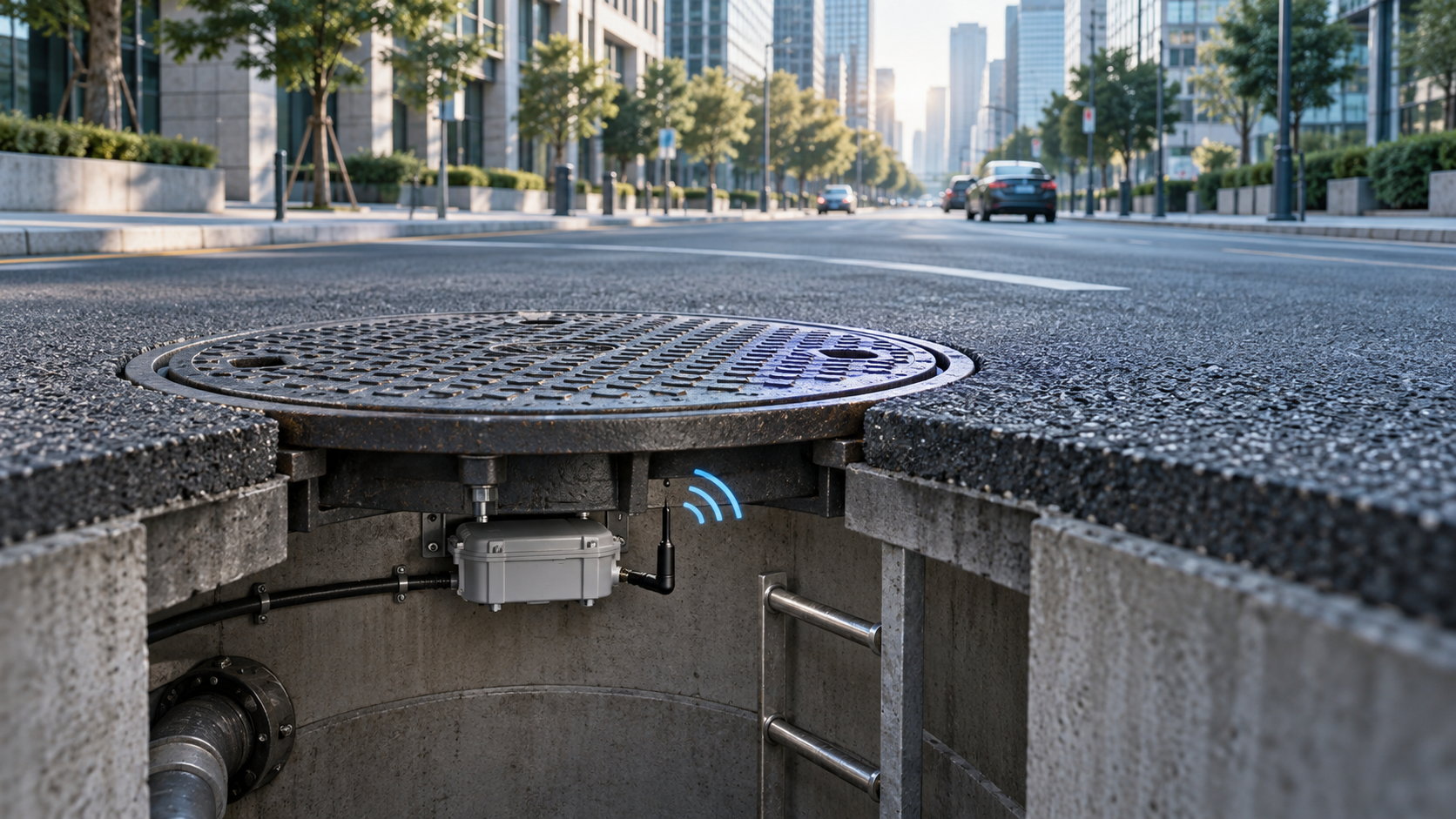
How to Choose the Best Smart Manhole Cover Sensor Battery
A smart manhole cover sensor may spend most of its life doing very little. For long periods, the dev

The 3.0V Standard: Unlocking the Power of Lithium Manganese Dioxide Batteries
Primary Lithium Manganese Dioxide Batteries deliver long life, steady voltage, and strong safety, so

How to Choose Lithium D Batteries: ER34615 Specs, Life & Application
Key Takeaways Lithium D batteries provide higher voltage, long life, and wide temperature tolerance