

How To Test A CR2032 Battery Under Real Application Loads
A coin cell can look “fine” at 3.0 V yet fail in the device. If you are learning how to test a cr2032 battery, use a digital multimeter first, then verify it with a resistor load or electronic load that simulates the real circuit.
To test a CR2032, measure open-circuit voltage with a digital multimeter[1], then repeat the measurement while the cell is powering a known load.A healthy production cell is usually near 3.0–3.3 V open circuit, but real usability depends on voltage sag under load, pulse current, temperature, and the device cut-off voltage.
Use the quick check to screen failures, then apply the engineering method below to connect bench testing with real application power.
Table of Contents
- 1. What Is a CR2032 Battery and Where Is It Used?
- 2. Quick Method: How to Test a CR2032 Battery with a Multimeter?
- 3. CR2032 Testing for Incoming Quality Control
1. What Is a CR2032 Battery and Where Is It Used?
A CR2032 is a 3 V lithium coin cell with a 20 mm diameter and about 3.2 mm height.
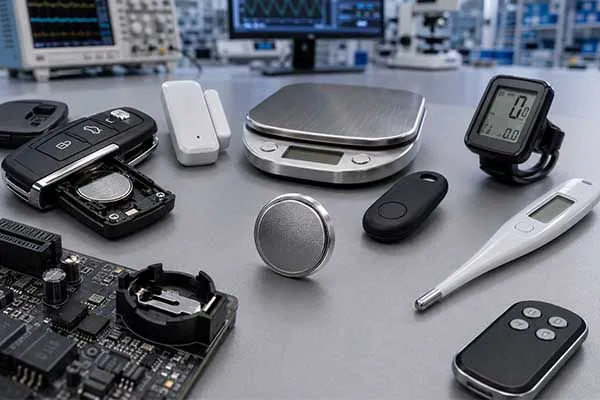
It is commonly used for memory backup, remote controls, security tags, smart transmitters, meters, medical accessories, and compact electronics where long shelf life and low average drain are more important than high continuous current.
System-design view of the CR2032
For an engineer, a CR2032 should not be judged only as a small retail button cell. It is a compact electrochemical power source with strict limits around continuous drain, pulse drain, temperature, contact pressure, and storage history.


Panasonic’s CR2032 datasheet lists 3 V nominal voltage, 225 mAh nominal capacity, 0.2 mA continuous drain, 20.0 mm maximum diameter, 3.2 mm maximum height, and an operating temperature range of -30°C to +85°C; Energizer’s CR2032 datasheet identifies the chemistry as lithium manganese dioxide and lists 3.0 V nominal voltage with capacity rated to a 2.0 V endpoint under specified test conditions.
The cr2032 voltage curve is relatively flat for much of its useful life, so small voltage differences can hide meaningful differences in remaining usable energy.
| Application | Typical Design Concern | Testing Focus |
|---|---|---|
| Utility meter backup | Long calendar life, stable standby drain | OCV, leakage, storage traceability |
| Automotive remote | Short RF pulse and cold-start behavior | Loaded voltage, pulse sag, contact pressure |
| Medical accessory | Reliability and batch consistency | Lot-level screening and documentation |
| Industrial sensor | Sleep current plus transmit burst | Pulse simulation and device cut-off margin |
As a CR2032 battery manufacturer, we normally ask one question before testing: what is the device really doing to the cell? A clock backup and a wireless transmitter may both use the same cr battery size, but their voltage sag behavior can be completely different.
A lithium manganese dioxide battery works well when the current profile matches the datasheet assumptions. When it does not, a custom CR2032 battery solution may require tabs, nickel leads, a holder redesign, parallel buffering, or a larger coin-cell format.
2. Quick Method: How to Test a CR2032 Battery with a Multimeter?
If you want to know how to test a button battery, set the multimeter to DC voltage, place the red probe on the positive flat face and the black probe on the negative rim or bottom face, then read the voltage.
For a more realistic result, add a resistor load[2] and measure whether the voltage remains above the device requirement; this is the practical answer to how to test a cr2032 battery.
Tools required and multimeter settings
The fastest answer to how to test a button battery with a multimeter is simple: use a clean digital multimeter, insulated probe tips, and a stable holder so the cell is not shorted by accident.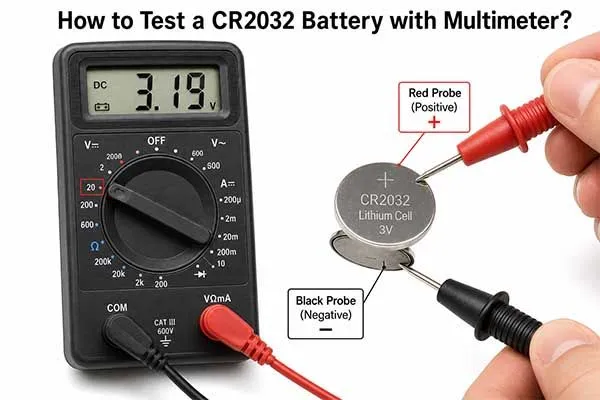
Set the meter to DC volts, preferably a 20 V range or auto-range mode. In a work instruction, the phrase how to test a cr2032 battery should always state the meter range.
Touch the red probe to the “+” side and the black probe to the opposite side. This open-circuit reading is useful for sorting dead or reversed cells, but it is only the first part of a CR2032 voltage test.
For a real screening method, add one resistor across the cell and measure voltage across the resistor after 5–10 seconds. A 15 kΩ load is close to many datasheet capacity conditions because it draws about 0.2 mA at 3 V. A 10 kΩ load draws about 0.3 mA. A 5.6 kΩ load draws about 0.54 mA. A 1 kΩ load draws about 3 mA and is already a much harder check for a small coin cell.
How to test CR2032 batteries without a tester?
- Device test: Test it in another working device of the exact same type.
- Tester pen: Use a cheap, dedicated button battery tester with indicator lights.
- Visual check: Look for leaks, white crust, or bulging, which means it is dead.
This is the practical bridge between how to test a cr2032 battery at a bench, how to test a cr2032 battery for a real product, and how to test cr2032 battery samples when the search query is written without the article “a”.
Energizer’s public data shows CR2032 capacity is specified under a 15 kΩ condition to a 2.0 V endpoint, while Panasonic lists operating-voltage and capacity curves versus load resistance, which supports load-based interpretation rather than voltage-only judgment.
Before documenting how to test a cr2032 battery for operators, define whether the reading is a quick CR2032 voltage test or a real load check.
| Test Condition | Engineering Screen | Interpretation |
|---|---|---|
| Open circuit, no load | 3.00–3.30 V | Usually acceptable for storage or light-load devices |
| Open circuit, no load | 2.80–2.99 V | Borderline; perform a CR2032 load test before use |
| Open circuit, no load | <2.80 V | Reject for production use unless the device has a very low cut-off |
| 15 kΩ for 5–10 s | ≥2.90 V | Good low-drain reserve for typical memory or meter backup |
| 10 kΩ for 5–10 s | ≥2.85 V | Good practical screen for many low-power electronics |
| 5.6 kΩ for 5–10 s | ≥2.75 V | Useful for stronger screening when pulse margin matters |
Why Voltage Alone Is Not Enough?
Open-circuit voltage is a static reading, so how to test a cr2032 battery cannot stop at the first number on the display. It tells you the electrochemical potential when almost no current is being drawn. It does not fully tell you available capacity, pulse capability, cold-temperature behavior, or contact reliability.
A CR2032 can show 3.05 V on the bench and still reset a transmitter when the circuit asks for a short burst. That is why a CR2032 load test matters to test a cr2032 battery beyond a simple meter reading. The cell may pass the meter reading, but the voltage under load may collapse below the IC brownout threshold[3].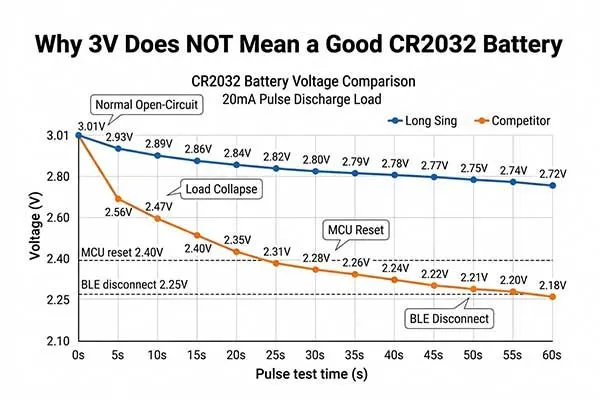
In one anonymized project with a German automotive electronics customer, the first request was not “which battery is cheapest?” but “which resistance values should we use to simulate the product?”
We recommended 15 kΩ for standby approximation, 10 kΩ for a conservative low-drain screen, 3.3 kΩ for sub-milliamp functional margin, 1 kΩ for approximately 3 mA stress, and 330 Ω only as a short pulse check near 9 mA.
After comparing the load profile, we recommended a tabbed CR2450 Li-MnO₂ model instead of forcing a standard CR2032 into a higher-pulse design; it was a practical example to test a cr2032 battery and then decide that the system needed a different cell size.
Their devices had different instantaneous pulse current requirements: memory backup below 0.1 mA, keyless-entry RF bursts around 10–30 mA, e-paper refresh peaks around 15–30 mA, and wireless sensor transmission that could exceed 50 mA without buffering. This case is also a reminder that internal resistance is not an abstract lab value; it becomes voltage drop inside the user’s product.
| Reading | Possible Reality | Engineering Response |
|---|---|---|
| 3.10 V open circuit | Fresh, but unproven under pulse | Run CR2032 load testing at the application load |
| 2.95 V open circuit | Usable for low-drain backup, risky for bursts | Check loaded voltage and device cut-off |
| 2.80 V open circuit | May work in a calculator but fail in RF | Reject for critical incoming lots |
| Voltage drops below 2.4 V under pulse | Brownout risk | Use a larger cell, capacitor, or pack redesign |
Common testing mistakes
Many bad decisions start with a good multimeter used in the wrong way.
The first mistake is pressing hard with metal probes until the cell slips, shorts, or scratches. The second mistake is reading 3.0 V and assuming the cell is new. The third mistake is using one random resistor without calculating current.
Use Ohm’s law[4]: current equals voltage divided by resistance. At 3 V, 15 kΩ is about 0.2 mA, 10 kΩ is about 0.3 mA, and 1 kΩ is about 3 mA. This matters when deciding how to test coin cell battery samples for a device that sleeps most of the time but wakes into a radio burst.
Another mistake is confusing a retail quick check with qualification. If you are writing a work instruction for operators, do not only say test 2032 battery with a meter. Say which load, which contact fixture, which stabilization time, which minimum voltage, and which lot traceability fields must be recorded.
For customers asking how to test button batteries or how to test a button battery, I also recommend separating consumer diagnosis from engineering release. Consumer diagnosis answers “does it still have voltage?” Engineering release answers “will this exact lot survive the device load, temperature, and shelf-life target?”
A UL certified lithium primary battery factory should make that distinction visible in its quality documents. Within the Long Sing factory QC process, operator instructions separate quick sorting, engineering sampling, and customer-specific release records.
| Mistake | Why It Is Risky | Better Practice |
|---|---|---|
| Only measuring OCV | Misses load sag | Add a defined resistor or electronic load |
| Using no fixture | Probe pressure changes contact resistance | Use a coin-cell holder or spring fixture |
| Testing one cell from a lot | Cannot represent batch variation | Use AQL or statistically defined sampling |
| Ignoring temperature | Cold increases voltage sag | Test at expected use temperature when needed |
3. CR2032 Testing for Incoming Quality Control
Incoming quality control should combine visual inspection, date-code review, open-circuit voltage, loaded voltage, dimensional checks, weight checks, and sampling discharge tests.
This is how to test a cr2032 battery at lot level. A CR2032 voltage test can screen obvious failures, but acceptance should be based on the device load profile and the supplier datasheet, not only a single no-load reading.
Factory-style incoming inspection and batch release
A CR2032 battery manufacturer should translate the datasheet into a repeatable production test, because to test a cr2032 battery in a factory is different from checking one loose cell on a desk.
At Long Sing Technology, the usual factory logic is to verify supplier lot identity, packaging condition, appearance, polarity marking, OCV distribution, loaded voltage, dimension, weight, and, when required, tab welding strength or nickel-lead connection.
For custom projects, our chief engineer Wilson Lu usually asks for the device load profile before confirming the battery test plan. This is especially important for meters, safety electronics, and healthcare devices where a single weak cell can create field-service cost. The same logic applies when a CR2032 battery manufacturer builds packs instead of loose cells.
For an OEM lithium primary battery supplier, the test method should also protect the customer from over-testing: if every cell is stressed with an excessive load for too long, the inspection itself consumes capacity.
For most incoming lots, the first gate is paperwork and traceability, because testing a cr2032 battery also depends on storage age and lot history. The second gate is fast electrical sorting. The third gate is application simulation. The fourth gate is engineering review if the batch shows wide voltage spread after voltage sorting.
A custom CR2032 battery solution may add welded tabs, heat-shrink sleeves, connectors, or a small pack assembly, so the inspection plan should include mechanical pull force and polarity verification. Testing a cr2032 battery in mass production is not a single meter reading; it is a documented flow that links datasheet, device profile, sample size, acceptance criteria, and failure handling.
CR2032 load testing becomes part of that release logic, not an afterthought.
| Incoming Check | Suggested Acceptance | Reason |
|---|---|---|
| Packaging and date code | No broken seal, clear lot traceability | Prevents mixed-age inventory |
| Appearance | No leakage, dents, rust, swelling, or contamination | Protects holder contact and safety |
| OCV | 3.00–3.30 V for fresh production lots | Fast screen for storage or polarity issues |
| 10 kΩ loaded voltage | ≥2.85 V after 5–10 seconds | Practical low-power application screen |
| 5.6 kΩ loaded voltage | ≥2.75 V after 5–10 seconds | Stronger screen for pulse-sensitive devices |
| Tab or lead assembly | Correct polarity, stable weld, no insulation damage | Required for pack or PCB-mounted versions |
| Engineering escalation | Wide OCV spread, abnormal sag, or customer complaint | Prevents hidden batch drift |
Acceptance standards for product design teams
The acceptance table above should not be copied blindly into every design. A written standard for a cr2032 battery testing should begin with the circuit requirement, not the battery drawer.
In design reviews, how to test a cr2032 battery is really a question about product-level voltage margin. If the device cut-off is 2.7 V, the margin under load must be higher than a device that runs down to 2.0 V. If the product ships into winter logistics, the room-temperature result may be too optimistic.
| Design Situation | Recommended Test Emphasis | Battery Decision |
|---|---|---|
| Low-drain meter memory | OCV, 15 kΩ load, shelf-life records | Standard CR2032 may be acceptable |
| RF remote or automotive accessory | Pulse sag and cold-temperature check | Consider CR2450 or buffering if sag is high |
| Medical safety device | Lot consistency and traceable inspection | Use tighter incoming limits |
| PCB-mounted design | Weld, tab, polarity, and vibration check | Use tabbed or connectorized cell |
If the product uses a spring holder, vibration and contact bounce may be as important as the cell itself. This is where a long life lithium primary battery manufacturer can support system design instead of only selling a commodity part.
A complete drawing package should define the cell model, holder or tab structure, test resistance, stabilization time, minimum voltage, sampling plan, storage condition, and re-test rule.
For high-reliability products, we may add accelerated storage comparison, pulse waveform capture with an oscilloscope[5], or device-level brownout monitoring. This is also where cr2032 testing battery becomes part of design validation, not only incoming inspection.
If cost is also a target, a competitive price lithium primary batteries program should still keep the engineering controls; this is testing a cr2032 battery for value without removing risk control; removing the CR2032 load test to save minutes often creates more cost later in returns, rework, and customer troubleshooting.
Conclusion
Testing a CR2032 is simple only when the device load is simple. For teams asking how to test a cr2032 battery, the method should start with voltage and application load. Use a multimeter first, then confirm results with defined resistance, pulse profile, and incoming quality control.
The practical answer to a cr2032 battery testing is comparing open-circuit voltage with loaded voltage. For industrial products, a custom CR2032 battery solution and disciplined CR2032 load testing reduce shipment risk early.
Frequent Asked Questions about Testing CR2032 Battery
(Click to Unfold)
Q:What is a CR2032 battery?
A:A CR2032 battery is a 3V lithium manganese dioxide coin cell battery commonly used in car keys, medical devices, IoT sensors, and backup memory systems. “20” refers to its 20mm diameter, while “32” means 3.2mm thickness. It offers stable voltage, long shelf life, and reliable low-current performance.
Q:How to tell if a CR2032 battery is good or bad?
A:A good CR2032 battery normally measures between 3.0V and 3.3V under no-load conditions. If the voltage drops below 2.7V or devices show unstable performance, reduced runtime, or startup failure, the battery is usually considered weak or near end-of-life.
Q:How low should a CR2032 battery last?
A:Most CR2032 batteries are considered depleted when voltage falls to around 2.0V–2.5V, depending on device requirements. High-drain electronics may stop working earlier, while low-power devices like RTC backup systems can continue operating at lower voltages.
Q:How can I test my coin battery without a tester?
A:You can test a coin battery by inserting it into a working device or using a simple LED load test. However, voltage-only checks may not reveal pulse performance or internal resistance problems. Industrial applications usually require load testing for accurate evaluation.
Q:What voltage is a 3-volt battery considered dead?
A:A 3V lithium coin battery is generally considered dead when voltage falls below 2.0V–2.5V under load. The actual cutoff depends on the device’s operating threshold, pulse current demand, and environmental conditions such as temperature.
Q:What voltage should a 2032 battery be?
A:A new CR2032 battery should normally measure between 3.0V and 3.3V. Stable voltage is important for electronic reliability, especially in wireless sensors, memory backup systems, and smart metering devices requiring consistent low-current output.
Q:When should you replace a CR2032 battery?
A:You should replace a CR2032 battery when devices show weak signals, reset issues, unstable operation, or voltage drops below recommended levels. Preventive replacement is common in industrial electronics and IoT systems to avoid unexpected downtime.
Q:What’s the difference between CR2032 and CR2032E?
A:CR2032 and CR2032E batteries usually share the same dimensions and voltage, but the “E” designation may indicate enhanced leakage resistance, extended shelf life, or manufacturer-specific performance improvements for electronic applications.
Q:How many types of 2032 batteries are there?
A:2032 batteries mainly include lithium manganese dioxide (CR2032), rechargeable lithium-ion versions (LIR2032), and lithium titanate rechargeable variants. Different chemistries offer different voltage ranges, rechargeability, pulse capability, and operating lifespan.
Note:
[1]Learn the correct DC voltage measurement method before testing coin cells.↪
[2]Use a defined load to simulate how the battery performs in a real circuit.↪
[3]Brownout thresholds help engineers judge whether loaded voltage is still safe.↪
[4]Ohm’s law helps calculate the test current for each resistor load.↪
[5]An oscilloscope can capture pulse sag that a simple meter may miss.↪
Keep reading lithium manganese dioxide battery chapter
- The 3.0V Standard: Unlocking the Power of Lithium Manganese Dioxide Batteries
- Choosing Between Lithium Manganese Dioxide vs Lithium-Ion Batteries
- Types of Battery: A Guide to LiSoCl₂ Vs LiMnO₂
- CR2025 VS CR2032: Practical Differences Between Coin-Shaped Batteries
- Hybrid Supercapacitors (HPC): The Ultimate Guide to Lithium-Ion Pulse Power Solutions
- Can LiMnO2 Batteries Be Charged: Lab Test Results & Industrial Solutions

The 3.0V Standard: Unlocking the Power of Lithium Manganese Dioxide Batteries
Primary Lithium Manganese Dioxide Batteries deliver long life, steady voltage, and strong safety, so

The Synergy of Power Density VS Energy Density: Hybrid Battery Solutions Explained
Power density vs energy density is the defining trade-off in modern battery system design, especiall

UN38.3 and ADR: Common Shipping Mistakes for Lithium Metal Battery Transportation
Lithium battery transportation for safety is a complex regulatory landscape where even a minor overs