

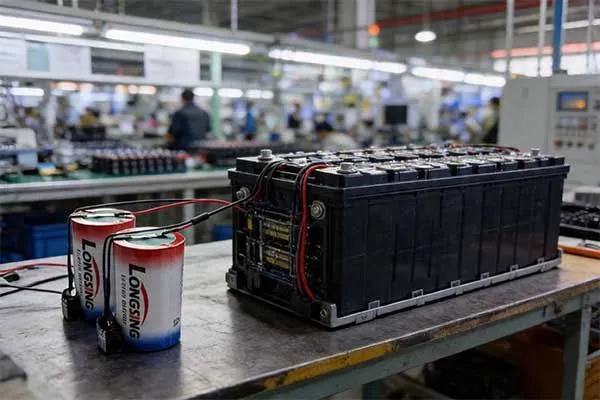
Choosing Between Lithium Manganese Dioxide vs Lithium-Ion Batteries
Selecting the wrong chemistry can result in premature field failures, ballooning maintenance costs, or unnecessary charging overhead.
Lithium manganese dioxide vs lithium-ion is not a trivial comparison; your application environment, lifecycle economics, and regulatory obligations each push the decision in a different direction.
Lithium manganese dioxide batteries (Li-MnO₂, commonly CR-series) are primary, non-rechargeable cells with nominal voltage ~3V, wide operating temperature (−20°C to +60°C), and ultra-low self-discharge, making them ideal for long-life, low-maintenance deployments such as utility meters, industrial sensors, and backup power.
Lithium-ion batteries (Li-ions) are rechargeable secondary cells (3.6–3.7V nominal) optimised for high cycle count and high energy density, best suited to consumer electronics, EVs, and applications with reliable recharge infrastructure.
Choosing incorrectly between Li-MnO₂ vs Li-ion creates avoidable cost and operational risk.
Understanding the full picture — chemistry, application fit, safety, lifecycle cost, and sourcing strategy — is what separates a robust design from a costly revision. The sections below give you the engineering decision framework to get it right the first time.
Table of Contents
- What’s the Difference – Chemical Mechanism Explained
- Application Matrix: Where Each Excels
- Safety, Regulations, and Environmental Impact
- Cost Analysis Over Lifecycle
- Strategic Sourcing: How to Choose for Your B2B Project
1. What’s the Difference – Chemical Mechanism Explained
Lithium manganese dioxide (Li-MnO₂) is a primary electrochemical system[1] in which lithium metal serves as the anode and manganese dioxide (MnO₂) as the cathode, delivering a stable ~3V open-circuit voltage with no memory effect, no charging circuit requirement, and an extremely flat discharge curve.
Lithium-ion is a secondary system using intercalation chemistry[2] — lithium ions shuttle between a graphite anode and a metal-oxide cathode (LCO, NMC, LFP, LMO, etc.) — enabling rechargeability at the cost of added BMS complexity and narrower thermal tolerance.
How the Electrochemistry Shapes Engineering Constraints
To make an informed choice, it is essential to distinguish between primary vs secondary battery technologies.
In a lithium manganese dioxide battery, the irreversible reduction reaction Li + MnO₂ → LiMnO₂ releases 3.0 V voltage per cell with no gaseous byproducts under normal conditions.
The lithium metal anode stores significantly more energy per unit mass than graphite, which directly explains why lithium manganese dioxide batteries achieve a theoretical specific energy of roughly 280 Wh/kg — superior to most Li-ion chemistries in terms of gravimetric energy density at low to moderate discharge rates.
Li-ion intercalation chemistry, by contrast, is reversible by design. The cathode material expands and contracts as ions insert and de-insert during each cycle.
This mechanical stress is the root cause of capacity fade and sets a hard ceiling on cycle life (typically 300–1000 cycles for standard NMC/LCO, up to ~2000 for LFP). A battery management system (BMS) is mandatory to prevent overcharge, over-discharge, and thermal runaway — adding board space, cost, and failure modes.
The following table consolidates the key electrochemical and performance parameters for a direct lithium manganese dioxide battery vs lithium ion engineering comparison:
| Parameter | Li-MnO₂ (CR Series) | Li-ion (NMC / LFP) |
|---|---|---|
| Nominal Voltage | ~3.0 V | 3.6 V (NMC) / 3.2 V (LFP) |
| Specific Energy (Wh/kg) | 230–280 | 150–260 (NMC) / 90–160 (LFP) |
| Rechargeability | Primary (non-rechargeable) | Secondary (rechargeable) |
| Typical Cycle Life | N/A (single discharge) | 300–2000 cycles |
| Annual Self-Discharge | <1% at 20°C | 2–5% |
| Operating Temperature | −20°C to +60°C | −0°C to +45°C (standard) |
| BMS Required | No | Yes |
| Shelf Life | 8+ years | 3–5 years (stored) |
| Pressure/Gas Risk | Low (sealed bobbin) | Higher (electrolyte decomp.) |
Li-MnO₂ that uses manganese dioxide as the cathode makes it more stable under abuse conditions and far safer for commercial deployment than lithium metal primary cells (e.g., lithium-sulfur dioxide).
The divergence at the extremes of the temperature axis is particularly consequential for industrial design — exactly the ambient conditions common in oil and gas metering, outdoor AMI nodes, and cold-chain asset tracking.
2. Application Matrix: Where Each Excels?
Li-MnO₂ (CR-series) cells excel in low-power, long-life, maintenance-free deployments: utility meters (gas/water/heat), industrial IoT sensors, TPMS, EAS tags, medical implantables, and safety devices where replacement is impractical.
Li-ion cells are the correct choice when the device is recharged regularly, consumes high peak current, or operates in conditions where the infrastructure for recharging exists — portable tools, EVs, consumer electronics, drones, and grid storage systems.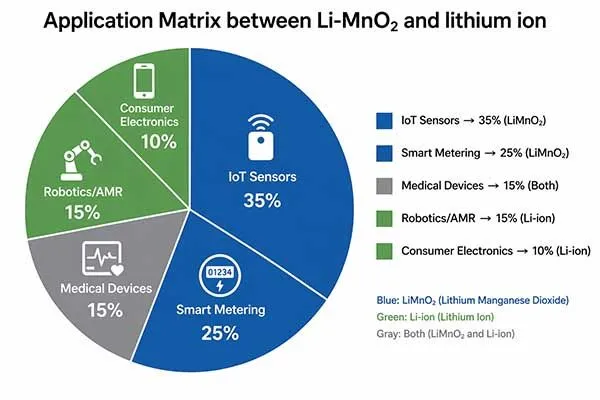
Industrial Metering and Public Utilities
This is the home turf of lithium manganese dioxide batteries. Gas meters, water meters, heat cost allocators, and smart electricity submeters all share the same design brief: sub-milliamp average current, 10–15 year expected service life, no access to mains power, and harsh ambient conditions (buried, in meter boxes, or on exposed pipework).
The standard combination here is a primary Li-MnO₂ bobbin cell paired with a Hybrid Pulse Capacitor (HPC) — often called a hybrid supercapacitor[3] — for pulse current delivery during RF transmission. Common cell form factors and typical application pairings are listed below:
| Application | Recommended Cell | Typical Capacity | Expected Service Life |
|---|---|---|---|
| Gas meter (NB-IoT / LoRa) | CR 34615 (D-size) | 17,000 mAh | 10–15 years |
| Water meter (pulse output) | CR 26500 (C-size) | 8,500 mAh | 10–12 years |
| Heat cost allocator | CR 14505 (AA) | 2,600 mAh | 8–12 years |
| Smart electricity submeter | CR 17505 (A-size) | 3,600 mAh | 10+ years |
| Industrial pressure sensor | CR 14250 (1/2 AA) | 1,200 mAh | 5–10 years |
Safety, Healthcare, and High-Reliability Backup
For smoke detectors, CO alarms, emergency lighting controllers, cardiac monitors, and AMDs (Automated Medication Dispensers), the design priority is predictable voltage delivery over the longest possible time with minimal self-discharge.
The non-rechargeable vs rechargeable distinction again resolves toward primary Li-MnO₂: there is no user behaviour to rely on for recharging, and a dead backup battery during an emergency event is a catastrophic outcome.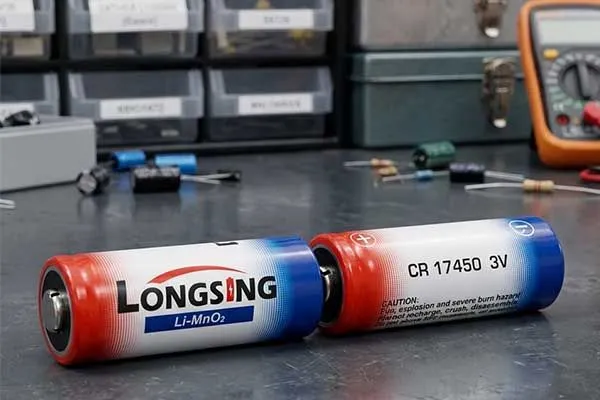
A lithium manganese battery in a 9V-equivalent CR configuration (e.g., two CR17450 in series) is a well-proven choice for smoke detector OEMs. Ten-year sealed units now mandate primary lithium cells in several US and EU jurisdictions — another regulatory driver that competes with any cost argument for Li-ion.
Consumer Electronics, Power Tools, EVs, and Grid Storage
These are where we use li-ion’s a lot. High charge/discharge frequency, user-managed charging, high peak power, and a tolerance for BMS complexity all justify the added engineering overhead.
In these categories, asking whether to use lithium magnesium dioxide battery technology would be the wrong question — energy capacity per recharge cycle, not total shelf life, is the governing parameter.
3. Safety, Regulations, and Environmental Impact
Li-MnO₂ primary cells carry a lower abuse-tolerance risk profile than Li-ion: no thermal runaway[4] pathway from overcharge (they cannot be charged), no electrolyte decomposition risk from cycling, and bobbin construction that withstands short-circuit without venting.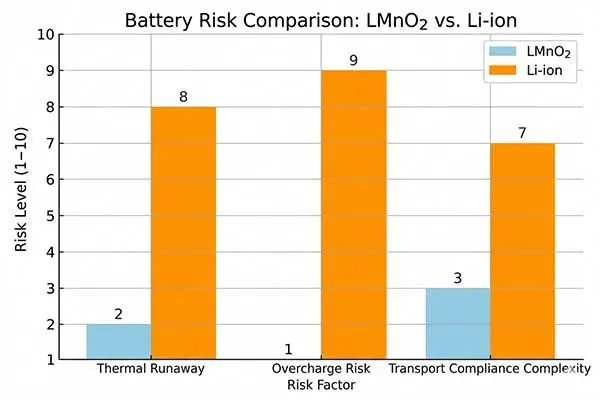
Li-ion cells, while safe within design limits, require robust BMS protection and are subject to more stringent transport and disposal regulations (IATA, IEC 62133, UN 38.3).
Both chemistries contain lithium metal and must comply with hazardous material handling protocols.
Regulatory Landscape
The difference between the CR battery vs Li-ion regulatory burden starts at the transport stage. Primary lithium cells (including Li-MnO₂) ship under IATA Packing Instruction[5] PI 970 with a 2g-per-cell lithium content limit for passenger aircraft and specific watt-hour caps for cargo.
Li-ion secondary cells fall under PI 965/966/967 and face tighter watt-hour restrictions, state-of-charge limits (≤30% SOC for certain shipment categories), and mandatory incident reporting for large lots.
For product certification, Li-MnO₂ cells typically require UL 1642 or IEC 60086-4 compliance. Li-ion cells require IEC 62133 (consumer portable) or UL 2054 (household and commercial), plus UN 38.3 electrochemical testing for all new designs.
If your device is CE-marked for the EU market, the Battery Regulation (EU) 2023/1542[6] introduces new due diligence requirements for supply chain traceability that apply to both chemistries.
Environmental Considerations
Li-MnO₂ cells contain manganese dioxide — a less environmentally critical material than the cobalt used in NMC/LCO Li-ion cathodes. Cobalt has documented supply chain concerns including child labour risk in DRC mining operations.
Recycling under end-of-life: In the EU, the Battery Regulation mandates producer responsibility and collection targets. In North America, Call2Recycle[7] provides a compliant collection network for both primary and secondary lithium cells.
4. Cost Analysis Over Lifecycle
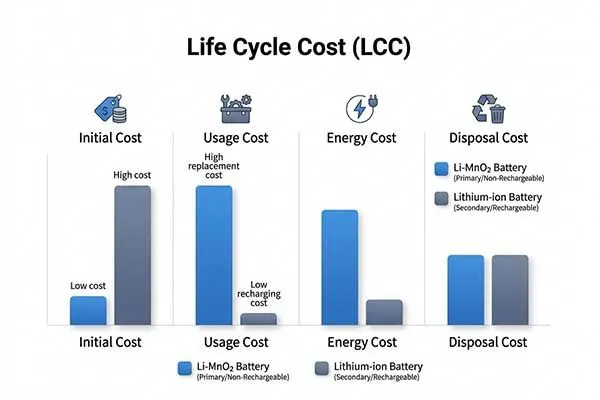 On a per-cell acquisition basis, Li-MnO₂ primary cells are generally lower cost than equivalent Li-ion packs. However, total cost of ownership (TCO)[8] depends heavily on application lifetime, replacement frequency, and labour cost per service visit.
For devices with 10+ year field life and inaccessible installation, primary Li-MnO₂ consistently delivers lower TCO. For high-cycle applications, rechargeable Li-ion reduces consumable spend but adds BMS and maintenance overhead.
| Scenario | Battery Type | Replacements (15yr) | Labour/Visit | Battery Cost | TCO/Device |
|---|---|---|---|---|---|
| Utility meter (NB-IoT) | Li-MnO₂ ER34615 | 0–1 | $0–$40 | $4.50 | ~$44 |
| Utility meter (NB-IoT) | Li-ion 18650 + BMS | 3–4 | $35 × 4 = $140 | $8 × 4 = $32 | ~$185 |
The TCO advantage of primary Li-MnO₂ at scale is clear. For 100,000 meters, the delta is approximately $14.1M over the device lifetime — a figure that justifies significant engineering investment in selecting the right primary cell and cell/HPC combination at the design stage.
Total Cost of Ownership Considerations
TCO modelling for B2B lithium manganese battery deployments should include:
- Inventory holding cost: Primary cells have 10+ year shelf life; Li-ion degrades in storage, requiring more frequent stock rotation.
- BMS amortisation: Every Li-ion device carries embedded BMS cost; primary Li-MnO₂ devices do not.
- Warranty and reliability: A single field failure in a gas metering network triggers regulatory scrutiny. Primary Li-MnO₂’s predictable discharge curve and tested shelf life reduce warranty claims.
- Scrap rate at manufacture: Li-ion packs with integrated BMS have more components, higher assembly defect exposure, and greater in-process test burden.
5. Strategic Sourcing: How to Choose for Your B2B Project?
The Li-MnO₂ vs Li-ion sourcing decision should follow a structured engineering gate process: confirm operating temperature range, average and peak current draw, expected device service life, available power infrastructure, regulatory environment, and lifecycle cost model before specifying chemistry.
For industrial metering, safety devices, and inaccessible installations, primary Li-MnO₂ with or without HPC is almost always the correct answer. For portable, frequently recharged, or high-current applications, Li-ion is the right platform.
Engineering Decision Flow
Before committing to either chemistry, work through this gate sequence:
- Temperature: Does the application exceed −20°C or +60°C sustained? → Li-MnO₂ only.
- Recharge access: Is there reliable mains or solar recharge available? → Li-ion is viable.
- Service life target: Is the target >5 years without maintenance access? → Li-MnO₂.
- Peak current: Does the device require >2A pulse current? → Add HPC to Li-MnO₂ or evaluate Li-ion.
- Regulatory: Does the end market mandate primary lithium for the device category (e.g., 10-year smoke detectors)? → Li-MnO₂ mandatory.
- TCO: Does lifecycle cost modelling show >30% saving with primary chemistry? → Li-MnO₂.
When to Choose Li-MnO₂
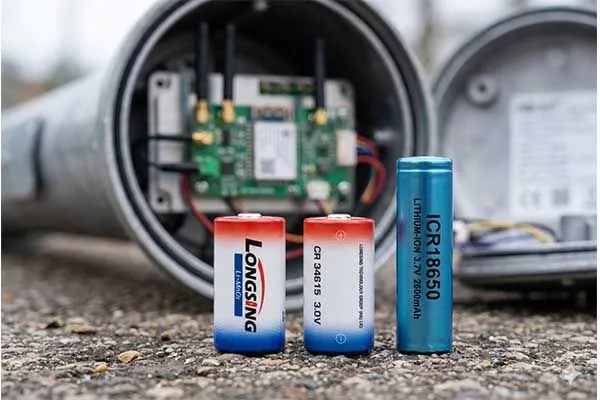
- Utility and industrial metering (gas, water, heat, electricity submeters): CR34615 + HPC1520 for NB-IoT/LoRa-enabled meters; CR26500 for pulse-output meters.
- Safety devices (smoke detectors, CO alarms, fire control panels): CR17450 or CR2 in multi-cell configurations; 10-year sealed units.
- Healthcare and monitoring (cardiac monitors, infusion pumps, remote patient devices): CR2032/CR2450 coin series for low-drain; CR14500 for higher capacity requirements.
- Industrial IoT and asset tracking (pipeline sensors, SCADA remote nodes, vibration monitors): CR14250 or CR26500; consider HPC for devices with periodic RF transmission bursts.
- Military and harsh-environment backup (geophone arrays, seismic monitors, GPS trackers in Arctic/desert): CR34615 or custom multi-cell pack with operating range to −55°C.
When to Choose Lithium-Ion
- Consumer electronics (smartphones, laptops, wearables): Standard 18650/21700 NMC or pouch LCO cells.
- Power tools and robotics: High-drain LFP or NMC cylindrical packs with high-rate BMS.
- Electric vehicles and e-mobility: Large-format prismatic or cylindrical NMC/LFP packs.
- Grid storage and UPS: LFP chemistry for cycle life and thermal stability at scale.
- Drones and UAVs: High-C-rate LiPo (NMC pouch) for power-to-weight ratio.
Case Study: Replacing Batteries in a UAE Oil and Gas Field Deployment
The Problem: Frequent Battery Failures in High-Temperature Metering Nodes
A major oil and gas company in the UAE contacted our engineering team regarding premature battery failures in their wellhead pressure and flow metering nodes. The devices were deployed across multiple facilities in the Abu Dhabi region, operating in ambient temperatures regularly reaching 55–65°C. The incumbent battery was a 3.6V rechargeable lithium-ion 18650 pack (2-cell series, 7.2V nominal, 4,000 mAh) — a solution originally selected by the system integrator for its high energy density and assumed flexibility.
The immediate problem: average field life was 14–18 months against a target of 5 years. Two failure modes dominated — thermal degradation of the electrolyte above 60°C and capacity fade from the BMS repeatedly throttling charge cycles to protect cell integrity in the heat. The customer was also paying for scheduled maintenance visits every 18 months per node across a fleet of approximately 400 units — an operational cost running into six figures per maintenance cycle.
The secondary problem, less immediately obvious but commercially significant: the rechargeable architecture introduced a regulatory complication. Lithium-ion secondary cells in pressure vessel environments are subject to additional ATEX/IECEx hazardous area classification review in the UAE. Even though the cells were not being actively charged in the field, the fact that they could be charged (and therefore could, in theory, be connected to an external charge source by a field technician unaware of the hazard zone rating) created a compliance ambiguity that the customer’s HSE team wanted resolved.
What we decided to do
Our sales manager Luke Liu received the initial enquiry by phone. The customer’s procurement lead provided basic operating data — temperature range, current consumption profile (average 180 µA, with 650 mA pulse bursts during GPRS transmission), and the 5-year service life target. Luke escalated immediately to our chief engineer Wilson Lu, who identified within the first call that the pulse current profile was the diagnostic key: at 650 mA over a 1.5-second transmission window, a standard bobbin Li-MnO₂ cell alone would show significant voltage depression. The correct solution was a Li-MnO₂ + HPC hybrid configuration.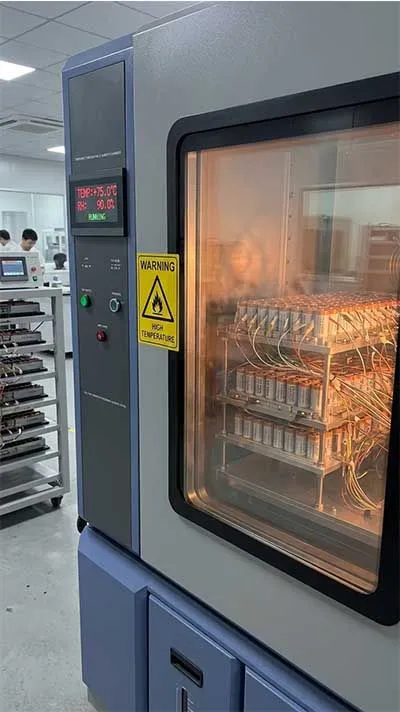
Wilson ran a capacity and pulse simulation using the customer’s telemetry duty cycle (transmission every 15 minutes, 24/7). The model output confirmed that an CR34615 (D-size, 17,000 mAh, rated to +85°C) paired with our HPC1520 Hybrid Pulse Capacitor would comfortably deliver the required pulse current while the primary cell maintained the device’s standby load — with a projected service life of 6.2 years under worst-case 65°C ambient conditions.
Testing and Validation Before Order
Because the UAE ambient regularly exceeds the customer’s stated “55–65°C” range during summer months and in direct sun (surface temperatures on equipment enclosures can reach +75°C), we conducted accelerated life testing on the proposed CR34615 + HPC1520 combination at +70°C and +75°C continuous, simulating the customer’s 15-minute transmission duty cycle. After 90-day thermal soak, capacity retention at +70°C was 94.7%; at +75°C, 91.2% — within the customer’s acceptable range for a 5-year projection.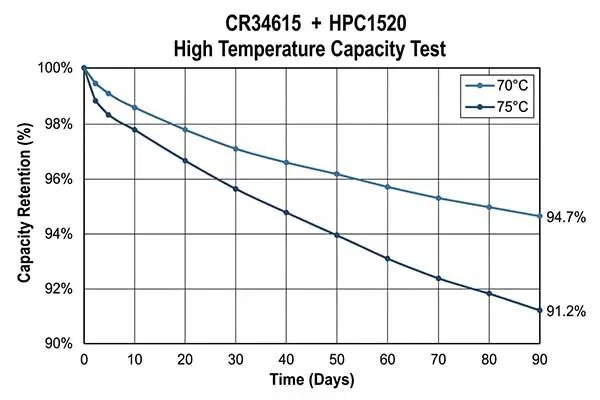
We also verified ATEX compatibility documentation for both the CR34615 and HPC1520: as primary (non-rechargeable) components, they carry no in-field charging risk, which resolved the customer’s HSE compliance ambiguity directly. This was communicated to the customer in a follow-up call with their HSE manager and confirmed in writing.
The Order and Outcome
The customer placed an initial purchase order for 10,000 battery packs comprising CR34615 cells and HPC1520 battery, representing a full fleet replacement. Cells were supplied with full UL 1642 certification documentation, IEC 60086-4 test reports, and UN 38.3 compliance certificates to satisfy the UAE customs and in-country regulatory requirements.
As a long life lithium primary battery manufacturer, we supported the customer’s installation team with a cell-level integration guide and thermal management guidelines for the enclosure design. Field performance data reported at the 12-month mark confirmed zero premature failures across the deployed fleet — a direct contrast to the 14–18 month failure pattern of the previous Li-ion architecture.
Conclusion
The lithium manganese dioxide vs lithium-ion decision is ultimately an engineering and lifecycle economics question, not a specification default. Li-MnO₂ wins decisively in long-life, maintenance-free, temperature-extreme, and safety-critical applications. Li-ion wins in high-cycle, regularly recharged, and high-power-density use cases.
By mapping your application against the decision framework above — temperature, recharge access, service life, peak current, regulation, and TCO — you can identify the right chemistry, the right cell model, and the right sourcing partner before your design is locked.
Frequent Asked Questions about Li-MnO2 vs Lithium ion
(Click to Unfold)
Q:What is lithium manganese dioxide battery?
A:A lithium manganese dioxide (Li-MnO₂) battery is a primary (non-rechargeable) lithium battery using manganese dioxide as the cathode, known for high energy density, long shelf life, and stable voltage in low-power applications.
Q:Is lithium-ion the same as lithium manganese dioxide?
A:No. Lithium-ion batteries are rechargeable secondary batteries, while Li-MnO₂ batteries are typically non-rechargeable primary cells designed for long-term, low-drain applications.
Q:What are the disadvantages of Li-MnO2 batteries?
A:Li-MnO₂ batteries cannot be recharged, have limited high-current performance, and may become costly in frequent replacement scenarios compared to rechargeable lithium-ion alternatives.
Q:What’s the difference between lithium and lithium manganese dioxide batteries?
A:“Lithium battery” is a broad category. Li-MnO₂ is a specific type using manganese dioxide chemistry, offering stable output and long shelf life for specialized applications.
Q:Is lithium manganese dioxide safe?
A:Yes. Li-MnO₂ batteries are considered safe due to stable chemistry, low leakage risk, and reliable performance, especially in controlled low-drain environments.
Q:Where can I find suppliers of high-capacity lithium manganese dioxide cells?
A:You can source high-capacity Li-MnO₂ cells from specialized manufacturers like Long Sing Technology, offering customized solutions for industrial, IoT, and metering applications.
[1]Understand how primary batteries differ from rechargeable systems.↪
[2]Learn how ion intercalation enables rechargeable batteries.↪
[3]Explore how supercapacitors support pulse power delivery.↪
[4]Understand the risks behind battery thermal runaway events.↪
[5]Check global air transport regulations for lithium batteries.↪
[6]Learn about new EU battery compliance and traceability rules.↪
[7]Find certified recycling solutions for lithium batteries.↪
[8]Evaluate the full lifecycle cost beyond initial battery price.↪
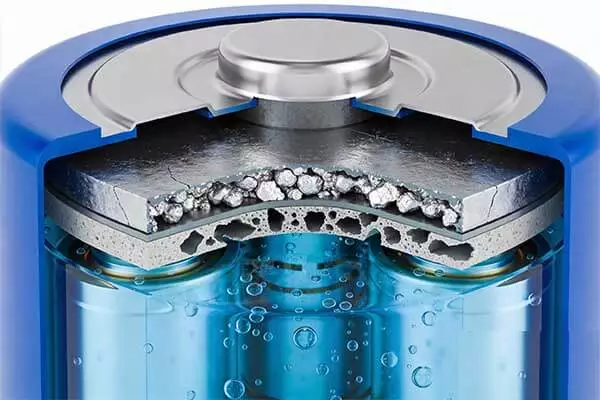
Can LiMnO2 Batteries Be Charged: Lab Test Results & Industrial Solutions
If an engineer asks, “can LiMnO2 batteries be charged,” the risk is already present: a w
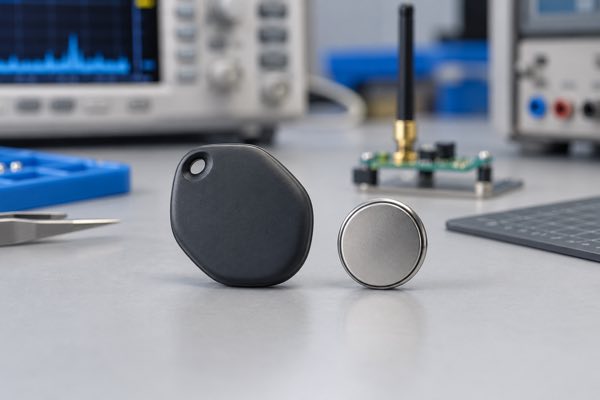
Bluetooth Tracker Battery: How to Choose the Right CR2032
Bluetooth trackers are becoming smaller and more capable. Many compact models spend most of their ti
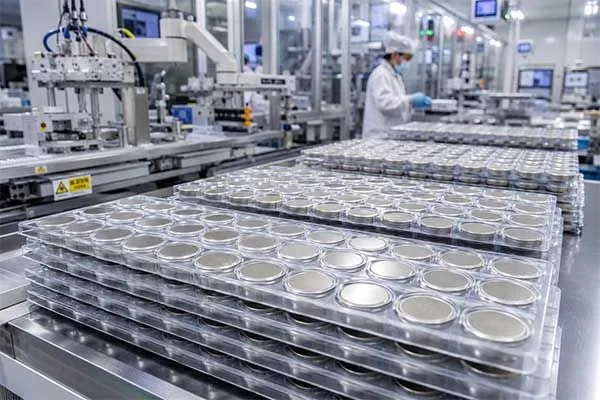
What Is a Button Cell Battery? Types, Manufacturing & Selection
Designing compact industrial IoT devices often fails due to erratic power delivery from substandard