

How to Choose the Right CR Battery Sizes: Selection Workflow and Sourcing Specifications
Key Takeaways
- Standard CR battery sizes are identified by IEC codes, defining nominal voltage, dimensions, and chemistry.
- Choosing CR battery sizes requires matching dimensions, voltage, capacity, discharge needs, and application conditions.
- Industrial applications include meters, sensors, medical devices, tracking equipment, and backup power systems.
- Engineers can select batteries by defining requirements, comparing specifications, validating fit, and confirming sourcing details.
You’ve designed a meter or IoT device—but the battery keeps underperforming in the field. Wrong CR battery sizes kill deployments before they start. This guide cuts through the confusion so your next design ships right the first time.
Choosing the right CR battery sizes involves matching physical dimensions and electrical requirements to your device. Common options include the CR2032 and CR2450.
Engineers must evaluate standard specifications, operating temperatures, and peak current demands to ensure seamless integration. Correct sizing ensures reliable power delivery, maximizes spatial efficiency, and extends the lifespan of your equipment.
Dive into our comprehensive guide to explore engineering parameters, critical selection workflows, and robust sourcing strategies that will actively empower your next successful industrial hardware deployment.
Table of Contents
- 1. What are the Standard CR Battery Sizes and Dimensions?
- 2. What are the Core Industrial Application Scenarios?
- 3. How Does the Selection Workflow for Engineers Operate?
1. What are the Standard CR Battery Sizes and Dimensions?
The most common CR battery sizes range from CR1025 (10 mm diameter, 2.5 mm height) up to CR2477 (24.5 mm diameter, 7.7 mm height), all delivering a nominal 3 V output.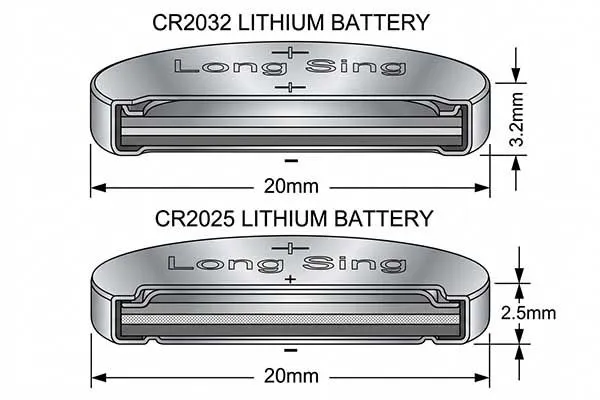
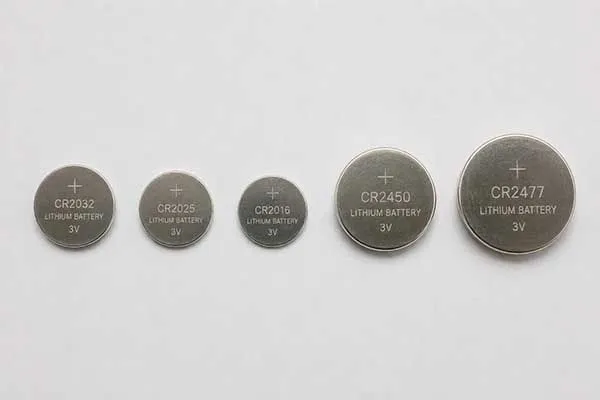
Industrial CR battery sizes like the CR2450 and CR2477 offer the highest volumetric capacity in the coin cell format, while smaller button cell battery sizes such as CR1220 and CR1616 suit space-constrained PCB designs.
Coin cell sizes and coin battery sizes are terms used interchangeably in procurement, though IEC nomenclature[1] is preferred for formal engineering documentation.
Performance Comparison and Technical Considerations
Understanding coin battery sizes beyond the diameter-height encoding is critical for long-term field reliability. The table below compares the most frequently specified industrial CR battery sizes used in metering, security, and IoT applications:
| Model | Diameter (mm) | Height (mm) | Nominal Capacity (mAh) | Typical Self-Discharge | Common Applications |
|---|---|---|---|---|---|
| CR2016 | 20.0 | 1.6 | 90 | <1%/yr | Key fobs, thin wearables |
| CR2025 | 20.0 | 2.5 | 160 | <1%/yr | Glucose monitors, remotes |
| CR2032 | 20.0 | 3.2 | 220 | <1%/yr | BIOS backup, utility meters |
| CR2450 | 24.5 | 5.0 | 620 | <1%/yr | Smart meters, GPS trackers |
| CR2477 | 24.5 | 7.7 | 1000 | <1%/yr | Industrial data loggers |
| CR123A | 17.0 | 34.5 | 1500 | <1%/yr | Security cameras, medical |
CR2032 vs CR2450 battery comparison is one of the most common sizing decisions engineers face. The CR2032 is 20 mm diameter while the CR2450 is 24.5 mm. They are not pin-compatible.
For IoT nodes running at 5–15 µA standby, a CR2450 can extend service life from roughly 4 years to over 10 years—a difference that determines whether a field technician needs to visit the device at all.
Why Nominal Capacity ≠ Actual Delivered Capacity
Nominal capacity figures are measured at room temperature (20–23 °C) under a specific constant-resistance load to full cutoff voltage, typically 2.0 V. In the field, actual delivered capacity can diverge significantly:
- Pulse loads (e.g., cellular modems, valve actuators): High-current pulses cause temporary voltage sag. If the voltage drops below the device’s brown-out threshold[2] even for milliseconds, the MCU resets—even though the battery retains significant charge. This is the most common “dead battery” failure mode in industrial CR battery sizes.
- Low temperature: At −20 °C, a CR2032’s deliverable capacity may fall to 60–70% of its rated value.
- Elevated temperature storage: Long warehouse dwell times above 40 °C accelerate internal self-discharge.
A real engineering case illustrates this well.
A Japanese security system integrator came to us because their deployed devices were experiencing random voltage drops and MCU resets—despite batteries that read “partially charged” on a multimeter.
They had been using standard CR2032 cells from a spot-market supplier. The root cause was twofold: the coin cell battery sizes were physically compatible, but the cells were rated for a maximum continuous discharge of only 3 mA, while the security sensor’s GSM alarm burst drew 150–200 mA for 200 ms. Every alarm event caused a deep voltage sag.
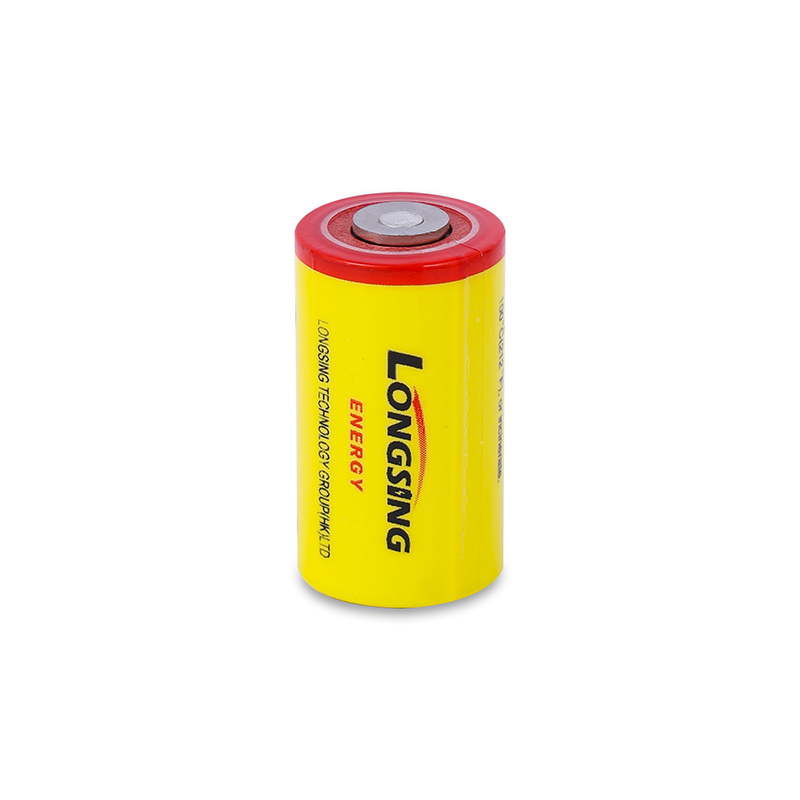
We recommended replacing the CR2032 with a Long Sing Technology CR2450 paired with our hybrid supercapacitor module (HPC series). The supercapacitor handles instantaneous pulse current, while the CR2450 provides stable background energy for the 8–10 year device lifespan required by the customer.


The customer also required a guarantee of long-term inventory voltage integrity—because many IoT products’ operational lifespans are directly determined by standby current draw.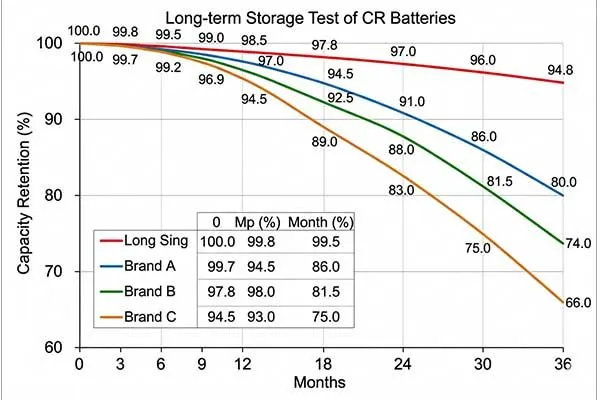
We demonstrated shelf-life test data showing <1% annual self-discharge under IEC 60086-4 conditions, and committed to batch-level OCV traceability for each shipment. This is the kind of engineering partnership that a reliable OEM lithium primary battery supplier must provide.
The lesson: cr batteries types and coin cell sizes that look identical on a datasheet can perform very differently under real pulsed-load conditions. Always request a pulse-load discharge curve from your supplier, not just the standard constant-resistance curve.
2. What are the Core Industrial Application Scenarios?
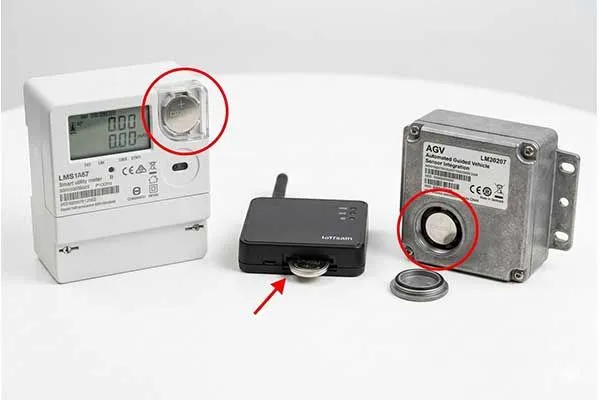
Primary lithium CR battery applications span utility metering (gas, water, electricity), industrial safety sensors, RTLS asset tags, medical implantables, and backup power for PLCs and memory modules.
| CR Battery Model | Typical Industrial Application Scenarios | Key Advantages in Industrial Use |
|---|---|---|
| CR1025 | Miniature RFID tags, asset tracking devices, wearable industrial sensors, compact security tokens, electronic labels. |
Extremely compact footprint enables integration into ultra-small electronic assemblies where space is highly constrained. |
| CR1616 | Utility metering modules, industrial timers, access control systems, backup power for low-power electronics. |
Thin profile simplifies installation in space-restricted industrial products. |
| CR2016 | Industrial control panels, safety monitoring devices, calibration instruments, portable electronics. |
Cost-effective solution for medium-duration applications requiring dependable backup power. |
| CR2025 | Industrial sensors, Bluetooth tracking devices, security monitoring equipment, smart tags. |
Provides a favorable balance between compact size and operational lifespan. |
| CR2032 | Smart meters, TPMS modules, industrial IoT devices, electronic instrumentation, wireless communication nodes. |
Industry-standard format with broad availability, strong reliability, and compatibility across numerous industrial designs. |
| CR2430 | Smart utility meters, logistics tracking equipment, environmental monitoring stations, alarm systems. |
Supports continuous operation in demanding field deployments requiring long battery life. |
| CR2450 | Industrial IoT gateways, GPS tracking devices, smart agriculture sensors, wireless telemetry systems. |
Large energy reserve enables multi-year operation and supports moderate pulse-current demands. |
| CR2477 | Utility metering, smart city infrastructure, industrial asset tracking, long-life monitoring systems, automated logistics devices. |
One of the highest-capacity coin cells available, delivering exceptional longevity for maintenance-sensitive installations. |
3. How Does the Selection Workflow for Engineers Operate?
The correct workflow for selecting CR battery sizes begins with defining the load profile—average current, peak pulse current, pulse duration, and duty cycle—before consulting any capacity table.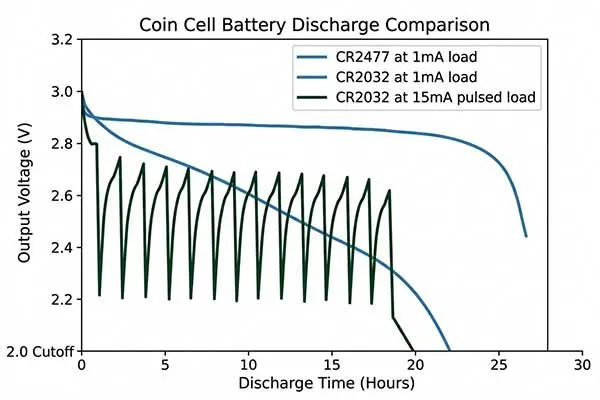
Matching coin battery sizes to a PCB footprint without first calculating energy budget and pulse tolerance is a leading cause of premature field failures. Industrial CR battery specifications must be confirmed against operating temperature range, self-discharge rate, and required certifications before finalizing a BOM.
Follow these steps in order:
Step 1 — Define the load profile. Measure or simulate: average standby current (µA), peak pulse current (mA), pulse width (ms), and pulse frequency. This determines both minimum capacity and minimum pulse capability required.
Step 2 — Calculate required capacity. Use: C (mAh) = I_avg (mA) × Life (hours) × derating factor. Apply a minimum 20% derating for temperature and aging. For a 10-year life at 10 µA average: 0.01 mA × 87,600 h × 1.25 = 1,095 mAh—pointing to CR2477 or a cylindrical bobbin-type cell.
Step 3 — Verify pulse tolerance. Request the supplier’s pulse discharge curve at your target pulse current and duration. If the voltage sag under pulse exceeds your MCU’s minimum operating voltage, consider adding a hybrid supercapacitor buffer as described in the security system case above.
Step 4 — Confirm physical constraints. Map available coin cell sizes against your PCB or housing envelope. Note that battery sizes like CR2450 and CR2477 require different holder part numbers despite sharing the same diameter.
Step 5 — Validate certifications. For North American distribution: UL 1642. For EU/CE: IEC 60086-4. For transportation: UN 38.3. A UL certified lithium primary battery factory can provide cell-level and pack-level certificates, simplifying your own product compliance process.
Step 6 — Qualify the supply chain. Request: shelf-life test data, OCV distribution histograms per lot, and lead-time commitments. Spot-market cells often fail lot-to-lot consistency checks.
Industrial Sourcing Critical Factor: Tabbed vs. Naked Coin Cells
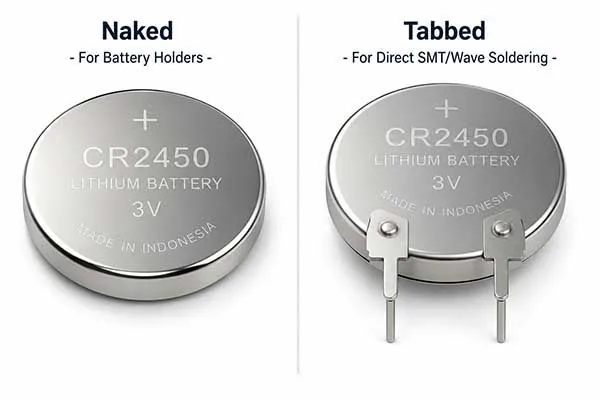
For industrial PCB assembly, coin cell battery sizes are available in two mounting configurations: naked (bare cell for use in a through-hole or SMD holder) and tabbed (spot-welded nickel tabs enabling direct PCB soldering).
The choice affects both assembly process and thermal management. Tabbed coin cells eliminate holder contact resistance and improve vibration resistance, but require careful reflow or hand-soldering procedures to avoid exceeding the battery’s maximum allowable case temperature during assembly.
Tabbed Configuration Types
| Configuration | Tab Style | Assembly Method | Best For |
|---|---|---|---|
| Naked | None | Press-fit holder | Replaceable batteries, field service |
| Single-tab | One positive tab | Manual solder | Low-volume, prototype |
| Dual-tab (standard) | Pos + neg tabs | Manual solder | High-reliability PCB |
| SMD (castellated)[3] | Formed SMD leads | Reflow (low-temp profile) | Automated assembly lines |
When specifying industrial CR battery sizes with tabs, always confirm:
- Tab material: Nickel-plated steel is standard; pure nickel tabs offer better weldability for automated assembly.
- Tab dimensions: Non-standard tab geometry can cause fixture incompatibility on automated pick-and-place lines.
- Soldering temperature limit: Most coin cell battery sizes are rated to a maximum case temperature of 100 °C for ≤10 seconds. Exceeding this permanently degrades capacity.
- Storage and ESD: Tabbed cells must be stored in anti-static trays; bulk packaging causes tab tangling and micro-short risk.
As a long life lithium primary battery manufacturer supplying customers across North America, Western Europe, and Asia-Pacific manufacturing hubs, we maintain both naked and tabbed variants of our full CR battery sizes catalog, with minimum order quantities designed for industrial production runs rather than distributor minimums. Customers requiring competitive price lithium primary batteries for high-volume metering or safety device programs are encouraged to discuss annual blanket orders, which allow us to lock pricing and pre-position inventory for guaranteed lead times.
Conclusion
Choosing the right CR battery sizes is a multi-variable engineering decision, not a catalog lookup. Start with your load profile, calculate true energy budget with derating, verify pulse tolerance, confirm coin cell sizes against your housing, and validate certifications before issuing a BOM.
Industrial CR battery sizes from CR2032 to CR2477 cover the vast majority of metering, safety, and IoT applications—but only when matched to a supplier who can demonstrate lot-level consistency, long-shelf-life data, and flexible tab configurations. For complex applications combining pulse loads with decade-long service requirements, pairing a high-capacity coin cell with a hybrid supercapacitor buffer is the engineering-proven solution.
Frequent Asked Questions about CR Battery Sizes
(Click to Unfold)
Q:What are the CR battery sizes?
A:CR batteries come in diverse diameters and thicknesses, such as the slim CR2016, standard CR2032, and thicker CR2450. The naming reveals dimensions; for instance, “2032” means 20mm diameter and 3.2mm thickness. At Long Sing Technology, we engineer lithium thionyl chloride hybrids for high-pulse needs.
Q:Are all CR Batteries the same size?
A:No. While sharing a 3V nominal voltage, physical dimensions vary widely. A CR2430 is wider than a CR2032, and a CR2016 is half the thickness. Long Sing Technology provides precise sizing across lithium thionyl chloride and hybrid pulse capacitor packs to ensure perfect fit.
Q:What does cr mean on a battery?
A:“CR” denotes a lithium manganese dioxide chemistry with a round shape. The “C” signifies a lithium negative electrode, while “R” indicates a cylindrical form. For advanced applications, Long Sing Technology leverages similar lithium chemistries like Li-SOCl₂ for superior energy density.
Q:How many CR battery types are there?
A:Dozens exist, defined by IEC standards. Common types range from CR1216 to CR2477, varying in capacity from 25mAh to 1000mAh. Beyond standard coin cells, Long Sing Technology specializes in bobbin-type Li-SOCl₂ cells and hybrid pulse capacitors for demanding IoT deployments.
Q:What is the thicker version of the CR 2032?
A:The CR2032’s thicker counterpart is the CR2045 or CR2050, offering higher capacity while maintaining the 20mm diameter. For extreme longevity and pulse capability in that footprint, Long Sing Technology recommends our hybrid lithium thionyl chloride capacitor packs as a superior alternative.
Q:How do cr2030 and cr2032 batteries differ?
A:Both are 20mm in diameter, but the CR2032 is 3.2mm thick versus the CR2030’s 3.0mm. This 0.2mm gives the CR2032 roughly 10-15% more capacity (around 225mAh vs 210mAh). Long Sing Technology ensures strict dimensional control for reliable connections in our battery packs.
Q:What are some uses for the 2032 battery?
A:CR2032 batteries power compact devices like key fobs, motherboards, medical sensors, and asset trackers. For industrial applications requiring wider temperature ranges and high pulse currents, Long Sing Technology supplies lithium thionyl chloride hybrids that drastically outlast standard CR2032 cells.
Q:Do CR2032 brand matter?
A:Absolutely. Brand quality affects leak resistance, capacity stability, and shelf life. Premium manufacturers guarantee low self-discharge and consistent voltage. Long Sing Technology ensures this through rigorous sourcing, specializing in robust lithium chemistries and hybrid capacitors for mission-critical industrial performance.
Note:
[1]Learn about the international IEC standard for coin cell identification.↪
[2]Understand how pulse loads affect battery voltage in real-world applications.↪

Continuous Monitoring: How to Prevent Battery Failure in Toxic Gas Monitor
Every year, industrial accidents happen because gas detectors fail at critical moments. The root cau

What Makes the Science Behind Lithium Thionyl Chloride Battery So Unique?
Key Takeaways Li-SOCl2 batteries combine a lithium anode with thionyl chloride chemistry for high en

How Does Leakage Current Impact Hybrid Supercapacitors and Li-SOCl₂ Batteries in Low-Power Devices?
Leakage current quietly drains energy from low-power devices long before engineers notice performanc