

Are supercapacitors safer than batteries?
Key Takeaways
- Supercapacitors are generally safer than batteries because they store energy electrostatically, eliminating chemical reactions that trigger thermal runaway, fires, and toxic gas emissions.
- The safest option depends on the application: supercapacitors win in high-cycle, extreme-temperature scenarios; batteries suit sustained long-duration energy delivery.
- Hybrid supercapacitor-battery systems combine safety with energy density for industrial meters, healthcare devices, and high-reliability backup power.
- Cell balancing, protective circuitry, and hybrid integration resolve key safety challenges encountered in real-world deployments.
Rising battery safety incidents threaten industrial and utility infrastructure. Thermal runaway and electrolyte leakage put critical equipment at risk. Supercapacitors offer a fundamentally different storage mechanism that eliminates most chemical failure modes—but is “safer” always the right choice?
Supercapacitors are generally safer than batteries because they store energy electrostatically in an electric field rather than through chemical reactions. This eliminates thermal runaway, the leading cause of battery fires and explosions.
Supercapacitors also tolerate wider temperature ranges and sustain far more charge–discharge cycles without degradation. However, batteries remain superior in energy density, making them essential for applications requiring sustained long-term power delivery over months or years.
Understanding supercapacitor vs battery trade-offs helps engineers select the right technology for specific safety and performance requirements.
Let’s break down the physics, real-world scenarios, and design trade-offs that determine which technology is genuinely safer.
Table of Contents
- Why Do Supercapacitors Have a Different Safety Profile?
- When Can a Supercapacitor Be the Safer Choice?
- When Is a Battery Still More Suitable?
1. Why Do Supercapacitors Have a Different Safety Profile?
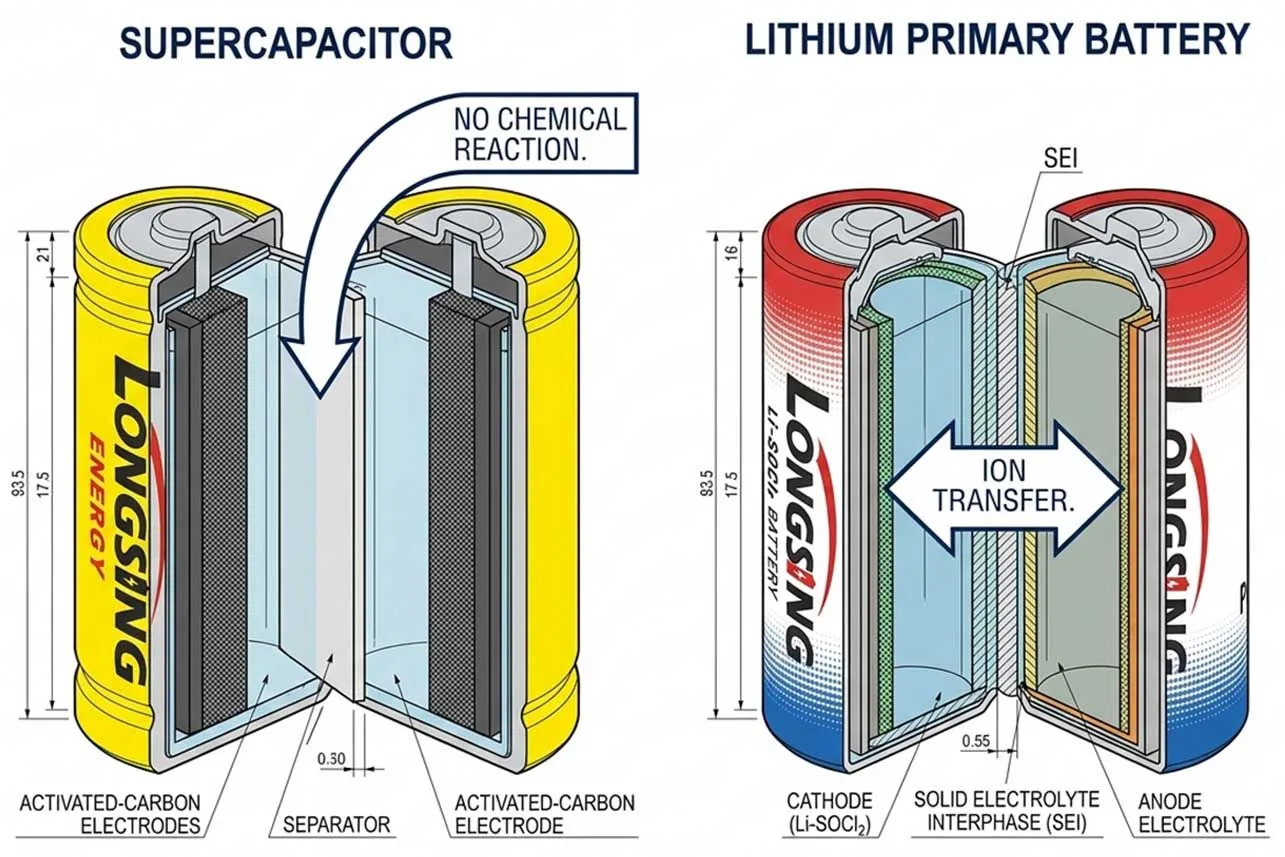
Supercapacitors achieve a superior safety profile through electrostatic energy storage—no chemical reactions occur during charging or discharging.
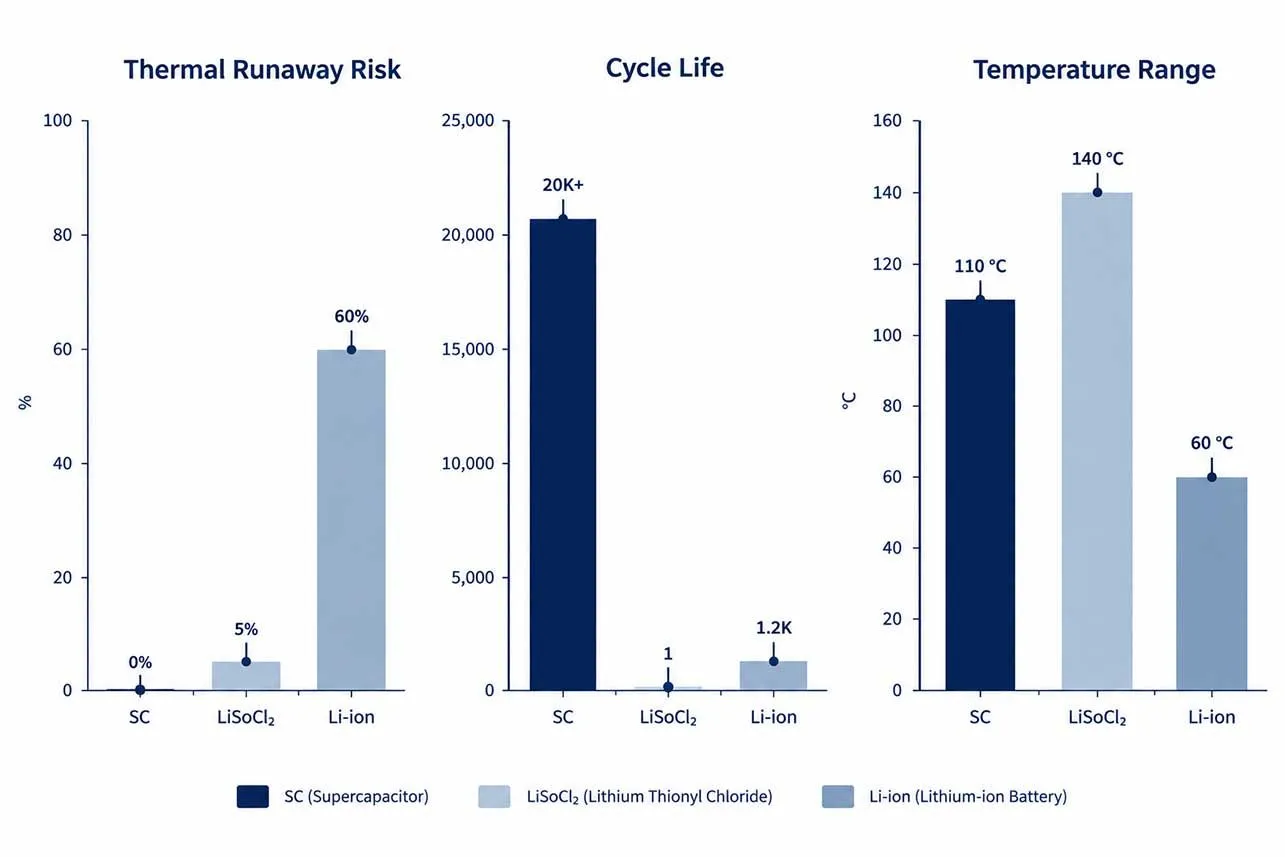
With stable electrolytes and no lithium plating or solid electrolyte interphase (SEI) formation, the failure modes that plague batteries simply do not exist in supercapacitor technology.
Electrostatic vs. Electrochemical Storage Mechanisms
The core difference lies in how energy is stored and released. Batteries rely on reversible chemical reactions—lithium ions shuttle between electrodes through an electrolyte, forming and dissolving an SEI layer. Under abuse conditions such as overcharging, short-circuiting, or physical damage, these reactions can become exothermic and self-sustaining, triggering thermal runaway.
Supercapacitors store energy in an electric field between two electrodes separated by a thin dielectric. There is no phase change, no lithium plating, and no gas generation during normal operation. Key safety outcomes include:
- No thermal runaway risk from internal short circuits
- No toxic gas emission during failure events
- No electrolyte decomposition under moderate overvoltage
- Consistent performance across millions of charge–discharge cycles
How Do Safety Metrics Compare Across Technologies?
| Safety Parameter | Supercapacitor | LiSoCl₂ Primary Battery | Lithium-ion Battery |
|---|---|---|---|
| Thermal Runaway Risk | None | Very Low | Moderate–High |
| Cycle Life (to 80% capacity) | 20,000+ cycles | Single use | 500–2,000 cycles |
| Operating Temperature Range | −40 °C to +70 °C | −55 °C to +85 °C | 0 °C to +60 °C |
| Overcharge Tolerance | Very High | Moderate | Low |
| Failure Toxicity | None | HCl gas (possible) | HF gas (possible) |
At Long Sing Technology, a 2022 R&D 100 Award winner, we have encountered specific safety-related challenges in our hybrid pulse capacitor (HPC) product line.
One issue involved cell voltage imbalance in multi-cell supercapacitor stacks—individual cells could exceed rated voltage under uneven aging, creating localized stress. Our engineering team, led by Wilson Lu, resolved this through active balancing circuits and rigorous incoming-cell screening protocols that ensure each cell operates within its safe voltage window.
A second challenge involved electrolyte migration under extreme humidity, addressed through improved potting compounds and enhanced seal designs validated at our manufacturing facility.
2. When Can a Supercapacitor Be the Safer Choice?
A supercapacitor becomes the safer and superior choice when the application demands high power bursts, rapid cycling, extreme temperatures, or zero tolerance for chemical failure—scenarios where battery degradation introduces unacceptable operational risk.
Extreme Environments and High-Cycle Industrial Applications
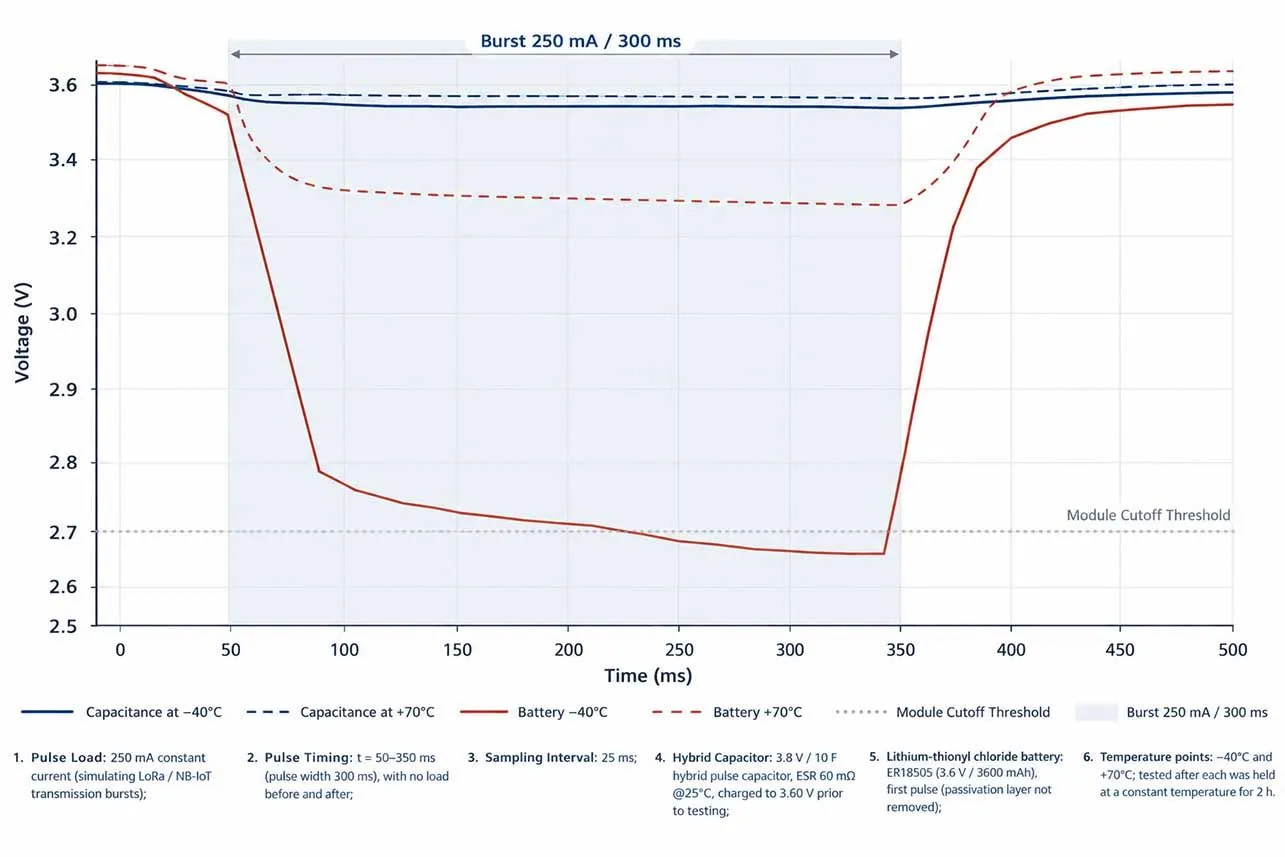
In industrial and utility metering, equipment often operates in uncontrolled outdoor environments with wide temperature swings. A supercapacitor tolerates −40 °C to +70 °C without significant capacity loss, while many battery chemistries lose 30–50 % of capacity below freezing or degrade rapidly at high heat.
Key scenarios where supercapacitors provide the safest solution include:
- Smart utility meters requiring daily pulse transmission across millions of cycles—the HPC1550 hybrid pulse capacitor delivers reliable pulses for 15+ years without replacement
- Safety and healthcare devices where a sudden battery failure could be life-threatening; supercapacitors provide dependable, fail-safe pulse power
- High-reliability backup power systems that must activate instantly without warm-up and carry no fire risk during extended standby
Which Applications Demand Intrinsic Safety?
| Application Scenario | Safety Priority | Recommended Technology | Key Advantage |
|---|---|---|---|
| Industrial smart meters | High cycle life, no fire risk | Hybrid supercapacitor | 15+ year pulse reliability |
| Medical / healthcare devices | Zero failure tolerance | Supercapacitor + primary battery | Instant response, no thermal risk |
| Hazardous zones (oil & gas) | No ignition source permitted | Supercapacitor only | Intrinsic safety certification |
| Extreme cold (−40 °C) | Reliable startup power | Supercapacitor | No capacity fade at low temperature |
| Safety-critical backup | Instant power, no fire risk | Supercapacitor bank | Sub-millisecond activation |
As a leading hybrid supercapacitor manufacturer, we engineer our HPC series specifically for these demanding conditions. The HPC1550 combines LiSoCl₂ chemistry with a hybrid pulse capacitor to deliver high pulse current alongside ultra-long shelf life, safely powering industrial meters in environments where conventional batteries would fail or pose ignition hazards.
3. When Is a Battery Still More Suitable?
Despite supercapacitor safety advantages, atteries remain essential for applications requiring sustained energy delivery over long durations, compact form factors, or high energy density—where safety can be managed through proper design, protection, and certification.
Long-Duration Energy and Energy Density Requirements
A supercapacitor’s energy density typically ranges from 5–10 Wh/kg, while a LiSoCl₂ primary battery can exceed 700 Wh/L. For remote sensors, GPS trackers, or industrial IoT nodes that must operate 10–15 years on a single cell.
Battery safety does not have to be compromised. Proper engineering mitigates inherent risks:
- Select stable chemistry: LiSoCl₂ batteries exhibit no thermal runaway at normal operating temperatures.
- Add protective circuits: Current-limiting resistors, fuses, and reverse-polarity protection prevent abuse scenarios.
- Integrate hybrid systems: Pair a battery with a supercapacitor to handle peak pulses while the battery provides steady base current.
How Do Hybrid Systems Bridge the Safety–Density Gap?
| Design Parameter | Battery Only | Hybrid (Battery + SC) | Supercapacitor Only |
|---|---|---|---|
| Energy Density | High (300–700 Wh/L) | Balanced (200–500 Wh/L) | Low (5–10 Wh/kg) |
| Pulse Power Delivery | Limited | Excellent | Excellent |
| Safety Level | Good (with protection) | Excellent | Excellent |
| Cost per Wh | Low | Moderate | High |
| Best Suited For | Sustained low-drain loads | Mixed pulse + steady load | Pure burst power |
At our factory, we also address a recurring practical challenge: customers over-specify battery safety while under-specifying power requirements.
In one case, a European utility meter manufacturer reported voltage droop during communication bursts with a battery-only configuration.Our team, with sales support from Luke Liu, proposed a custom HPC hybrid pack—a supercapacitor for pulse power paired with a LiSoCl₂ battery for base load—solving the voltage droop while maintaining the customer’s strict safety requirements. This hybrid approach demonstrates that safety and performance need not be mutually exclusive.
Frequent Asked Questions about Supercapacitor vs battery safety
(Click to Unfold)
Q: Is a supercapacitor better than a battery?
A: Supercapacitors are better than batteries for applications requiring very high power, rapid charge/discharge, and frequent cycling. Batteries generally provide higher energy density for long-duration power. For industrial applications, Long Sing Technology combines lithium batteries with Hybrid Pulse Capacitors (HPC) when both long service life and high pulse power are required.
Q: Can supercapacitors catch fire?
A: Supercapacitors have a different safety profile from lithium batteries and do not typically experience the same type of lithium-ion thermal runaway. However, excessive voltage, overheating, short circuits, or mechanical damage can still cause failure. Proper voltage control, current protection, cell balancing, and system design remain essential for safe operation.
Q: Do supercapacitors need a BMS?
A: Not every supercapacitor system requires a conventional battery management system (BMS), but protection and monitoring may still be necessary. Multi-cell supercapacitor modules can require voltage balancing, overvoltage protection, temperature monitoring, and current control. Hybrid systems combining lithium batteries and HPC capacitors may use dedicated battery and capacitor management circuits.
Q: Are supercapacitors safer for IoT devices?
A: Supercapacitors can offer safety advantages for IoT devices that require short, high-power pulses, frequent cycling, or rapid charging. They can complement a primary lithium battery rather than replace it. Long Sing Technology’s Hybrid Pulse Capacitor solutions help supply pulse power while reducing the stress placed on the primary battery in applications such as utility smart meters and industrial IoT.
Conclusion
Supercapacitors are inherently safer than batteries for high-power, high-cycle, and extreme-environment applications. Batteries remain essential for long-duration energy delivery. Hybrid designs—like our HPC series—combine both technologies to maximize safety, reliability, and performance across industrial metering, healthcare, and backup power.

2026 Procurement Outlook: Navigating Lead Times and Raw Material Trends in Lithium Coin Cell Battery
Coin cell battery market disruptions loom on the horizon as manufacturers face unprecedented raw mat

How to achieve 10 year battery smoke detector under Ultra-low self-Discharge and high reliability
A 10 year battery smoke detector is designed to lose only a minimal amount of energy over time, ensu
What is the difference between polymer and hybrid capacitors: ESR, Lifetime & ROI Guide
Power electronics engineers are losing warranty battles they should be winning. Boards fail, ESR cli