

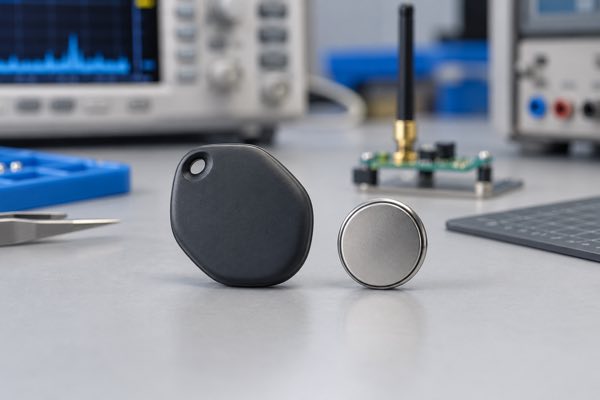
Bluetooth Tracker Battery: How to Choose the Right CR2032
Bluetooth trackers are becoming smaller and more capable. Many compact models spend most of their time in deep sleep and wake only for short wireless, sensing or finding events. Actual service life therefore depends on the complete duty cycle rather than the battery format alone. [1]
That is the more important engineering lesson.
A compact tracker does not achieve a long service interval simply because a CR2032 contains enough nominal mAh. Its battery must spend long periods supporting an ultra-low-power system while still maintaining sufficient voltage whenever the MCU, radio, buzzer, sensors or precision-finding circuitry wake up.
A Bluetooth tracker battery must provide enough total energy for a long service interval while maintaining sufficient loaded voltage during every wireless or finding event.
Featured Snippet: What Battery Is Used in a Bluetooth Tracker?
Many compact Bluetooth trackers use primary lithium coin cells such as CR2032 because the format provides a compact 3 V-class power source with long storage characteristics for low-power electronics. However, CR2032 is not suitable for every tracker. Battery selection depends on sleep current, BLE activity, pulse load, internal resistance, system cutoff voltage, temperature, available space and the required service interval.
Table of Contents
1. How Does a Bluetooth Tracker Actually Use Battery Power?
A Bluetooth tracker normally does not draw one constant current throughout its life.
Instead, its battery sees a duty-cycled load profile. Long low-power periods are interrupted by short active events involving processing, radio communication or finding functions.
A simplified sequence may look like:
Low-Power State
→ MCU Wake-Up
→ Sensor Processing
→ Bluetooth LE Activity
→ Finding / Alert Function Where Applicable
→ Return to Low-Power State
The exact sequence depends on the product.
Most of the Duty Cycle May Be Spent at Low Power
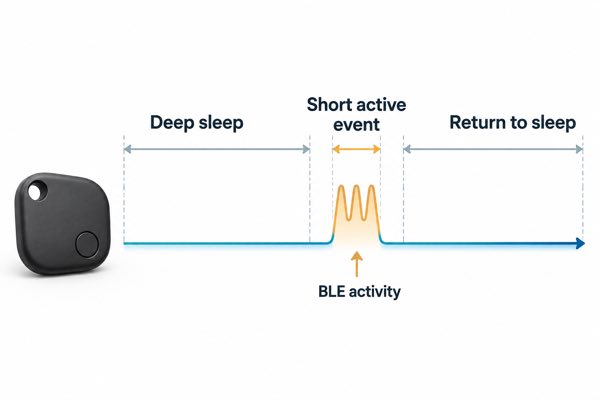
Long tracker runtime usually depends on keeping the electronics inactive for as much time as the application permits.
That may involve:
- MCU sleep modes
- low-power sensor states
- infrequent wake-ups
- short processing windows
- minimal radio-on time
- low quiescent current in always-on circuitry
The key point is:
Low average current is achieved by minimizing active time—not because every tracker function inherently operates at ultra-low current.
That distinction becomes important when selecting a coin cell.
BLE Advertising and Connection Events Create Short Active Loads
Bluetooth Low Energy is designed for energy-efficient communication, but BLE power consumption is not one fixed number.
The Bluetooth SIG explains that connected peripherals wake at defined connection intervals, while Peripheral Latency can allow them to skip some connection events and remain asleep longer. [2]
Advertising behavior also matters. Longer advertising intervals generally reduce average energy use, while shorter intervals improve discoverability at the cost of more frequent radio activity. Connection interval, TX power, PHY, packet size and data-transfer behavior can also affect total consumption. [3]
For a tracker OEM, important inputs can therefore include:
- Advertising interval
- Connection interval
- TX power
- Data payload
- Connection duration
- Synchronization frequency
- Number of wake-up events
This produces a practical firmware trade-off:
Battery Life ↔ Discoverability / Responsiveness
Advertising more frequently can help a tracker be detected sooner, but it also increases cumulative radio energy.
Sensors, Buzzer, LED and UWB Can Change the Load Profile
A smart tracker may contain more than a BLE radio.
Depending on the product, additional loads can include:
- Accelerometer or movement sensor
- Buzzer or speaker
- LED
- NFC-related circuitry
- Ultra-wideband circuitry
- Other sensing or user-interface functions
Not every tracker contains all of these features.
Where precision finding is supported, a tracker may combine Bluetooth-based discovery with ultra-wideband (UWB). This creates multiple wireless operating modes that must be included in the system power profile. [7]
A UWB transceiver is a separate active radio subsystem, so its active current, event duration and simultaneous loads should be evaluated separately from BLE background operation.
The battery engineer therefore needs to know the maximum simultaneous load, not just the individual current consumption of isolated components.
Why Average Current Alone Can Hide the Real Battery Requirement
Consider two questions:
Question 1:
Does the battery contain enough total energy to support the expected service interval?
Question 2:
Can the battery maintain enough voltage during the highest active load?
They are related, but they are not the same.
A tracker can have an extremely low average current yet still place meaningful short-duration demands on a coin cell.
That leads to the real design framework:
Long-Term Energy + Loaded-Voltage Performance
2. What Really Determines Bluetooth Tracker Battery Life?
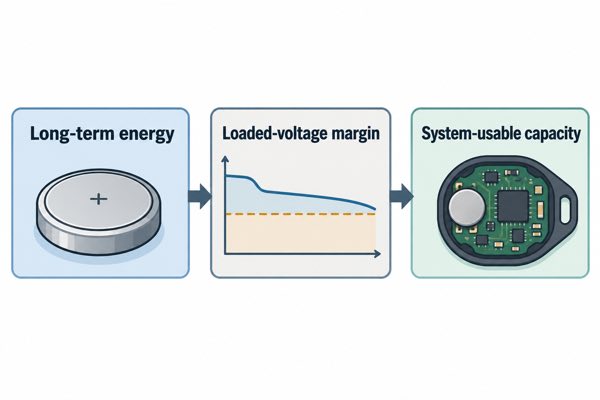
Tracker battery life should not be reduced to:
Battery Capacity ÷ Average Current
That formula can be useful as an initial energy estimate, but actual usable service life also depends on pulse behavior, internal resistance, self-discharge, temperature, system cutoff voltage and the battery’s real discharge conditions.
| Layer | Main Question | Key Factors | Typical Failure Mode |
|---|---|---|---|
| Long-Term Energy | Is there enough stored energy for the required service interval? | Sleep current, BLE event energy, sensors, buzzer/LED, UWB where applicable, event frequency, self-discharge | Battery energy is consumed earlier than expected |
| Loaded-Voltage Margin | Can the battery maintain sufficient voltage during active events? | Peak current, pulse duration, internal resistance, contact resistance, temperature, state of discharge | Device browns out or a wireless/finding event fails |
| System-Usable Capacity | How much nominal capacity can the electronics actually use? | Minimum system voltage, real load, temperature, aging, pulse behavior | Energy remains in the cell, but voltage falls below the device requirement |
Nominal Capacity Is Not the Same as Usable Capacity
A CR2032’s rated mAh value is measured under defined test conditions.
Nominal capacity is measured under defined laboratory conditions that specify load, temperature and endpoint voltage. [5]
The capacity-test endpoint can be lower than a real tracker’s minimum operating voltage, so the full datasheet rating may not be usable by the system. [6]
That matters because a real tracker may stop operating at a voltage higher than the datasheet capacity-test endpoint.
Therefore:
Nominal capacity is a battery datasheet value; system-usable capacity is an application result.
If the electronics need more voltage than the battery can maintain near the end of discharge, part of the nominal capacity may never become usable in that tracker.
Internal Resistance Turns Current Pulses Into Voltage Drop
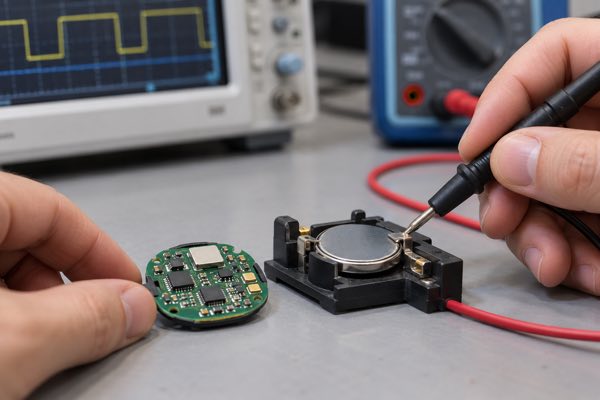
A useful first-order approximation is:
ΔV ≈ I × R
or:
Vload ≈ VOC − I × Rtotal
where:
- VOC = battery open-circuit voltage
- I = load current
- Rtotal = effective resistance through the cell and electrical path
This is useful for understanding the problem, but a real coin cell is not a fixed resistor.
Peer-reviewed research on lithium coin cells used in wireless sensing systems shows that pulse discharge produces both rapid voltage losses associated with ohmic and interfacial effects and slower electrochemical changes during the pulse. The cell also exhibits recovery after the pulse ends. [4]
So actual pulse performance depends on more than a single internal-resistance number.
Relevant variables can include:
- Pulse amplitude
- Pulse duration
- State of discharge
- Temperature
- Rest time between pulses
- Cell construction
- Storage history
A Tracker Can Reach Electrical End of Life Before the Cell Is Empty
Suppose a tracker requires at least a certain system voltage.
During a high-current event:
Vloaded falls
If:
Vloaded < Vsystem,min
the tracker may experience:
- MCU brownout
- BLE transmission failure
- failed precision-finding operation
- buzzer degradation
- device reset
- premature low-battery indication
even though chemical energy remains inside the coin cell.
This produces one of the most important conclusions in tracker battery design:
A battery can still contain stored energy after the tracker has already reached its electrical end of life.
This is why OEMs should evaluate usable energy above the real minimum system voltage, not only nominal mAh.
Battery Contacts Also Affect Loaded Voltage
For a replaceable CR2032 design, the electrical path includes more than the cell itself:
Coin Cell
→ Cell Terminals
→ Holder / Spring Contacts
→ PCB
→ Power Circuit
→ MCU / Radio
Contact resistance can therefore reduce voltage margin during short active events.
Holder design should consider:
- Contact force
- Contact material
- Mechanical tolerance
- Surface contamination
- Vibration
- Assembly consistency
For that reason, pulse qualification should ideally use the real holder and enclosure rather than only a laboratory connection to a bare cell.
Self-Discharge Matters in Ultra-Low-Power Devices
Self-discharge becomes more relevant as the device’s own average current becomes smaller.
Published self-discharge figures vary with cell construction, storage temperature, test method and manufacturer, so a single percentage should not be generalized across all CR2032 cells. [6]
The engineering lesson is broader:
For a tracker designed to operate for a very long service interval, calendar loss can become a meaningful part of the battery budget.
A more complete lifetime model should consider:
Application Consumption
- Self-Discharge / Calendar Loss
- Capacity Unavailable Below System Cutoff
- Design Reserve
Temperature Affects Both Energy and Pulse Margin
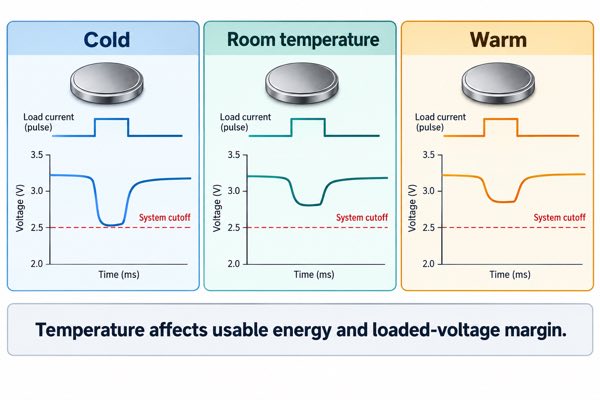
CR coin-cell datasheets provide temperature-dependent discharge curves because performance changes with temperature and load.
CR coin-cell discharge behavior and usable capacity change with both temperature and load conditions. [6]
At lower temperature, the same active load may produce less favorable voltage behavior and reduce the amount of energy practically available above the tracker’s cutoff voltage.
At higher temperatures, short-term electrical behavior and long-term storage behavior must both be considered.
Therefore:
Temperature is both a lifetime variable and a loaded-voltage variable.
A tracker expected to operate in luggage, vehicles, outdoor equipment or other variable environments should be validated under its actual temperature profile.
Firmware and Reporting Strategy Affect Battery Life
Battery selection and firmware optimization should not be treated as separate projects.
The Bluetooth configuration can directly alter cumulative radio energy.
BLE power optimization depends on advertising interval, connection interval, Peripheral Latency, TX power, PHY and packet behavior. [3]
That means reducing unnecessary:
- wake-ups
- advertisements
- synchronization events
- radio-on time
- excessive transmission power
can extend the service interval without physically increasing battery size.
3. Why CR2032 and Li-MnO₂ Coin Cells Fit Compact Trackers
CR2032 is a common battery format for compact low-power electronics because it combines a small physical package with a primary lithium manganese dioxide chemistry and a nominal voltage around 3 V.
It is a relevant design option for Bluetooth tags—but it should not be treated as the default answer for every tracker.
Why Li-MnO₂ Is Relevant to Compact Low-Power Trackers
CR-series coin cells commonly use lithium manganese dioxide (Li-MnO₂) chemistry.
In this chemistry, lithium is paired with manganese dioxide to provide a primary 3 V-class coin-cell system used in compact low-power electronics. [5]
For tracker design, Li-MnO₂ can offer a useful combination of:
- Primary, non-rechargeable operation
- Compact coin-cell formats
- Approximately 3 V nominal architecture
- Low self-discharge characteristics
- Long-duration low-load operation
- Replaceability in suitable mechanical designs
These characteristics make the chemistry relevant to trackers that do not require an integrated rechargeable charging system.
But:
Li-MnO₂ chemistry alone does not prove that a specific coin cell is suitable for a specific tracker.
The real load waveform still has to be validated.
Why CR2032 Is Common
The CR2032 format provides a useful compromise among:
- Diameter
- Thickness
- Weight
- Energy
- Availability
- Replaceable holder design
LONGSING currently publishes the following values for its Website A CR2032:
- Chemistry: Li-MnO₂
- Nominal voltage: 3.0 V
- Nominal capacity: 220 mAh
- Published size: 20.0 × 3.2 mm
- Weight: 3.0 g
- Maximum continuous current: 5 mA
- Maximum pulse capability: Typical up to 15 mA
- Published operating temperature: −20°C to +60°C. [8]
These are current LONGSING product-page values.
They should not be interpreted as proof that the battery will provide a specific tracker lifetime or support every BLE/UWB waveform.
The pulse value, in particular, should always be considered together with the application’s actual pulse duration, repetition, temperature and minimum voltage requirement.
CR2032 vs CR2450 for Bluetooth Tracker Design
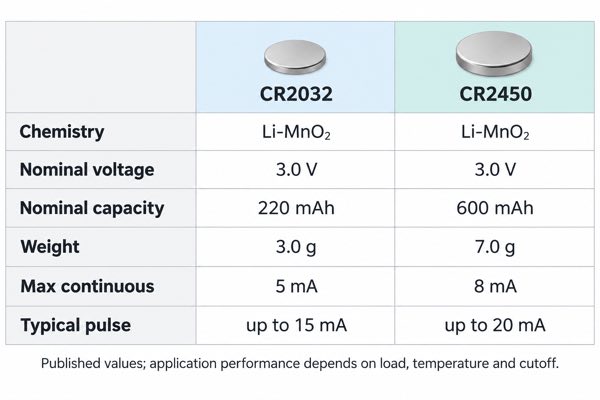
| Design Factor | LONGSING CR2032 | LONGSING CR2450 | Why It Matters |
|---|---|---|---|
| Chemistry | Li-MnO₂ | Li-MnO₂ | Both are primary lithium coin-cell candidates |
| Nominal voltage | 3.0 V | 3.0 V | Must match tracker electrical architecture |
| Published nominal capacity | 220 mAh | 600 mAh | CR2450 provides a larger nominal energy budget |
| Published weight | 3.0 g | 7.0 g | Battery choice changes tracker mass |
| Published max continuous current | 5 mA | 8 mA | Actual operating waveform still requires validation |
| Published pulse capability | Typical up to 15 mA | Typical up to 20 mA | Headline current alone does not prove tracker compatibility |
| Physical envelope | Smaller / thinner format | Larger / thicker format | Enclosure and PCB layout may determine feasibility |
| Design question | Is compactness sufficient for the required service interval? | Is the additional energy worth the larger package and weight? | Larger is not automatically better |
LONGSING currently publishes the electrical values above for both products. [8]
For general format context, standard CR2450 cells are approximately 24.5 mm in diameter and 5.0 mm high, while CR2032 cells are approximately 20.0 × 3.2 mm. These are standard format dimensions and should be checked against the selected cell’s current technical data. [6]
Larger Capacity Does Not Automatically Mean Better Tracker Design
A larger coin cell can provide more stored energy, but the additional energy is not free.
Moving from a CR2032-class format toward CR2450 may require:
- More PCB area
- Greater enclosure diameter
- Greater thickness
- More battery mass
- A different holder
- Different mechanical retention
So the correct question is not:
Which coin cell has the highest capacity?
It is:
Which coin-cell format provides enough system-usable energy and voltage margin within the tracker’s mechanical envelope?
CR2450 may be justified when the additional energy or load margin is valuable enough to justify the larger package.
CR2032 may be preferable where compactness and lower mass dominate.
Neither is universally better.
Replaceable Coin Cell vs Sealed Architecture
Battery selection also affects the product architecture.
Replaceable Coin Cell
Potential advantages:
- User-replaceable energy source
- Product life can extend beyond one battery
- No rechargeable charging circuit is required
Engineering trade-offs:
- Battery door
- Coin-cell holder
- Contact resistance
- User-access design
- Mechanical tolerance
- Sealing complexity
Sealed / Integrated Battery Architecture
Potential advantages:
- Different industrial-design possibilities
- No user-access battery door
Trade-offs:
- Battery replacement becomes more difficult or impossible
- Product lifecycle strategy changes
- Service and disposal strategy must be considered
There is no universal winner.
The correct architecture depends on the tracker size, required environmental protection, expected service model and product lifecycle.
4. What Should Tracker OEMs Specify Before Selecting a Battery?
A battery RFQ should describe the real tracker workload—not only the requested battery model.
For example:
“We need a CR2032 for a Bluetooth tracker.”
is not yet enough information to confirm suitability.
Electrical Requirements
Provide:
- Nominal operating voltage
- Minimum system voltage
- MCU / radio voltage requirements
- Sleep current
- Peak current
- Pulse duration
- Simultaneous maximum load
- Low-battery threshold
- Power-conversion architecture
The minimum system voltage is especially important because it determines how much of the battery’s nominal capacity can actually be used.
Bluetooth and Wireless Requirements
Provide:
- Wireless protocol
- Advertising interval
- Connection interval
- TX power
- Typical connection duration
- Reporting / synchronization interval
- Payload behavior
- Precision-finding requirement
- UWB usage, if applicable
The supplier does not need a full Bluetooth software specification, but it does need a realistic current-versus-time profile.
Peripheral Loads
Include:
- Accelerometer
- Other sensors
- Buzzer
- Speaker
- LED
- UWB
- NFC-related active circuitry where applicable
- Other user-interface functions
Most importantly:
Provide the actual operating sequence, not only isolated component datasheets.
If the radio, buzzer and MCU can operate together, that combined condition may be the real worst-case battery event.
Lifetime and Environmental Requirements
Define:
- Target service interval
- Typical daily use
- Expected number of finding events
- Storage period before deployment
- Minimum operating temperature
- Maximum operating temperature
- Typical temperature profile
- End-of-life minimum voltage
- Required reserve
This allows energy consumption, calendar loss and loaded-voltage behavior to be evaluated together.
Mechanical Requirements
Provide:
- Maximum coin-cell diameter
- Maximum thickness
- Battery mass limit
- Holder type
- Contact architecture
- Battery-door design
- Enclosure requirements
- Water / dust sealing requirements
- Replacement strategy
For replaceable trackers, the holder and contacts should be treated as part of the battery system because they contribute to the total electrical path.
Bluetooth Tracker Battery RFQ Checklist
| OEM Input | Why It Matters |
|---|---|
| Minimum system voltage | Defines how much nominal battery capacity is actually usable |
| Sleep current | Drives long-term background energy consumption |
| BLE advertising interval | Changes cumulative RF energy |
| Connection / synchronization behavior | Determines radio active time |
| Peak current | Defines loaded-voltage requirement |
| Pulse duration | Determines severity of voltage drop |
| UWB requirement | May introduce a different active-load profile |
| Buzzer / LED load | May create short simultaneous peaks |
| Target service interval | Defines total energy requirement |
| Operating temperature | Affects voltage behavior and usable capacity |
| Available battery size | Determines feasible coin-cell format |
| Battery holder / contacts | Adds resistance to the current path |
| Replacement strategy | Influences mechanical and enclosure design |
| Storage before use | Makes calendar loss and self-discharge relevant |
Where LONGSING Fits
LONGSING Website A currently provides a Li-MnO₂ primary-lithium product family that includes CR-series coin cells such as CR2032 and CR2450. The Li-MnO₂ category is positioned around 3 V primary battery applications including Bluetooth devices, IoT sensors and tracking devices.
For Bluetooth tracker development, these products should be treated as candidate primary-battery options, not predetermined tracker solutions.
A practical selection process is:
Define Minimum System Voltage
↓
Measure Sleep Current
↓
Measure BLE / Sensor / Finding Events
↓
Build the Long-Term Energy Budget
↓
Define Peak Current + Pulse Duration
↓
Select Candidate Coin-Cell Format
↓
Validate Loaded Voltage in the Real Holder
↓
Repeat at Temperature
↓
Repeat Near End of Service Life
↓
Finalize CR2032 / CR2450 / Other CR Format
The correct Bluetooth tracker battery is the cell that meets both the long-term energy requirement and the worst-case loaded-voltage requirement within the available mechanical envelope.
Conclusion
A Bluetooth tracker battery should not be selected from nominal mAh alone.
Long service life depends on the interaction between deep-sleep consumption, BLE duty cycle, active finding events, self-discharge and the amount of battery energy that remains usable above the device’s minimum voltage.
CR2032 is a highly relevant Li-MnO₂ coin-cell option for compact trackers, but its actual suitability must be validated against the real pulse profile, temperature and mechanical design.
For tracker OEMs, energy budget and loaded-voltage margin should always be engineered together.
Developing a Bluetooth Tracker or Smart Tag?
For a meaningful primary-battery evaluation, provide:
- Operating voltage
- Minimum system voltage
- Sleep current
- BLE peak current
- Peak-current duration
- Advertising interval
- Connection / reporting interval
- Wireless protocol
- UWB requirement, if applicable
- Buzzer / LED load
- Sensor configuration
- Target service interval
- Operating-temperature profile
- Available battery diameter and thickness
- Battery-holder / contact design
- Replacement strategy
LONGSING can then evaluate relevant CR2032, CR2450 or other Li-MnO₂ primary-lithium options against the actual tracker load and mechanical requirements rather than selecting a battery from nominal capacity alone.
Frequently Asked Questions About Bluetooth Tracker Batteries
Click to explore more information about Bluetooth tracker batteries
1. What battery is used in a Bluetooth tracker?
Many compact Bluetooth trackers use primary lithium coin cells such as CR2032, but there is no universal tracker battery. The correct cell depends on the tracker’s voltage requirements, sleep current, BLE activity, pulse load, temperature, available space and target service interval.
2. Why do many smart trackers use CR2032 batteries?
CR2032 provides a compact Li-MnO₂ primary-lithium format with approximately 3 V nominal voltage and useful stored energy for many low-power electronic designs. It can also support replaceable-battery architectures. However, its actual suitability depends on the complete tracker power profile.
3. How long does a CR2032 last in a Bluetooth tracker?
There is no fixed service life that can be determined from the CR2032 format alone. Lifetime depends on sleep current, BLE advertising and connection behavior, sensor activity, buzzer or UWB usage, battery capacity, internal resistance, self-discharge, temperature and system cutoff voltage. Actual battery life also varies with usage, environment, replacement-battery characteristics and the complete device power profile. [1]
4. Does Bluetooth Low Energy use much battery power?
Bluetooth LE is designed for low-power communication, but actual energy consumption depends strongly on its configuration. Advertising interval, connection interval, Peripheral Latency, TX power, packet behavior and synchronization frequency all influence average energy use. [2][3]
5. How does internal resistance affect a CR2032 tracker battery?
Internal resistance contributes to voltage drop when current rises. During BLE, buzzer or other active events, the loaded voltage may fall below the electronics’ minimum requirement even when energy remains in the cell. Coin-cell pulse behavior is dynamic, so the real current waveform should be tested rather than relying only on a single resistance value. [4]
6. Is CR2450 better than CR2032 for a smart tracker?
Not necessarily. CR2450 can provide a larger nominal energy budget, but it is also physically larger and heavier. CR2032 may better fit compact products, while CR2450 may be justified where more energy is required and the enclosure can accommodate it. Both still require pulse and loaded-voltage validation.
7. Does UWB reduce smart-tracker battery life?
UWB can add additional radio activity and therefore change the tracker’s power profile, but the impact depends on how often and how long UWB is used. Not all Bluetooth trackers include UWB, and its energy impact should be modeled separately from BLE background operation.
8. What information should an OEM provide when selecting a Bluetooth tracker battery?
Provide the voltage window, minimum system voltage, sleep current, peak current, pulse duration, BLE advertising and connection behavior, UWB requirement, buzzer and sensor loads, expected service interval, temperature profile, battery-space limits and holder design. These inputs allow both energy capacity and loaded-voltage margin to be evaluated.
References
[1] Bluetooth SIG — Bluetooth Low Energy Primer. ↪
Supports the duty-cycled communication model used to explain why tracker service life depends on configuration and activity.
[2] Bluetooth SIG — Bluetooth LE Connection Intervals and Peripheral Latency. ↪
Supports low-power connection behavior and the ability of peripherals to remain asleep between required events.
[3] Bluetooth SIG — Bluetooth LE Advertising and Connection-Parameter Concepts. ↪
Supports the role of advertising interval, connection behavior, TX settings and packet activity in energy consumption.
[4] Journal of Power Sources — Lithium Coin-Cell Transient Response During Pulse Discharge. ↪
Supports the dynamic voltage response of lithium coin cells, including fast resistance-related loss, slower electrochemical effects and recovery.
[5] IEC 60086 Series — Primary-Battery Chemistry, Capacity and Test Terminology. ↪
Supports the distinction between nominal battery ratings and application-specific usable capacity.
[6] IEC 60086 Series — Coin-Cell Format, Temperature and Discharge-Test Context. ↪
Supports standardized format terminology and the need to interpret capacity, temperature and discharge data under defined conditions.
[7] FiRa Consortium — Discover Ultra-Wideband Technology. ↪
Supports the general explanation of UWB as a separate wireless subsystem where precision finding is applicable.
[8] LONGSING Website A — CR2032, CR2450 and Li-MnO₂ Product Information. ↪
Supports the LONGSING-specific nominal voltage, capacity, weight and published continuous/pulse-current values referenced in this article.
4 Proven Ways for Your Smart Parking Sensor Battery
Smart parking sensor battery guide covering Li-SOCl2, LoRaWAN and NB-IoT pulse loads, passivation, l
9 Reliable Ways to Size Your NB-IoT Water Meter Battery
An NB-IoT water meter battery may support years of very low-current operation, yet an NB-IoT communi

Total Cost of Ownership: How to calculate the TCO in battery
Total Cost of Ownership (TCO) in batteries is the full cost of having and using a battery over its e