


Reliable HPC1550 Pulse Power in the Vehicle Tracking World
A vehicle tracker may spend most of its life asleep, then wake to read sensors, acquire a GNSS position and transmit data through a cellular network. The standby load can be small, but the active load is a different electrical problem.
A battery may contain enough energy for the planned deployment and still allow the tracker to reset when the modem transmits. The reason is usually loaded-voltage performance, not simply a shortage of amp-hours.
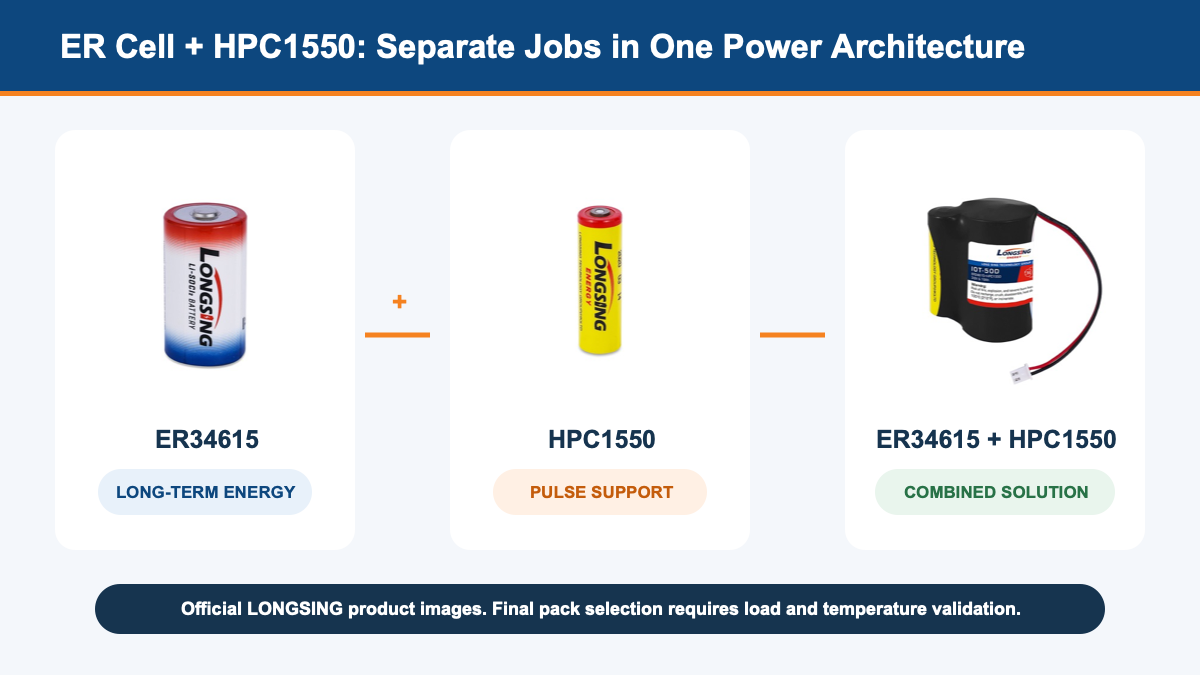
For long-life standalone trackers, a Li-SOCl2 ER cell can provide the energy reserve. When the measured pulse is too demanding for the selected ER cell alone, an HPC1550 Hybrid Pulse Capacitor can be evaluated as a separate pulse-support element.
Quick Answer
HPC1550 is not a Li-SOCl2 primary battery. In an ER + HPC power system, the ER cell supplies long-term energy while HPC1550 supports short high-current events. The need for this architecture depends on the real tracker waveform, minimum operating voltage, temperature, reporting interval and retry behavior.
Table of Contents
1. Why Vehicle Trackers Need Both Energy and Pulse Power
A tracker is not a constant-current load. A typical operating cycle is:
Sleep → Wake → Sensor Reading → GNSS Acquisition → Network Registration → Data Transmission → Sleep
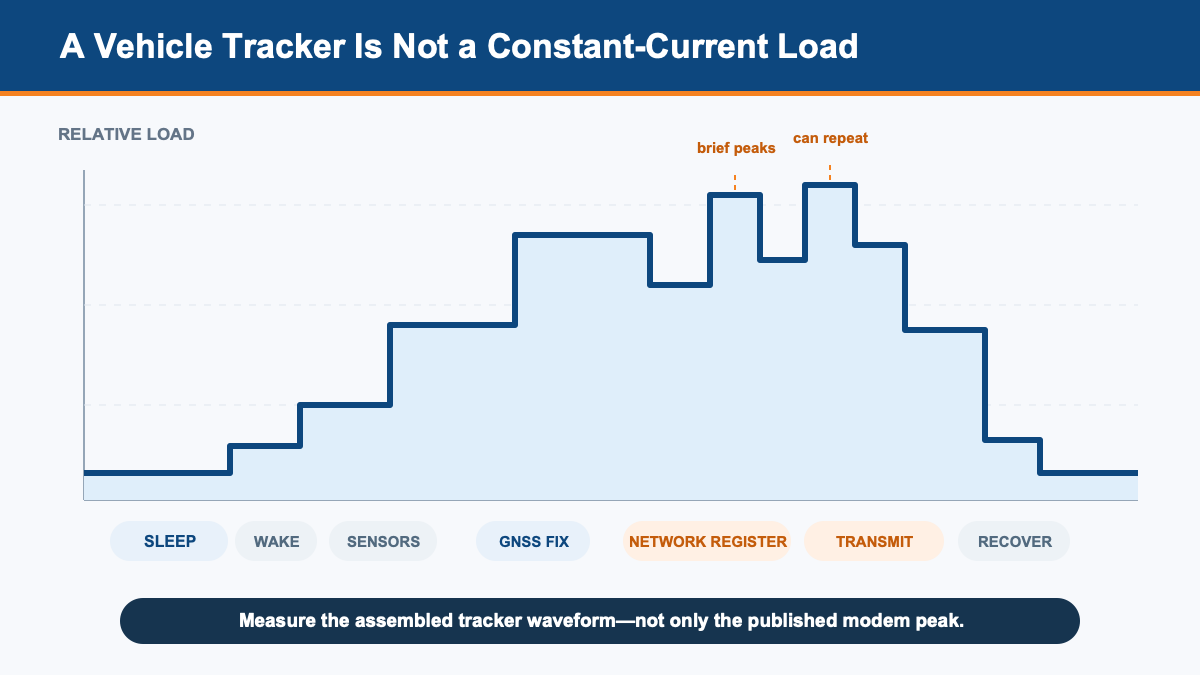
The device may remain in a low-power state for hours, then ask the battery to support GNSS and cellular activity within seconds. LTE-M and NB-IoT power-saving modes can reduce standby consumption, but active communication still requires substantially more current. [1]
Network conditions also matter. A clean laboratory report may be short, while weak coverage can extend registration, increase RF activity or trigger several retries. This changes both the energy consumed per report and the duration of the high-current load. [2]
Energy capacity and pulse power answer different questions
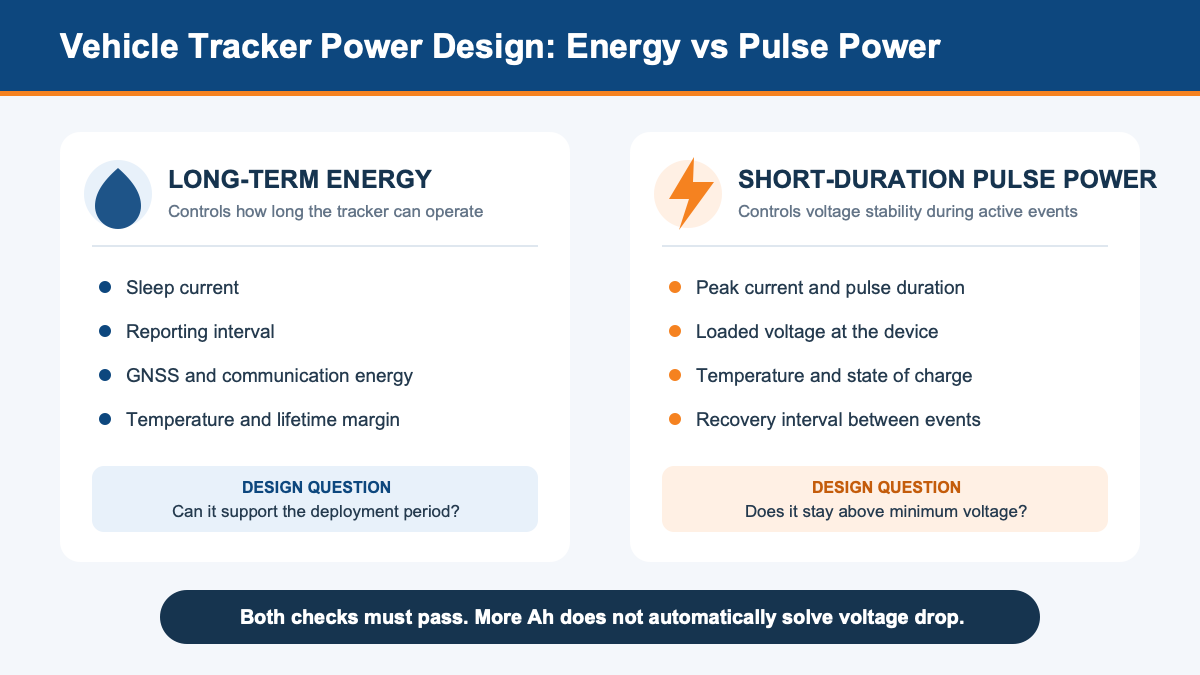
| Design Check | What It Determines | Main Inputs |
|---|---|---|
| Long-term energy | Whether the tracker can meet its deployment life | Sleep current, report frequency, GNSS time, retries, temperature and losses |
| Pulse power | Whether the tracker remains stable during active events | Peak current, duration, impedance, temperature and state of charge |
| Minimum voltage | Whether the MCU, modem or converter resets | Loaded voltage at the electronics, including wiring and PCB losses |
| Recovery time | Whether the system is ready for the next event | Reporting interval, repeated alarms and network retries |
A larger ER cell can add stored energy, but more amp-hours do not automatically guarantee acceptable voltage during a pulse. Current capability also depends on cell construction, impedance, temperature, storage history, passivation, pulse duration and recovery time. The useful approval test is the loaded-voltage waveform of the assembled tracker.
2. How Li-SOCl2 ER + HPC1550 Works
Bobbin-type Li-SOCl2 cells are well suited to long unattended operation at relatively low current. LONGSING options such as ER14505, ER18505, ER26500 and ER34615 provide different energy and size choices. The correct cell depends on the measured duty cycle and enclosure, not simply the application name.
Li-SOCl2 chemistry also develops a passivation layer during storage and prolonged low-current operation. This contributes to its storage characteristics, but it can produce an initial voltage delay under some conditions. Adding an HPC should not be described as eliminating passivation. Its practical role is to reduce the transient current demanded directly from the ER cell and support the system voltage during the active event.
| Component | Primary Role |
|---|---|
| Li-SOCl2 ER cell | Stores the energy required over months or years |
| HPC1550 | Supports short-duration high-current loads |
During sleep, the ER cell supplies the background load and allows the pulse-support element to recover. When the tracker wakes, HPC1550 can provide a larger share of the transient current.
Published HPC1550 data
| Parameter | Published Value |
|---|---|
| Maximum charging voltage | 4.1 V |
| Nominal charge / discharge current | 100 mA / 250 mA |
| Maximum continuous discharge current | 2000 mA |
| Maximum capacity | 450 mAh |
| Capacity at 3.67 V / 3.90 V | 175 mAh / 350 mAh |
| Discharge cutoff voltage | 2.5 V |
| Impedance | ≤60 mΩ |
| Published operating temperature | -40°C to +85°C |
| Maximum external dimensions | 14.6 × 50.5 mm |
These are product specifications, not a guarantee that every tracker with a load below 2 A will work. Starting voltage, pulse duration, consecutive events, recovery time, ER-cell behavior, wiring resistance and the electronics’ minimum voltage still have to be checked in the complete system. [3]
3. Vehicle and Logistics Tracking Applications
The same energy-versus-power problem appears across vehicle and logistics tracking, although the operating cycle is different in each product.
- Commercial vehicle trackers: long parking periods make sleep current important, while movement, tamper and theft alarms can add unscheduled reports.
- Trailer trackers: many trailers have no continuous electrical supply, so the battery must support long unattended periods followed by GNSS and cellular activity.
- Asset and cargo trackers: devices may sleep for days or weeks and wake only for scheduled or event-based location reports.
- Fleet terminals: extra sensors and more frequent reporting can increase both energy use and the number of pulse events.

T-Box and eCall applications should be described carefully. Some systems use vehicle power, a rechargeable backup battery, capacitors or a combination of sources. HPC1550 is relevant to the pulse-load problem, but ER + HPC is not a universal T-Box architecture.
Temperature and coverage can combine
A tracker may move between a warm warehouse, an outdoor yard and cold storage during one deployment. Low temperature changes voltage response and impedance, while weak coverage can keep the modem active longer or cause repeated transmissions. The worst credible validation case should combine these conditions rather than test them only at room temperature.

HPC1550, HLC1550 and other 1550-format products
The number “1550” does not define one universal technology or specification. Products described as HPC1550, HLC-1550, UPC1550 or SPC1550 may serve a similar pulse-support purpose, but voltage limits, impedance, available charge, temperature range, dimensions and test conditions can differ. A replacement should be compared by datasheet and then validated electrically and mechanically in the real tracker. [4]
4. Selecting and Validating the Power System
A reliable selection process starts with the tracker rather than a preferred battery size.
- Measure the complete waveform. Capture sleep, wake-up, GNSS acquisition, network registration, transmission, retries and shutdown. Record peak current, event duration, total energy and loaded voltage.
- Define the minimum acceptable voltage. Use the limit at the MCU, modem or converter after including connector, wiring, protection and PCB losses.
- Calculate lifetime energy. Include sleep, scheduled reports, alarms, retries, sensor operation, conversion losses, temperature and engineering margin.
- Select the ER cell and pulse-support element separately. The ER cell must supply usable lifetime energy; HPC1550, if required, must support the transient within its published limits and recover before the next event.
- Test the difficult conditions. Check temperature extremes, long storage or sleep, depleted-state behavior, weak signal and repeated alarms.
- Validate the production assembly. Test the intended pack, harness, connector, PCB, regulator, antenna, enclosure and firmware together.
pack interconnect and protection →
HPC1550 pulse-support node →
system power rail →
MCU + GNSS + cellular modem
Before selecting a 1550-format pulse solution, the design team should know the real pulse duration, minimum system voltage, time between events, number of possible retries, required temperature range and usable lifetime energy. If these inputs are unknown, choosing by a headline current rating is premature.
LONGSING publishes the HPC1550 component and assembled options such as ER34615 + HPC1550. These are starting points for evaluation, not substitutes for testing the finished device.
Frequently Asked Questions
Click to explore more information about HPC1550 vehicle tracker power systems
Is HPC1550 a Li-SOCl2 primary battery?
No. HPC1550 is a Hybrid Pulse Capacitor. The ER cell supplies long-term energy, while HPC1550 supports higher-current events.
Why can a GPS tracker need pulse support?
GNSS acquisition and cellular communication can require much more current than sleep. Pulse support may be useful when the selected ER cell cannot maintain the required voltage during those events.
Does every LTE-M or NB-IoT tracker need HPC1550?
No. The decision depends on the measured waveform, minimum voltage, selected ER cell, temperature, reporting interval and repeated-event behavior.
Can a larger ER cell solve the transmission-voltage problem?
It can add energy and may help in some designs, but more amp-hours do not automatically guarantee acceptable voltage during a pulse. Loaded-voltage testing is still required.
Is HLC1550 the same as HPC1550?
Not automatically. Compare technology, voltage limits, impedance, available charge, temperature range, dimensions and operating conditions before qualifying an alternative.
What information is needed for an ER + HPC1550 proposal?
Provide the sleep and active current waveform, pulse duration, report frequency, retries, minimum voltage, temperature range, service-life target, enclosure space and connector requirements.
Selecting the Power System From the Real Tracker Load
A reliable vehicle tracker battery is not simply the highest-capacity cell that fits the enclosure. The power system needs enough usable energy for the deployment and enough short-duration power to keep the electronics stable through GNSS and cellular activity.
For a long-life standalone tracker, a Li-SOCl2 ER cell can provide the energy reserve. When the measured waveform shows that the selected ER cell cannot maintain the required voltage by itself, HPC1550 can be evaluated as a separate pulse-support component.
If you are developing a vehicle tracker, trailer tracker or logistics monitoring device, LONGSING can review the current waveform, minimum voltage, reporting behavior and environmental requirements. You can also review the IoT battery pack range or contact LONGSING with the application details.
Match the Right Power System to Your Tracker
Share your load waveform, minimum voltage, temperature range and service-life target.
References
[1] Cellular IoT operating-state and power-saving reference. ↵
Supports the distinction between low-power standby and higher active communication current.
[2] Mobile IoT deployment guidance for PSM, eDRX and network behavior. ↵
Supports the discussion of how network conditions and retries affect tracker energy use.
[3] LONGSING HPC1550 product specification reference. ↵
Supports the published electrical values, temperature range and dimensions used above.
[4] 1550-format Hybrid Layer Capacitor manufacturer reference. ↵
Supports the statement that 1550-family names are not automatically interchangeable.
Taming the Millisecond AI Surge: How Hybrid Pulse Capacitors Solve AI Data Center Power Challenges
AI training clusters swing from idle to full GPU draw within a few milliseconds. That transient curr

Thermal Runaway Prevention: Why Factory-Level Testing is Non-Negotiable for Lithium Battery Safety?
Lithium battery safety begins long before a cell is integrated into a device; it is a critical bench
9 Reliable Ways to Size Your NB-IoT Water Meter Battery
An NB-IoT water meter battery may support years of very low-current operation, yet an NB-IoT communi