

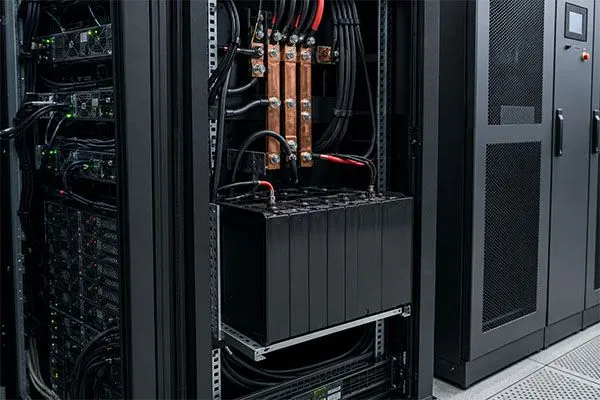
Taming the Millisecond AI Surge: How Hybrid Pulse Capacitors Solve AI Data Center Power Challenges
AI training clusters swing from idle to full GPU draw within a few milliseconds. That transient current spike sags rack voltage, trips protective circuits, and stresses backup batteries.
Left unmanaged, this AI pulse load threatens both server uptime and upstream grid stability. A hybrid pulse capacitor absorbs the surge instantly.
A hybrid pulse capacitor solves AI data center power challenges by combining a lithium-ion capacitor cell with fast switching electronics that absorb millisecond-scale GPU current spikes before the UPS or battery backup unit can react.
Installed between the server power supply and the load, it supplies the instantaneous peak current a battery struggles to deliver, limits voltage sag, and reduces high-current cycling stress on the BBU, improving overall AI server power reliability.
The following sections trace where these power spikes originate inside an AI data center, how a hybrid pulse capacitor fits into the backup chain, and how to select one correctly.
Table of Contents
- Why AI Data Centers Create Extreme Pulse Power Demands
- Where Hybrid Pulse Capacitors Fit in the Power Backup Systems?
- How Hybrid Pulse Capacitors Improve AI Server Stability?
- How to Select a Hybrid Pulse Capacitor for Data Center Power Systems?
1. Why AI Data Centers Create Extreme Pulse Power Demands
AI data centers face extreme pulse loads because GPU clusters[1] shift from idle to full compute power within milliseconds during synchronized training steps.
This AI pulse load can exceed steady-state draw by 200% or more in a fraction of a second, far faster than mechanical or electrochemical systems can respond, producing server cabinet voltage sag and, at scale, a measurable data center pulse on the upstream grid.
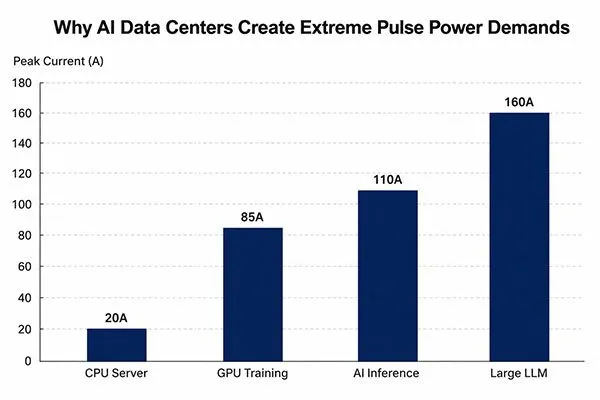
Modern AI data center racks pack dozens of GPUs that execute synchronized all-reduce operations[2] across a training job.
When thousands of processing cores transition together — from a memory-bound idle phase into a compute-bound burst — the combined switching rate can reach levels that legacy data center power consumption models never anticipated.
Traditional IT load was relatively flat and forecastable; AI server power draw is bursty, correlated across an entire rack, and repeats every few hundred milliseconds through a training run.
AI Pulse Load vs Traditional IT Load
| Characteristic | Traditional IT Load | AI Pulse Load |
|---|---|---|
| Rise time | Seconds to minutes | Sub-millisecond to a few milliseconds |
| Peak-to-average ratio | ~1.1–1.3x | Up to 2–3x |
| Synchronization | Largely independent servers | Correlated across a GPU cluster |
| Repetition | Rare, gradual | Repeats every training step |
Two consequences follow.
First, at the rack level, a fast voltage sag can trip undervoltage protection or force a GPU to throttle, causing a partial rack outage even though the facility UPS never lost power.
Second, at scale, hundreds of racks pulsing in near-synchrony reflect a jagged demand signal back through the PDU and switchgear toward the grid connection — a documented concern for utilities feeding large hpc infrastructure campuses.
The practical solution is to stop treating the surge as a UPS problem and instead absorb it as close to the GPU as possible.
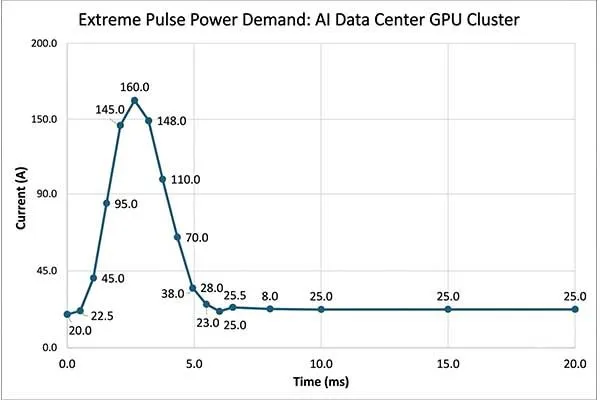
A locally placed hybrid pulse capacitor decouples the millisecond-scale spike from the facility power path entirely, so the disturbance never propagates upstream in the first place, rather than asking the grid or a larger UPS to chase a load event that has already resolved by the time it responds.
Every additional GPU generation raises the stakes for AI data center operators evaluating a high pulse capacitor strategy rather than relying on UPS capacity alone.
2. Where Hybrid Pulse Capacitors Fit in the Power Backup Systems?
A hybrid pulse capacitor sits at the last stage of the power chain in an AI data center, between the server BBU and the GPU load, downstream of the UPS and PDU.
Because it is physically adjacent to the load and reacts in microseconds, it buffers pulses that a centralized UPS — regardless of its rated capacity — is too far away and too slow to catch.
Understanding the Modern Data Center Power Architecture
A typical data center UPS chain runs Grid → UPS → PDU → Rack → BBU → GPU, with each stage adding distance and response latency.
The data center UPS and its batteries are sized for outage ride-through measured in minutes, not for millisecond transients[3]; even a supercapacitor UPS rated for the full rack load still sits behind meters of busbar and multiple protection stages, so its output impedance and control-loop delay[4] are simply too high to catch a sub-millisecond GPU pulse.
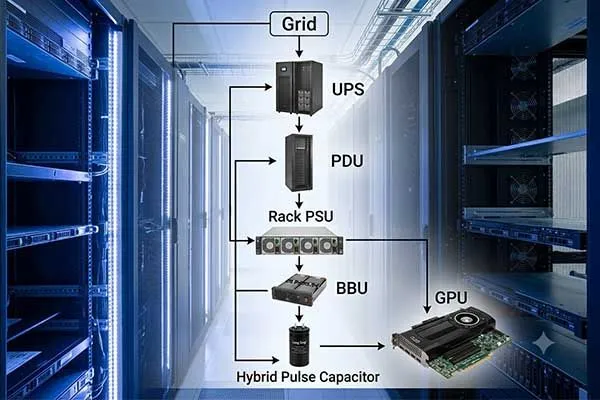
This is why a larger UPS does not solve a GPU power spike — capacity and speed are different design problems, and no amount of added capacity closes a physical distance and response-time gap measured in milliseconds.
Positioned last in this chain, the hybrid pulse capacitor closes that gap, delivering the hybrid supercapacitor pulse power a facility UPS cannot supply in time. It sits directly on or near the server board inside the server cabinet, downstream of the BBU battery, so the electrical path between capacitor and GPU is short enough that stray inductance[5] does not delay the response.
How Can AI Compute Power Fluctuations Be Managed to Prevent Rack Power Loss and Grid Disturbances?(click to see answer)
The most effective solution is a multi-layer power buffering architecture rather than relying on a single energy source: utility power, UPS systems, battery energy storage (BESS), and high-power supercapacitor modules.
In this architecture, supercapacitors absorb instantaneous power spikes lasting from milliseconds to several seconds, while lithium batteries handle longer-duration backup energy and generators gradually assume sustained loads during utility outages.
This layered approach allows each energy storage technology to operate within its optimal response window.
The same bank is sometimes described as a hybrid supercapacitor for BBU protection, a lithium-ion capacitor UPS stage, or a data center ride-through capacitor — different names for the same function inside power infrastructure equipment.
Its role is narrow but essential: absorb the pulse locally, hold the rail within spec for the few milliseconds the event lasts, then hand steady-state duty back to the battery and UPS once the transient has passed.
Many AI data center teams evaluate supercapacitor UPS solutions at the facility level and a hybrid pulse capacitor at the rack level as complementary layers, not competing options.
| Layer | Typical Response Time | Role |
|---|---|---|
| Grid / UPS | Seconds to minutes | Outage ride-through, steady-state supply |
| PDU / Rack Distribution | Not applicable (passive) | Power distribution, monitoring |
| BBU / Battery | Milliseconds to seconds | Backup energy reserve |
| Hybrid Pulse Capacitor | Microseconds | Instantaneous pulse buffering at the load |
3. How Hybrid Pulse Capacitors Improve AI Server Stability?
Hybrid pulse capacitors improve AI server stability by supplying peak current during load transients, keeping rail voltage above the undervoltage threshold, and diverting high-current pulses away from the lithium battery[6].
This reduces BBU cycling stress, extends battery service life, and prevents pulse-triggered server resets during sustained AI pulse load conditions in AI data center racks.
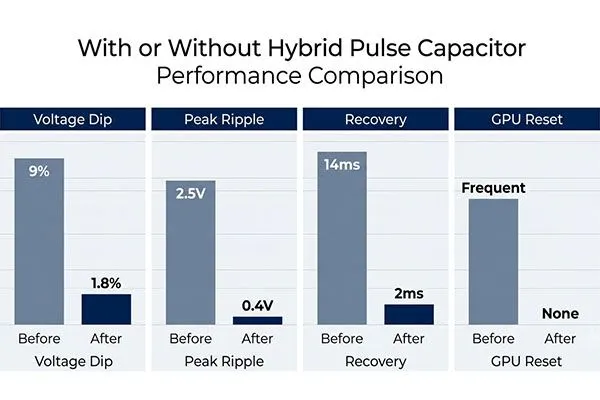
Stability improvement depends on how the hybrid pulse capacitor is switched into the circuit, and the honest answer is that a well-designed unit does not really "switch" at all.
A hybrid supercapacitor (HSC) module built with an integrated software-hardware controller stays continuously connected in parallel with the battery rail through a low-impedance current-sharing network. Firmware monitors rail voltage in real time; the moment it senses the onset of a voltage droop, the capacitor's low-ESR path is already conducting, so current sharing shifts toward the capacitor within microseconds rather than waiting for a discrete switchover event.
Tips
How Does an Integrated Hardware-Software Controller Achieve Near-Zero Interruption Switching?(click to see answer)
Near-zero interruption switching is achieved through continuous power monitoring, predictive control algorithms, and parallel energy path management, rather than by physically switching one power source completely off before another turns on.
Instead of sequential switching, the controller allows multiple power sources to operate simultaneously within predefined control limits.
Once the battery reaches its target power level, the controller gradually reduces supercapacitor discharge and restores its stored energy.
Because there is no relay or switch to actuate, there is no switching delay to hide — the transition looks smooth because, electrically, nothing is being switched.
This HSC architecture — sometimes specified as a lithium ion capacitor high power module — is designed to work with the battery, not instead of it. For an AI data center operator, this hybrid supercapacitor pulse power behavior is what keeps a GPU node online through a training-step transient that would otherwise trip protection.
This matters directly for database server power sag protection and any workload sensitive to millisecond-scale dips, since even a brief undervoltage event can trigger a GPU throttle or a controller reset.
It is worth stating plainly that this hybrid supercapacitor pulse power stage is not meant to replace the lithium battery — it is a combination architecture: the capacitor absorbs the fast, repetitive pulse, while the battery still carries the sustained backup duty during an actual outage.
Whether specified as a pulse discharge capacitor, a high pulse capacitor bank, or simply the pulse buffering stage in a broader supercapacitor UPS solutions design, the underlying engineering requirement stays the same: absorb extreme pulse loads at the source.
Hybrid Pulse Capacitor vs Supercapacitor vs Lithium Battery
| Attribute | Standalone Supercapacitor | Lithium Battery | Hybrid Pulse Capacitor |
|---|---|---|---|
| Response time | Microseconds | Milliseconds to seconds | Microseconds |
| Power density | Very high | Moderate | Very high |
| Energy density | Low | High | Moderate |
| Cycle life | 500,000+ cycles | 500–2,000 cycles | 500,000+ cycles |
| Best role | Short pulse buffering | Sustained backup energy | Pulse buffering + battery protection |
4. How to Select a Hybrid Pulse Capacitor for Data Center Power Systems?
Selecting a hybrid pulse capacitor for an AI data center power system means matching capacitance and voltage to the pulse energy required, sizing ESR to the peak current target, and derating lifetime against the operating temperature with an adequate safety margin.
Capacitance, voltage, ESR, peak current, lifetime, operating temperature, and safety margin should be evaluated together, not in isolation.
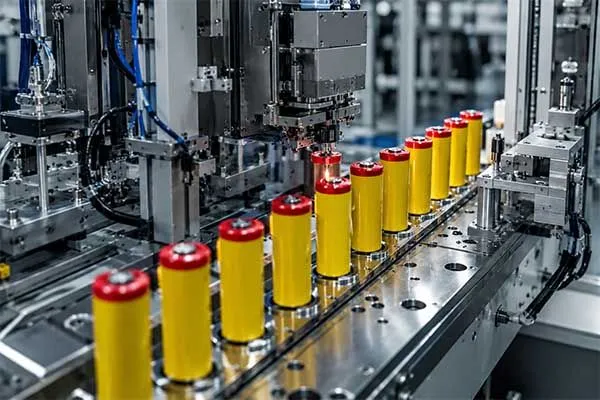
None of these seven parameters can be optimized alone for an AI server power design.
Capacitance sets how much energy the hybrid pulse capacitor can hold for a given pulse duration, while voltage rating must clear the rail with margin for ripple and tolerance stack-up.
Peak current capability, together with ESR, determines how much of that stored energy can actually be delivered in the available microseconds — but lower ESR is not automatically better. Pushing ESR down usually means fewer, thicker electrode layers or a larger cell format, which raises cost and size and can worsen current-sharing balance across a multi-cell bank; a moderately higher ESR that still meets the peak current target, runs cooler, and is better matched to the rest of the pack is often the more reliable engineering choice than the lowest ESR number on a datasheet.
Lifetime and operating temperature are linked: every roughly 10°C rise in operating temperature can meaningfully shorten service life for a given capacitor chemistry, so a unit rated for high temperature backup capacitor duty inside a hot server cabinet needs derated lifetime figures, not catalog figures measured at room temperature.
Finally, a safety margin on voltage, current, and temperature — typically 15–20% headroom — absorbs manufacturing tolerance, aging, and unexpected load growth over a multi-year deployment, supporting a genuinely long life server backup battery system rather than one sized only to the nominal case.
| Parameter | Design Consideration |
|---|---|
| Capacitance | Match to required pulse energy and duration |
| Voltage | Rail voltage[7] plus ripple and tolerance margin |
| ESR | Balance against peak current; lowest value is not always optimal |
| Peak Current | Confirm against actual GPU or PSU transient profile |
| Lifetime | Derate for temperature and duty cycle |
| Operating Temperature | Rate for worst-case server cabinet ambient |
| Safety Margin | 15–20% headroom on voltage, current, and temperature |
Whether the datasheet calls it a UPS capacitor, a capacitor UPS module, or simply a hybrid pulse capacitor, the same seven-parameter checklist applies. Teams sourcing a pulse discharge capacitor for hpc infrastructure, or evaluating supercapacitor UPS solutions and high pulse capacitor options for a new rack design, generally converge on this checklist.
None of this is theoretical: an AI data center rack seeing extreme pulse loads on every training step will expose an undersized capacitor within weeks, not years.
Long Sing's Hybrid Pulse Capacitor Manufacturing and Validation
Long Sing Technology's industrial power electronics background, built through more than a decade supplying critical power systems for utility metering and healthcare devices, now extends to data center power backup applications, and its pulse power work was recognized with an R&D 100 Award in 2022. The engineering team increasingly supports AI data center and broader hpc infrastructure customers who previously only needed a pulse discharge capacitor for grid-side power quality work.
A colocation data center operator in Texas, United States, experienced unexpectedly short service life from rack-mounted Battery Backup Units supporting AI inference servers. Although the lithium batteries were specified for more than eight years of operation, capacity degradation became noticeable after only 22 months.
Routine diagnostics showed no abnormal charging behavior or thermal runaway. However, battery impedance measurements revealed a continuous increase in internal resistance, especially in racks serving burst-intensive AI inference workloads.
Using a Chroma battery cycling platform combined with Electrochemical Impedance Spectroscopy (EIS), engineers identified that the batteries were repeatedly supplying thousands of short-duration current pulses every hour. These rapid micro-cycles accelerated lithium plating, electrolyte degradation, and heat accumulation despite the relatively low total energy throughput.
To reduce electrochemical stress, Long Sing Technology integrated a Hybrid Pulse Capacitor module in parallel with the BBU battery pack. The final specification supplied was a 2.7V 400F cell bank – six cells in series, ~65V rail, ESR of approximately 18 mΩ per cell, rated for a 150A peak pulse and a 10-year design life at 45°C ambient.
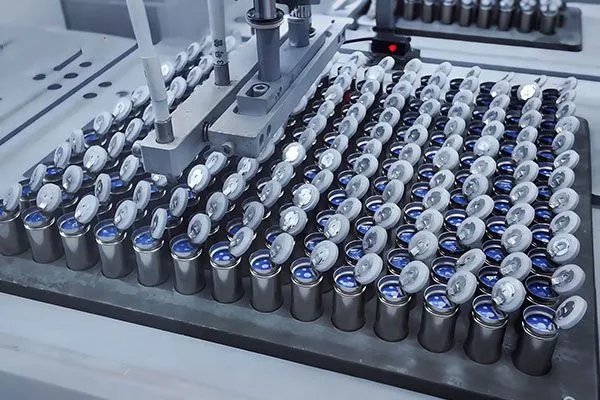
The capacitor assumed responsibility for sub-second current bursts while the lithium battery delivered only sustained backup energy.
After six months of field validation, battery operating temperature decreased from 42.8 °C to 35.6 °C, RMS discharge current fell by 65%, and impedance growth slowed by approximately 58% compared with the original configuration. Predictive life modeling indicated that expected battery service life increased from approximately 2.5 years to more than 7 years under identical workload conditions.
The same HSC platform underpins Long Sing Technology's server BBU capacitor backup and RAID controller cache protection capacitor products, offered as a supercapacitor for RAID cache protection, an HPE smart storage hybrid capacitor replacement.
A database backup power capacitor supporting database backup pulse power during unexpected sag events — a RAID capacitor must hold cache data long enough for a safe flush to disk, which is a data protection requirement with no tolerance for delay.
In every case, the design intent stays the same: this is a combination architecture, not a battery substitute — the hybrid pulse capacitor absorbs the fast pulse and protects the battery, while the battery still carries the sustained backup load.
Frequent Asked Questions about HPC AI Data Center
(Click to Unfold)
Q: What is a zero data loss recovery appliance?
A: A zero data loss recovery appliance protects critical workloads by continuously replicating data and enabling rapid recovery after power failures or hardware faults. Stable backup power, including hybrid pulse capacitor modules, helps maintain uninterrupted operation during millisecond power disturbances.
Q: What is an AI data center?
A: An AI data center is a facility optimized for GPU clusters, high-performance computing, and AI model training or inference. It requires high-density power, efficient cooling, and ultra-fast backup energy systems to handle sudden millisecond power demand spikes.
Q: What is uptime for data centres?
A: Uptime measures the percentage of time a data center remains operational without service interruption. AI facilities often target 99.99% to 99.999% availability through redundant power systems, UPS infrastructure, and fast-response energy storage technologies.
Q: What are the four types of data centers?
A: The four common data center types are enterprise, colocation, hyperscale, and edge data centers. Each has different power density and backup requirements, but AI workloads increasingly require fast pulse power support for stable operation.
Q: Can hybrid pulse capacitors replace UPS batteries?
A: Not completely. Hybrid pulse capacitors complement UPS batteries by supplying extremely high current during millisecond load surges. They reduce battery stress, improve voltage stability, and extend battery service life in AI data center backup systems.
Q: How do hybrid pulse capacitors reduce voltage sag?
A: Hybrid pulse capacitors instantly deliver high pulse current when GPU loads increase, minimizing voltage drop before batteries respond. Their low ESR and rapid charge-discharge capability improve power quality and reduce transient voltage sag.
Conclusion
AI training racks demand power that is bursty, synchronized, and too fast for a UPS or battery alone to buffer. A hybrid pulse capacitor, placed directly at the load, absorbs these millisecond pulses, protects the BBU from repetitive high-current cycling, and prevents both rack-level sag and upstream grid disturbance.
It is not a replacement for battery backup but a companion to it — the combination gives AI data center operators pulse-level protection and outage-level ride-through in a single, correctly matched power architecture.
Note:
[1]Discover how modern GPU clusters accelerate large-scale AI training workloads.↪
[2]Understand how all-reduce operations synchronize thousands of GPUs during AI training.↪
[4]Learn how control-loop delay affects high-speed power regulation.↪
[5]Understand how stray inductance slows transient current delivery in power circuits.↪
[6]Compare the differences between hybrid supercapacitor and lithium battery.↪
[7]Discover why stable rail voltage is essential for reliable AI server operation.↪
Keep reading about hybrid supercapcitor
- Hybrid Supercapacitors (HPC): The Ultimate Guide to Lithium-Ion Pulse Power Solutions
- Supercapacitor vs Battery: The Truth Engineers Need to Know
- Pulse Power: Why Does A Smart Meter Need Supercapacitor for Communication?
- The Synergy of Power Density VS Energy Density: Hybrid Battery Solutions Explained
- Hybrid Charge–Discharge Dynamics of Lithium Batteries + Supercapacitor Systems: A Technical Deep Dive
- Supercapacitors vs Ultracapacitors: Electrical Characteristics You Should Know
- How Does Leakage Current Impact Hybrid Supercapacitors and Li-SOCl₂ Batteries in Low-Power Devices?
- 10 Real-World Hybrid Supercapacitor Products and Use Cases in 2026
- What is the difference between polymer and hybrid capacitors: ESR, Lifetime & ROI Guide

What is the difference between industrial batteries and regular batteries?
Industrial batteries and regular batteries differ mainly in their construction, capacity, and intend

CR123A, CR17450, and CR14505 The Ultimate CR Li-MnO2 Cylindrical Battery Comparison
Your industrial meter just failed in the field. The replacement costs are mounting. You need a batte

LoRa Battery Life: Power Consumption Analysis of Wireless SHM Protocols
LoRa’s exceptionally long battery life — often 10+ years — comes from its ultra-low power