

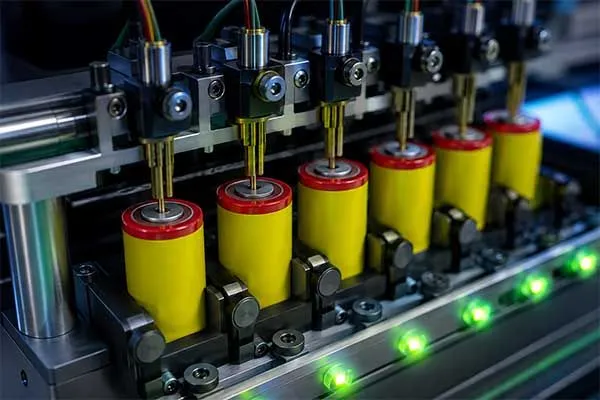
How Lithium Ion Capacitors Bridge the Gap Between Batteries and EDLCs
Struggling with power backups that either drain too fast or lack burst energy?
Standard batteries degrade under high pulses, while supercapacitors drain rapidly. Fortunately, lithium ion capacitors offer the perfect hybrid solution, delivering both high energy retention and massive power bursts seamlessly.
Lithium ion capacitors bridge the gap by combining the high energy density of lithium-ion batteries with the rapid charge and discharge power of electric double-layer capacitors.
They utilize a pre-lithiated carbon anode and a supercapacitor cathode, ensuring fast energy bursts, extended cycle life, and lower self-discharge rates. This makes lithium ion capacitors ideal for industrial applications requiring reliable backup power.
Let us delve deeply into how these advanced energy storage devices operate and why lithium ion capacitors might be the exact upgrade your demanding industrial electronics require today.
Table of Contents
- What is a lithium-ion capacitor?
- How do EDLC and LIC versus Battery compare?
- What are the Engineering Challenges and Solution Strategies with Lithium Ion Capacitors?
- How to Select the Right Lithium Ion Capacitor Cell?
1. What is a lithium-ion capacitor?
A lithium-ion capacitor is an asymmetric hybrid energy storage device. It pairs an electric double-layer capacitor cathode with a lithium-ion battery anode.
This structure allows the lithium-ion capacitor to store charge electrostatically and electrochemically. The pre-lithiation of the anode lowers its potential, granting a higher working voltage and energy density than standard capacitors while retaining rapid power delivery capabilities.
Lithium ion capacitor (often shortened to lithium-ion capacitors or LIC capacitor) is delivering higher energy than EDLCs and much higher power and cycle life than lithium‑ion batteries in many pulse‑power applications.
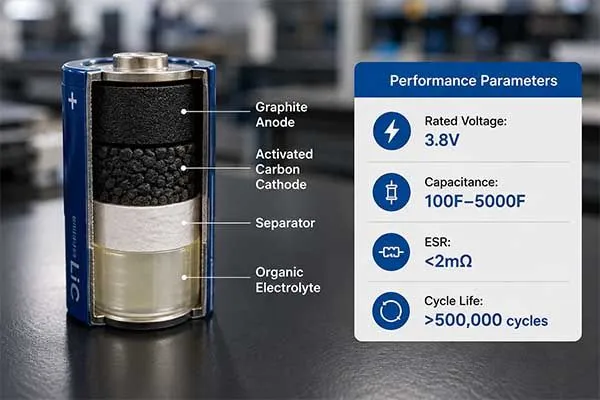
Lithium-ion capacitor solves a key problem in modern industrial systems: how to deliver fast, repetitive pulses of power with low self‑discharge while still keeping energy density high enough for practical backup times.
Because of this hybrid structure, lithium ion capacitors offer an excellent compromise between energy density and power density, making them attractive wherever EDLC battery stacks are too bulky and lithium‑ion battery packs are too slow or short‑lived under high current cycling.
In industry, that includes smart meters, PLC control cabinets[1], safety systems and utility devices that need high reliability backup power and pulse loads.
Click to Explore
A leading German PLC manufacturer faced recurring memory corruption whenever sudden power interruptions occurred during emergency shutdowns. The existing backup battery could not deliver sufficient peak current within milliseconds, causing incomplete data writes and unpredictable controller restarts.
The engineering team required an energy storage solution that combined ultra-fast charging(95% capacity in less than 60 seconds), maintenance-free operation(10 years), and exceptional cycle durability(500,000 cycles) without increasing system complexity.
After evaluating several technologies, a 3.8V Lithium-Ion Capacitor (LIC) rated at 220F, ESR <2mΩ, peak discharge current >200A, operating temperature -40°C to +85°C, and cycle life exceeding 500,000 cycles was selected.
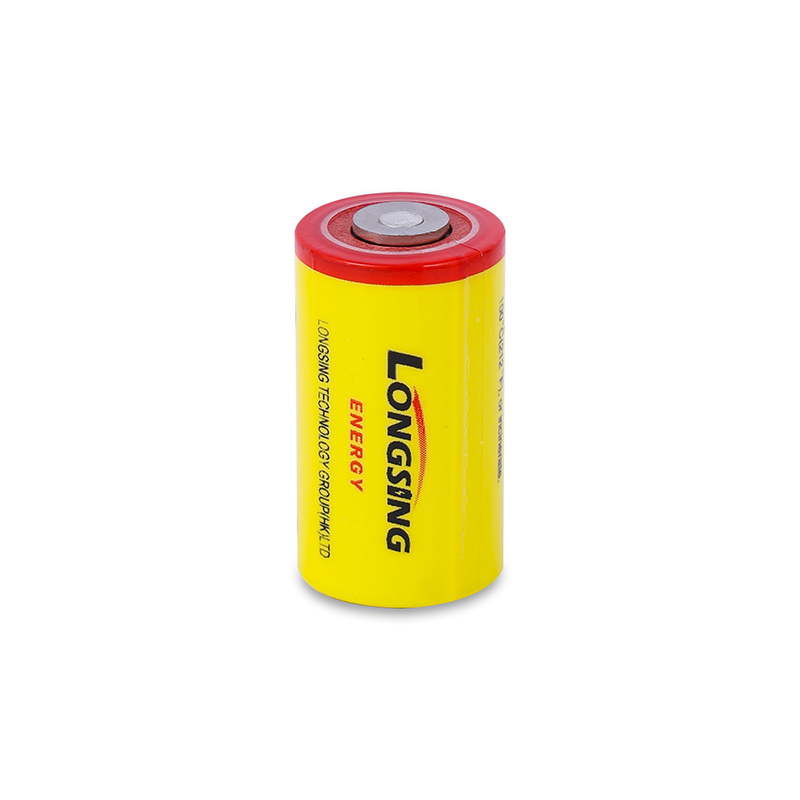
The first validation reduced shutdown failures but revealed voltage sag during repeated power interruptions. Engineers optimized the charging circuit and increased the hold-up energy margin by 30%.
In the second test, the PLC completed every emergency data save within 18ms, while the capacitor recharged to 95% capacity in under 60 seconds.
A final 100,000-cycle endurance test and accelerated thermal aging confirmed zero memory corruption events, stable capacitance retention above 90%, and maintenance-free operation.
The LIC solution ultimately provided reliable emergency backup energy, significantly improving PLC system reliability while eliminating battery replacement costs and reducing unplanned industrial downtime.
For an industrial lithium capacitor supplier such as Long Sing Technology, LIC solutions often sit next to lib battery packs and EDLC battery modules in the product lineup, allowing engineers to pick the right technology for each function.
How Does a Lithium ion Capacitor Work?
The operational magic of a hybrid lithium ion capacitor lies in its internal chemistry. The device relies on a crucial technique known as Pre-Lithiation[2].
During the manufacturing process, lithium ions are doped into the carbon-based anode before the cell is fully sealed. This pre-lithiation lowers the anode's electrochemical potential close to that of lithium metal, which significantly widens the overall operating voltage window — typically up to 3.8V or even 4.0V.
Consequently, the energy density increases exponentially compared to symmetric supercapacitors. The cathode operates precisely like a standard supercapacitor, adsorbing and desorbing ions rapidly on the surface of activated carbon, which delivers the massive power pulses.
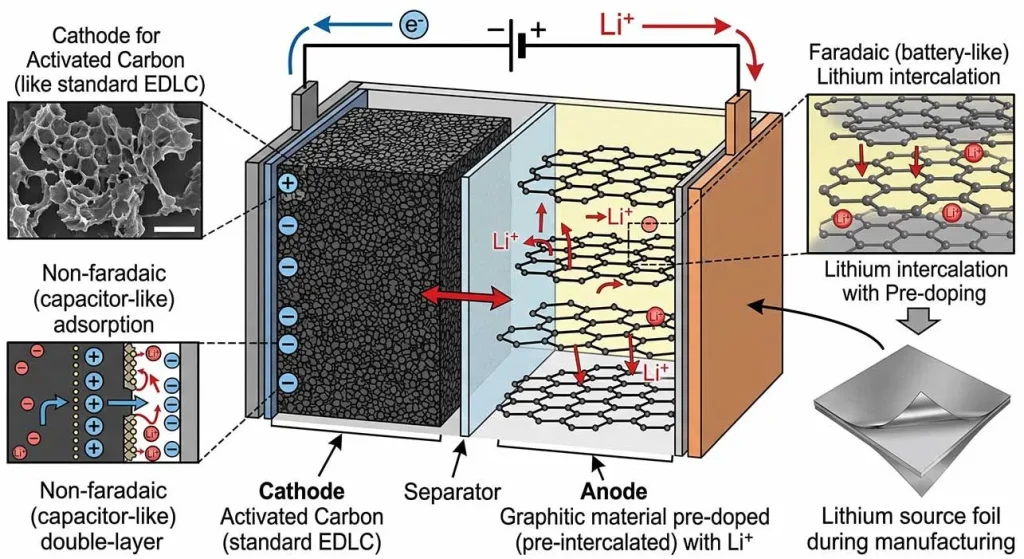
However, this asymmetric design mandates strict overcharge and over-discharge circuit protection. If the voltage drops below a critical threshold (typically 2.2V), the pre-lithiated anode can suffer irreversible structural collapse.For an in-depth look at these metrics, you can explore the principles of power density vs energy density.
Understanding this mechanism is crucial for any lithium ion capacitor manufacturer aiming to deliver reliable industrial products. A top-tier lithium ion capacitor manufacturer must rigorously control the pre-lithiation process to ensure consistency.
Key Performance Advantages & Technical Specifications
Lithium ion capacitors (LIC supercapacitor) deliver long cycle life, low internal resistance, and stable performance under frequent pulse loads, making them ideal for backup power, renewable energy, industrial automation, and transportation systems.
- Higher energy density than EDLCs
- Faster charging than lithium-ion batteries
- Low ESR for high-current pulse applications
- Wide operating temperature range
- More than 500,000 charge/discharge cycles
- Maintenance-free with excellent reliability
| Parameter | Typical Value | Advantage |
|---|---|---|
| Rated Voltage | 3.8V | Higher single-cell voltage than EDLCs |
| Energy Density | 15–30 Wh/kg | 3–5× higher than EDLCs |
| Power Density | Up to 10,000 W/kg | Delivers high pulse current instantly |
| ESR | <2 mΩ | Low heat generation and voltage drop |
| Charge Time | Seconds to Minutes | Supports rapid energy recovery |
| Cycle Life | >500,000 cycles | Far exceeds conventional Li-ion batteries |
| Self-Discharge | Lower than EDLCs | Better long-term energy retention |
| Operating Temperature | -40°C to +70°C (typical) | Reliable in harsh environments |
| Charge/Discharge Efficiency | >95% | High energy utilization |
| Typical Applications | AI servers, UPS, regenerative braking, AGVs, renewable energy, industrial backup | High-power and frequent cycling applications |
Whether deployed as a lithium ion capacitor solar charger buffer in off-grid systems or as a high-reliability backup power supply, their performance metrics remain unmatched. Our dedication to perfecting these specifications helped us win the prestigious R&D 100 Awards in 2022[3], proving that advanced specifications translate directly to real-world reliability.
2. How do EDLC and LIC versus Battery compare?
EDLCs, lithium ion capacitors and lithium-ion batteries differ strongly in energy density, power density, cycle life, working voltage, self‑discharge and cost, with LIC technology deliberately positioned between EDLC vs battery performance for demanding industrial applications.
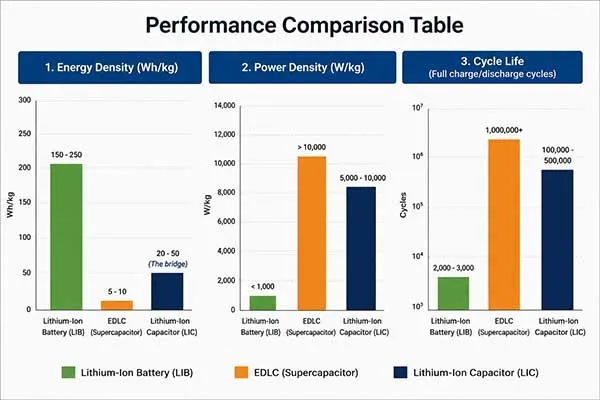
For engineers, the most important question is often LIC vs EDLC vs battery in a given design.
EDLC battery stacks excel at delivering huge power with extremely long cycle life but suffer from low energy density and noticeable self‑discharge; lithium‑ion batteries provide high energy density and low self‑discharge but are limited in peak power and cycling under high current.
Lithium-ion capacitors bridge the gap: they offer much higher energy density than EDLCs, much higher power density than lithium‑ion batteries, and robust cycle life under high‑current profiles[4], at the cost of somewhat higher price per Wh than standard cells.
When observing a lithium ion capacitor vs supercapacitor, the voltage stability of the LIC under load is significantly flatter, mimicking a battery’s discharge curve much closer than the steep linear drop of a supercapacitor.
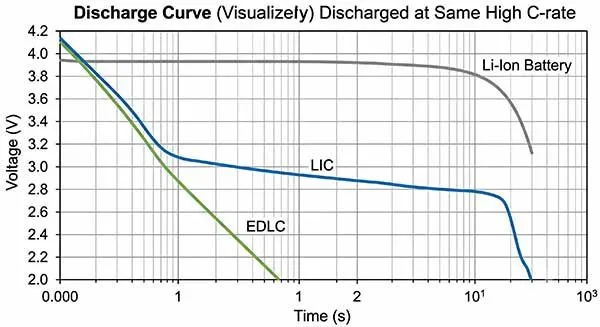
That makes this lithium ion supercapacitor or LIC supercapacitor an ideal choice for systems that need fast energy exchange and reliable backup, especially in smart infrastructure and automation where EDLC vs battery limitations are obvious.
| Metric | EDLC | Lithium ion capacitor (LIC) | Lithium-ion battery |
|---|---|---|---|
| Energy Density | Very low | Medium (bridges EDLC and battery) | High |
| Power Density | Very high | High | Medium |
| Cycle Life | Extremely high | Very high | Moderate |
| Working Voltage (single cell) | Up to ≈2.7 V | Up to ≈3.8–4.0 V | ≈3.6–3.7 V nominal |
| Self‑discharge Rate | High | Medium | Low |
| Cost per Wh | High (due to low Wh) | Medium‑high | Medium |
3. What are the Engineering Challenges and Solution Strategies with Lithium Ion Capacitors?
Lithium ion capacitors, while robust and versatile, present engineering challenges in over‑charging, voltage window control and thermal management under high‑current operation, requiring careful circuit design, protection, and mechanical and thermal integration.
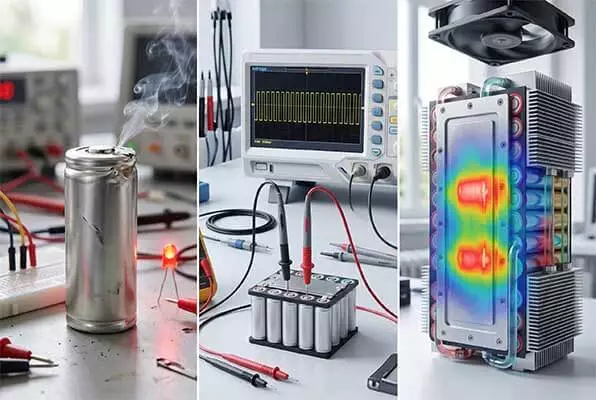
The dialectical reality is that while lithium-ion hybrid capacitors eliminate the need for frequent field maintenance, their initial integration is highly complex.
As an industrial lithium capacitor supplier, we have seen countless prototype failures from clients who mistakenly treated these advanced cells like simple, durable passive components. They require intelligent management to truly unlock their decades-long operational potential.
In many real projects, the main issues for lithium-ion capacitors are not basic chemistry but how they are integrated into the system: how to manage the voltage window, avoid over‑charge and over‑discharge, and handle heat when using LIC supercapacitor modules at high current.
Overcharging & Voltage Window Management
Over‑charging and incorrect voltage window management can shorten LIC lifetime, so designers use precise voltage monitoring, current limiting and protection circuits to keep hybrid lithium ion capacitor cells within their rated operating range during charge and discharge.
Once a lithium ion capacitor is viewed as both a capacitor and a battery, it becomes clear that respect for the maximum charge voltage and minimum discharge voltage is crucial.
Over‑charging can cause gas generation[5] or irreversible degradation, while deep discharge may destabilize the pre‑lithiated anode and reduce capacity; in EDLC vs battery terms, LIC devices demand more careful management than EDLCs but reward it with better energy density and low self‑discharge.
Protection strategies typically include:
- Dedicated voltage monitoring per cell or per parallel group.
- Current limiting or controlled CC/CV profiles[6] even when the LIC is used as a buffer.
- Cut‑off circuits for over‑voltage and under‑voltage, integrated into the lithium ion capacitor module or the system BMS.
For OEM lithium capacitor projects, custom lithium ion capacitor modules may embed balancing and protection functions to simplify system development. In these cases, the industrial customer only needs to respect a defined bus voltage range and interface, while Long Sing Technology handles detailed LIC vs EDLC vs battery trade‑offs inside the pack.
| Design aspect | Key consideration for LIC |
|---|---|
| Max voltage | Stay below rated cell voltage (≈3.8–4.0 V) |
| Min voltage | Avoid deep discharge that destabilizes pre‑lithiated anode |
| Balancing | Ensure cells in series remain matched |
| Protection | Include OV/UV and current limit circuitry |
Thermal Management in High-Current Applications
Lithium ion capacitors generate considerable heat under high‑current operation due to low ESR and large current flow, so thermal management with conduction paths, heat sinking and sometimes active cooling is essential to maintain performance, lifetime and safety.
| Thermal factor | Influence on LIC performance |
|---|---|
| Ambient temperature | Affects internal resistance and lifetime |
| Cooling method | Determines safe continuous current rating |
| Module design | Controls temperature gradients inside pack |
Studies of LIC technology under high currents show that when devices are pushed to hundreds of amperes, internal heat generation rises quickly, and cell temperature can exceed the optimal range if cooling is insufficient. Because LIC capacitors are often chosen specifically for high‑power use, this thermal management problem is central to real‑world deployment, especially in industrial control cabinets and power electronics
Effective strategies include:
- Using larger surface area modules with good thermal conduction to mounting structures.
- Integrating thermal interface materials and heatsinks[7] near the LIC module.
- Designing current profiles that avoid long continuous high‑current periods without cooling recovery.
4. How to Select the Right Lithium Ion Capacitor Cell?
Selecting the right cell requires calculating the exact capacitance needed for your voltage drop and time requirements, alongside evaluating environmental conditions. You must assess the maximum pulse current, operating temperature, and spatial constraints.
By defining these parameters, engineers can choose the optimal custom lithium ion capacitor or module that guarantees sustained reliability and efficient power delivery.
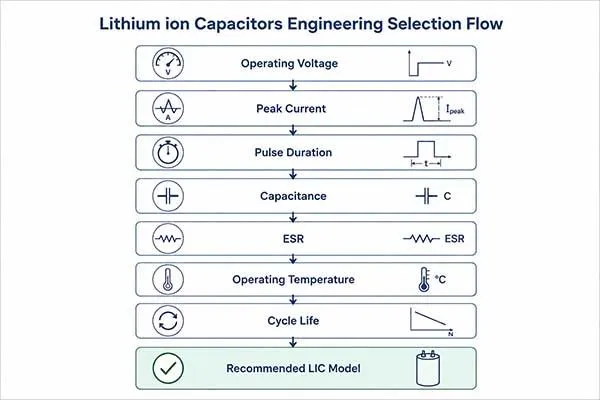
Choosing the perfect components demands a rigorous, analytical selection process. The dialectical challenge here is avoiding over-specification, which needlessly inflates project costs, versus under-specification, which inevitably leads to premature system failure in the field.
An oem lithium capacitor partner must deeply understand the application's true load profile. Unlike a basic edlc battery where capacity calculation is a simple linear function, an OEM must account for the non-linear discharge characteristics and strict voltage cut-offs of the LIC chemistry.
We pride ourselves on offering comprehensive custom lithium ion capacitor solutions, navigating our international clients through our strict project development flow. This workflow transitions seamlessly from initial requirement analysis and precise cell selection, to custom voltage and capacity matching, bespoke module design, robust mechanical packaging, and ultimately, stringent third-party certification and testing.
Step-by-Step Capacitance Calculation Formula
To properly size a system, electrical engineers must understand how to calculate the required capacity based on real-world application demands. The fundamental capacitance calculation formula for energy storage under a constant current load is:
C = (I × Δt) / ΔV
Where:
- C is the required system Capacitance in Farads (F)[8].
- I is the constant discharge current in Amperes (A).
- Δt is the required backup time in seconds (s).
- ΔV is the allowable voltage drop (V_max – V_min) in Volts (V).
Example Calculation(Click to Explore)
Suppose an industrial controller requires:
- Discharge Current (I) = 20 A
- Pulse Duration (Δt) = 0.15 s
- Maximum Voltage Drop (ΔV) = 0.3 V
Substitute these values into the formula:
C = (20 × 0.15) ÷ 0.3
C = 3 ÷ 0.3
C = 10 F
Result: A lithium-ion capacitor with a minimum capacitance of 10 F is required to support this pulse load while limiting the voltage drop to 0.3 V.
Engineering Tip: In practical designs, engineers typically add a 20–30% design margin to compensate for temperature variations, capacitor aging, and ESR-related voltage losses. Therefore, selecting a 12–15 F LIC would provide a more reliable solution for this application.
However, because a single lithium-ion capacitor contains substantial energy, calculating the required energy (in Joules[9] or Watt-hours) is often a far more accurate method for complex, variable-wattage loads:
E = 0.5 × C × (V_max² – V_min²)
When matching these theoretical calculations to real-world industrial products, our engineering teams carefully account for the Equivalent Series Resistance (ESR)[10] voltage drops, which become highly significant during massive high-current bursts.
This level of meticulous calculation is standard practice when we design any industrial backup solution. Whether you need a specific high-voltage rating for a smart grid application, ultra-high-capacity cells for safety monitors, or a fully integrated smart module with custom mechanical packaging for heavy machinery, our advanced OEM capabilities ensure your power architecture is both exceptionally safe and immensely reliable.
Conclusion
Lithium ion capacitors successfully bridge the gap between batteries and EDLCs by merging high energy density with exceptional power delivery and cycle longevity. While their integration requires careful voltage and thermal management, their ability to provide reliable, zero-maintenance backup power over decades makes them indispensable for modern industrial applications.
By partnering with an experienced manufacturer, carefully calculating capacitance requirements, and utilizing advanced module designs, engineers can leverage these robust hybrid devices to overcome the limitations of traditional energy storage systems.
Frequent Asked Questions
Lithium ion Capacitors(Click to Unfold)
Q:What is a lic battery?
A:A LIC (Lithium-Ion Capacitor) is a hybrid energy storage device combining lithium-ion battery anode technology with electric double-layer capacitor (EDLC) cathode design. It delivers higher energy density than pure supercapacitors and superior power density plus longer cycle life than conventional lithium batteries.
Q:Is lithium used in capacitors?
A:Yes. Lithium-ion capacitors (LICs) use pre-doped lithium ions in the anode. This lithium doping raises the cell voltage and energy density while retaining the high-power, long-life characteristics of electric double-layer capacitors (EDLCs).
Q:Is a lithium battery a capacitor?
A:No. A lithium-ion battery stores energy through chemical reactions (faradaic processes). A capacitor stores energy electrostatically. Lithium-ion capacitors are hybrids that combine both mechanisms for balanced power and energy performance.
Q:What is a LIB and lic battery?
A:LIB stands for Lithium-Ion Battery, which offers high energy density. LIC stands for Lithium-Ion Capacitor, a hybrid device bridging LIBs and EDLCs. LICs provide higher power, faster charge/discharge, and much longer cycle life than standard LIBs.
Q:Are supercapacitors safer than batteries?
A:Generally yes. Supercapacitors and lithium-ion capacitors store energy electrostatically with lower risk of thermal runaway, fire, or explosion compared to chemical lithium-ion batteries, especially under high-rate pulse or extreme temperature conditions.
Q:What is the minimum voltage a lithium-ion capacitor can handle?
A:Most commercial lithium-ion capacitors operate safely down to about 2.0–2.2 V. Going below this voltage can cause irreversible capacity loss or damage to the pre-doped lithium anode structure.
Q:Are supercapacitors cheaper to produce than batteries?
A:Not necessarily. While some EDLC materials are simpler, high-performance lithium-ion capacitors require precise lithium pre-doping and specialized electrodes, often making unit cost comparable to or higher than standard lithium batteries for similar capacity.
Q:Can a capacitor have more energy than a battery?
A:No. Traditional capacitors and even advanced supercapacitors/LICs store far less energy per volume or weight than lithium-ion batteries. LICs improve energy density over EDLCs but still lag behind batteries in pure energy storage capacity.
Q:Can a super capacitor be used to charge a battery?
A:Yes. A supercapacitor or lithium-ion capacitor can rapidly deliver high current to charge a battery or support it during peak loads. Hybrid systems often use LICs to handle pulse power while the battery provides bulk energy.
Q:What is the effect on a battery when it charges a capacitor?
A:Charging a capacitor from a battery draws high initial current, which can stress the battery and reduce its cycle life if frequent. Using a lithium-ion capacitor as intermediate buffer minimizes this stress by handling the high-rate pulses instead.
Note:
[1]Learn how PLC control cabinets support industrial automation.↪
[4]See how high-current profiles affect energy storage selection.↪
[5]Read research about gas generation mechanisms in lithium-based cells.↪
[6]Understand CC/CV charging profiles for lithium-based energy storage.↪
[7]Understand heatsink selection for high-power electronic modules.↪
[8]Understand the Farad (F), the standard unit of capacitance.↪
[9]Understand the Joule as the standard unit of energy.↪
[10]Learn why Equivalent Series Resistance (ESR) affects thermal performance.↪
Keep reading about hybrid supercapcitors
- Hybrid Supercapacitors (HPC): The Ultimate Guide to Lithium-Ion Pulse Power Solutions
- Supercapacitor vs Battery: The Truth Engineers Need to Know
- Pulse Power: Why Does A Smart Meter Need Supercapacitor for Communication?
- The Synergy of Power Density VS Energy Density: Hybrid Battery Solutions Explained
- Hybrid Charge–Discharge Dynamics of Lithium Batteries + Supercapacitor Systems: A Technical Deep Dive
- Supercapacitors vs Ultracapacitors: Electrical Characteristics You Should Know
- How Does Leakage Current Impact Hybrid Supercapacitors and Li-SOCl₂ Batteries in Low-Power Devices?
- 10 Real-World Hybrid Supercapacitor Products and Use Cases in 2026
- What is the difference between polymer and hybrid capacitors: ESR, Lifetime & ROI Guide
- Taming the Millisecond AI Surge: How Hybrid Pulse Capacitors Solve AI Data Center Power Challenges
- How Lithium Ion Capacitors Bridge the Gap Between Batteries and EDLCs

Hybrid Charge–Discharge Dynamics of Lithium Batteries + Supercapacitor Systems: A Technical Deep Dive
Are you struggling with premature battery failure in industrial meters or IoT devices due to high-pu

What is the difference between industrial batteries and regular batteries?
Industrial batteries and regular batteries differ mainly in their construction, capacity, and intend

UN38.3 and ADR: Common Shipping Mistakes for Lithium Metal Battery Transportation
Lithium battery transportation for safety is a complex regulatory landscape where even a minor overs