

Tank Level Sensor Battery: Long-Life Power for LoRaWAN and NB-IoT Monitoring
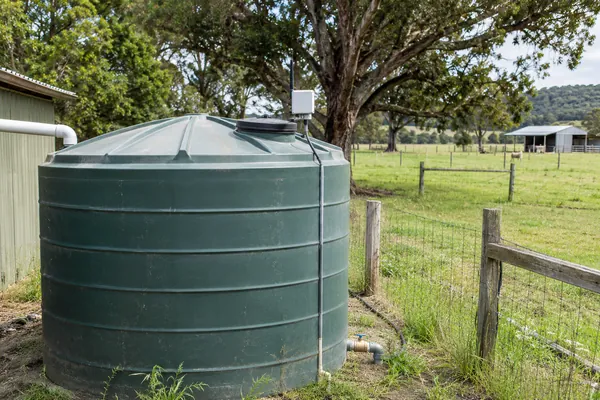
A farm water tank may have no nearby electrical supply. Its level sensor still needs to check how much water remains and report that information before anyone drives out to refill it. An industrial dosing tank presents a similar challenge: how can a small battery support long standby periods as well as reliable measurements and messages?
The answer begins with the tank and the sensor, not a battery catalogue. A radar unit, an ultrasonic transducer and a pressure probe do not necessarily draw the same current or run for the same length of time. Nor does taking a measurement every fifteen minutes mean that the radio must transmit every fifteen minutes.
In November 2026, a published water-management platform announcement described level monitoring alongside pump automation. Some systems use solar power. This article addresses independent primary-battery-powered monitoring nodes, not solar, rechargeable-backup or externally powered installations.[1]
Table of Contents
- 1. How Do Wireless Tank Level Sensors Work?
- 2. What Determines Battery Consumption in Tank Monitoring?
- 3. Why Doesn’t Battery Capacity Alone Predict Service Life?
- 4. How Should OEMs Choose a Li-SOCl2 ER Battery?
- 5. When Is an ER + HPC Configuration Worth Considering?
- 6. How Do You Estimate Tank Sensor Battery Life?
- 7. What Should an OEM Include in the Battery Specification?
1. How Do Wireless Tank Level Sensors Work?
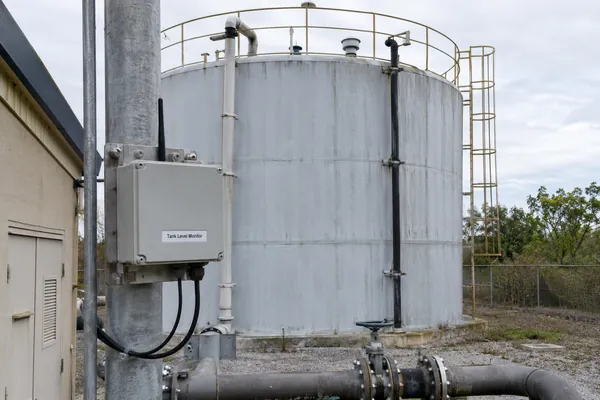
A typical wireless node contains a level-measurement element, a controller, local data storage where required, a radio and a power supply. It wakes according to the monitoring schedule, collects a reading, converts that reading into useful level or inventory data and either stores it or sends it to a server.
The measurement principle changes both the installation and the power requirement. Industrial instruments use non-contact radar, ultrasonic ranging, hydrostatic pressure and point-level switches, among other techniques.[2]
Radar: useful for non-contact inventory measurements
Radar determines distance from the instrument to the liquid surface using reflected electromagnetic signals. A controller then uses the installation reference height to calculate level. The sensor must be mounted with an appropriate measuring path and account for tank fittings, walls and any relevant process conditions. Autonomous radar instruments are already documented for this type of application; one 80 GHz design is intended for plastic vessels. That establishes the measurement approach without implying a LONGSING customer deployment.[3]
Power consumption depends on the complete measurement sequence. Sensor startup, acquisition, processing and any warm-up or stabilization period should be measured for the actual instrument; the radar frequency by itself does not determine battery current.
Ultrasonic: measurement timing and site conditions matter
An ultrasonic transducer measures the time taken for an acoustic pulse to travel to the surface and return. Temperature compensation and echo processing may be needed. Foam, condensation, turbulence and tank obstructions can affect measurement quality, so an installation that repeatedly retries a poor reading may consume more energy than its nominal schedule suggests.
A documented LoRaWAN ultrasonic distance sensor uses a Li-SOCl2-based supply, and some equipment variants incorporate a supercapacitor. This demonstrates one practical architecture without implying that all ultrasonic level sensors have the same battery life or require pulse support.[4]
Hydrostatic pressure and float/contact sensing
A hydrostatic transmitter estimates the height of a liquid column from hydrostatic pressure. Its accuracy depends on factors such as density, reference pressure and mounting arrangement. An active pressure transmitter can also have a sensor excitation or settling period that must be counted in the duty cycle.
A float or contact device may simply identify a high or low threshold rather than reporting continuous level. Its sensing energy can be small, but the controller and radio still require power when an event is reported.
For inventory management, level and volume are not interchangeable. A vertical cylindrical tank has a different level-to-volume relationship from a horizontal cylinder or an irregular vessel. Calibration tables or a tank-specific conversion model are often needed before a level reading becomes a reliable inventory estimate.
2. What Determines Battery Consumption in Tank Monitoring?
The first design decision is how often the tank needs to be measured. The second is how often a remote user needs a new reading. Treating those as the same interval may waste battery energy without improving an inventory decision. Both LoRaWAN and NB-IoT belong to the wider family of low-power wide-area networks (LPWANs), but their signaling and energy profiles cannot be treated as identical.
Consider an illustrative operating schedule: the device measures level four times an hour, keeps those readings locally and sends a summary every four hours. That would be 96 measurements but only six scheduled uploads in a day. These are schedule assumptions, not electrical measurements. The result changes if the tank is filled rapidly, if the network is unreliable or if an alarm requires an immediate message.
Measurement energy and radio energy are separate
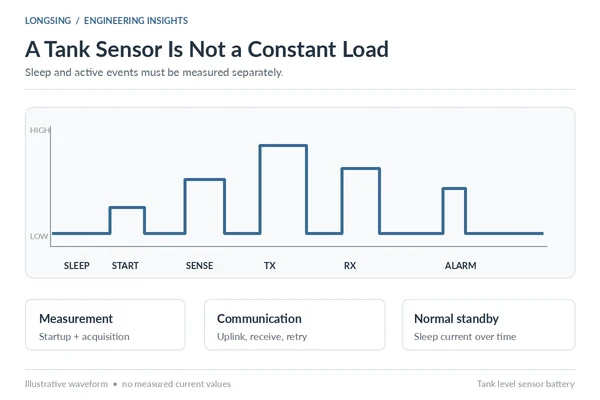
One measurement cycle may include sensor power-up, measurement, controller computation, data storage and shutdown. A wireless event has a different profile. It may include startup, synchronization, uplink transmission, receive activity and a period before the modem returns to low power.
LoRaWAN Class A devices schedule up to two receive windows after an uplink. If a valid downlink intended for the device is successfully received in RX1, RX2 is not opened. Packet airtime, spreading factor, retries and receive-window behavior influence the energy spent on each report.[5]
NB-IoT communication may include signaling, a radio connection and network-controlled inactivity time. A modem waking from Power Saving Mode does not necessarily have to perform a full network registration on every report; actual behavior depends on its state and the network. Cellular power-profiling documentation shows why the whole reporting event needs to be measured, including the period after payload transmission.[6]
A metal tank, concrete enclosure or poorly located antenna can worsen radio conditions. A weak cellular connection may require additional signaling or repetitions; a LoRaWAN link may operate at a different data rate or need retries. The radio specification alone is not a complete battery-load specification.
LONGSING’s NB-IoT water meter battery guide discusses similar communication loads, but tank nodes have different measurement and inventory requirements.
High-level, low-level and maintenance events
An alarm message is not necessarily equivalent to another scheduled report. Firmware might repeat a measurement to confirm an unusual reading, log a diagnostic record or retry an unsuccessful upload. The design should account for the additional activity without assuming that every tank behaves like an emergency flood-monitoring station.
A flood detection sensor battery may be challenged by rapid alarm traffic during an event. Tank inventory monitoring more often depends on the selected measurement and reporting intervals, reliable threshold detection and an affordable maintenance plan. Those are different sizing priorities.
3. Why Doesn’t Battery Capacity Alone Predict Service Life?
Nominal amp-hour capacity is measured under defined laboratory conditions. In a deployed tank sensor, the battery must provide usable energy and hold the system input above its minimum voltage during every important event.
A short rise in current produces voltage drop across the cell’s effective impedance, contacts, wiring and power circuit. Cold conditions, aging and extended standby can reduce the available margin. A controller may reset during modem activity while the cell still contains chemical energy.
Li-SOCl2 cells introduce a particular effect: passivation. A lithium-chloride surface layer helps limit self-discharge during storage and long periods at low current. After such a period, the initial response to a larger current may include voltage delay. The effect depends on cell design, history, temperature and load; it cannot be predicted simply from the printed capacity.[7]
Outdoor enclosures bring another complication. Inside a dark cabinet exposed to afternoon sun, the battery can be hotter than the forecast air temperature. Overnight cold can make a wireless transmission more demanding even if the level measurement itself is unchanged. Prolonged elevated temperature can also accelerate aging.
Design for the voltage and usable energy remaining near end of life, not a promised lifespan based on nominal capacity. See LONGSING’s long-life battery for remote monitoring guide.
4. How Should OEMs Choose a Li-SOCl2 ER Battery?
A primary Li-SOCl2 battery can be a good candidate when a remote tank node remains asleep most of the time, uses limited average current and needs a lengthy maintenance interval. The chemistry has high nominal energy density, a nominal cell voltage of 3.6 V and low self-discharge under appropriate conditions. These benefits do not remove the need to assess startup current, voltage delay and temperature.
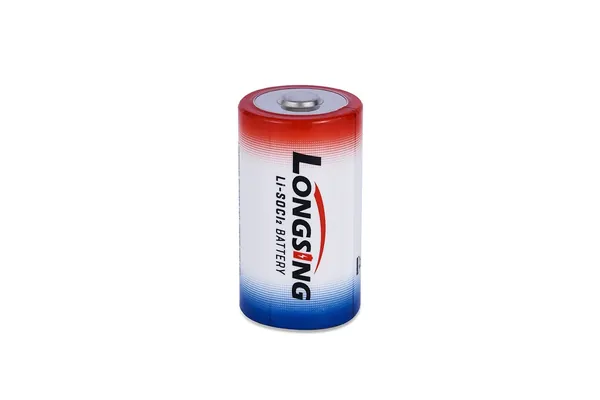
LONGSING’s Li-SOCl2 ER battery range includes several sizes suited to different mechanical and energy constraints. Published nominal capacities include ER14505 at 2.6 Ah, ER18505 at 4.0 Ah, ER26500 at 8.5 Ah and ER34615 at 19 Ah. All four are listed as 3.6 V primary cells. These are catalogue ratings, not the usable capacity of a finished level-monitoring product.
Choose size from lifetime energy, enclosure space and voltage requirements. A larger ER cell is not automatically the answer to a difficult NB-IoT pulse. Check continuous and pulse-current conditions, regulator efficiency and cutoff voltage at the device input.
Primary Li-SOCl2 ER cells must not be charged. Any pulse-support assembly must use a correctly engineered circuit with the selected components, rather than treating the primary cell as a rechargeable battery.
5. When Is an ER + HPC Configuration Worth Considering?
Some designs have enough nominal battery energy but fail a short-duration voltage test. A cellular modem can be a good example: after hours of low-current operation, the radio may demand a much higher current for a brief sequence. If the selected ER cell cannot maintain the required bus voltage, a pulse-support architecture deserves evaluation.
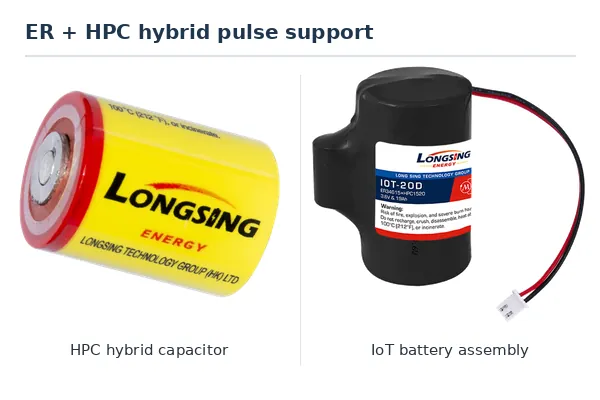
An ER + HPC system separates long-term energy storage from short bursts of power. The ER cell supplies the long-term energy; a Hybrid Pulse Capacitor contributes current during suitable transient events. Afterward, the ER cell replenishes the pulse-support component through the designed power path. That interval matters if another report or alarm may follow soon.
LONGSING publishes HPC and ER + HPC solution information and offers an ER26500+HPC1520 configuration. Its product page lists a 3.6 V nominal voltage, 8,500 mAh nominal capacity and a maximum 1-second pulse current of 1 A at a 3.0 V termination condition. That last figure is a specified test rating, not a continuous 1 A rating or a guarantee for any radio waveform.
Before selecting that configuration, measure pulse amplitude and length, event repetition rate, system cutoff voltage, HPC recovery time and operation at the specified temperature limits. Include the supporting circuit’s leakage in the lifetime budget. Also verify whether a measurement and transmission can overlap and whether repeated retries leave enough time for recovery.
Not every LoRaWAN sensor needs HPC. When a standalone ER cell passes the worst-case voltage and lifetime tests, a simpler supply may be the more appropriate engineering choice. The decision should follow the waveform, rather than the communication protocol’s name.
6. How Do You Estimate Tank Sensor Battery Life?
Measure the current taken by the complete device over one normal operation cycle and over a representative alarm or weak-network event. Where possible, test at the battery terminals and check the regulated supply at the electronics as well. Component datasheet numbers alone may omit conversion losses, sensor startup time or radio inactivity periods.
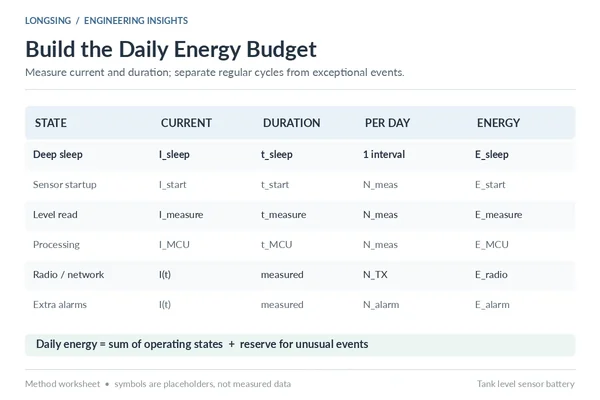
The table below is a blank engineering worksheet. It does not contain measured LONGSING customer data. A designer should enter the actual current waveform, duration and event count before deriving a lifetime estimate.
Tank Level Sensor Operating States and Battery Energy Budget
| Operating State | Current | Duration | Frequency | Energy Contribution |
|---|---|---|---|---|
| Deep sleep | Measure I_sleep | Remaining idle time | Throughout each day | V × I × cumulative sleep time |
| Sensor startup | Measure startup waveform | t_start | Every measurement | Startup-event energy × count |
| Level measurement | Measure I_measure(t) | t_measure | Scheduled measurement count | Measurement-event energy × count |
| MCU processing and storage | Measure I_MCU(t) | t_process | Per processing event | Processing-event energy × count |
| Radio uplink, RX and tail | Measure complete I_radio(t) | Full reporting event | Scheduled upload count | Radio-event energy × count |
| Additional alarms and retries | Measure incremental load | Event dependent | Estimated extra events | Incremental energy beyond normal schedule |
For measured voltage V(t) in volts, current I(t) in amperes and time t in seconds, event energy in watt-hours is:
E_event (Wh) = ∫ V(t) × I(t) dt / 3600
When voltage is approximately constant and only charge consumption is needed, calculate each event’s milliamp-hours from its current-time profile. Do not count the same time twice: sleep duration must exclude active states, and the incremental alarm allowance must exclude events already included in routine reporting.
For an illustrative target of Y years, the normal-cycle energy requirement is approximately:
E_load = 365 × Y × E_daily + E_extra_events
This is only the electrical load budget. It does not directly predict service life. Evaluate remaining usable battery energy after self-discharge, aging, expected temperature exposure, power-conversion losses and any leakage from pulse-support circuitry. Avoid counting the same allowance in both a retained-capacity factor and a separate loss term. For a separate explanation of leakage current in low-power devices, see LONGSING’s engineering article; the assembled node must still be measured to establish its actual standby load.
Finally, test the voltage during the most demanding expected measurement and communication sequences. A battery can pass the cumulative energy calculation but still fail when an aged, cold cell encounters a long radio event. Include weak-network behavior and representative end-of-life conditions in the validation plan.
7. What Should an OEM Include in the Battery Specification?
A useful battery inquiry begins with the level-monitoring device, not only a requested cell code. The OEM should describe the tank, the measurement method and the exact electrical work expected during the service period.
- Sensor and tank: radar, ultrasonic, hydrostatic or contact sensing; tank shape and material; mounting location; required level accuracy; relevant surface and environmental conditions.
- Power: operating-voltage range, minimum allowable input voltage, measured deep-sleep current, sensor startup waveform, measurement duration and power-conversion efficiency.
- Communication: LoRaWAN or NB-IoT module, full reporting-current waveform, upload interval, radio coverage assumptions, retries and alarm policy.
- Environment: minimum and maximum battery-enclosure temperature, outdoor exposure, sealing, condensation, storage period and anticipated aging.
- Service: target maintenance interval, battery access, mounting space, connector requirements and conditions for replacing the power assembly.
Site safety also matters. A remote water tank and a fuel or solvent tank are not equivalent installations. Where electrical equipment is intended for potentially explosive atmospheres, the appropriate hazardous-area classification, certification and installation requirements must be assessed. European Directive 2014/34/EU addresses relevant equipment and protective systems; an ordinary LONGSING ER cell is not automatically an ATEX- or IECEx-approved level-monitoring system.[8]
For a LONGSING battery assessment, the most useful starting material is a measured load trace alongside the temperature range, enclosure drawing and lifetime target. That gives the engineering team enough information to compare a standalone ER cell with an ER + HPC option without assuming that either is universally preferable.
Conclusion
A tank level sensor battery should be selected around the actual instrument and its reporting schedule. Measurement technology defines one part of the energy budget; wireless communication and network conditions define another. Tank geometry, weather exposure and access for maintenance shape the remaining constraints.
LONGSING’s primary Li-SOCl2 ER cells and ER + HPC configurations provide options for evaluation, but the final choice should be based on usable lifetime energy, pulse voltage, temperature and verified operation in the OEM’s equipment. Those checks are more valuable than promising a service life from nominal capacity alone.
Frequent Asked Questions about Tank Level Sensor Batteries
Click to explore more information about Tank Level Sensor Batteries
Q: What battery is used in wireless tank level sensors?
A: The choice varies by the instrument and power architecture. Primary Li-SOCl2 cells are candidates for long-standby wireless nodes, while other sensors use external power, solar systems or rechargeable storage. The complete device load determines suitability.
Q: How long does a tank level sensor battery last?
A: Battery life depends on usable capacity, measurement interval, sensor startup energy, wireless activity, temperature, aging and device cutoff voltage. A valid estimate requires a measured duty cycle and representative testing; nominal amp-hours alone do not establish a service-life guarantee.
Q: Is Li-SOCl2 suitable for remote tank monitoring?
A: It can suit low-average-current installations with long sleep periods. Designers must still check voltage delay, pulse capability, storage conditions and worst-case temperatures for the specific ER cell and equipment.
Q: Does radar measurement always consume more power than ultrasonic sensing?
A: No universal comparison applies. Startup, acquisition time, processing and the specific instrument architecture determine energy per measurement. Compare complete measured cycles rather than sensor technology names.
Q: Why can an NB-IoT tank sensor experience voltage drop?
A: Modem and network activity may create short high-current demands. Battery impedance, passivation, temperature, state of charge and power-path resistance determine whether the supply voltage remains above the device minimum.
Q: When does a tank sensor need ER + HPC?
A: Consider it when a standalone ER cell meets the lifetime energy requirement but cannot adequately support required current transients. Pulse duration, spacing, recovery and operating temperature must be validated. Many low-pulse LoRaWAN devices do not require HPC.
Q: How do reporting frequency and outdoor temperature affect battery life?
A: More measurements, uploads or retries increase energy demand, while cold conditions can reduce voltage margin. Heat can accelerate aging. Use a realistic schedule and the enclosure’s temperature history, not only average ambient conditions.
Q: What information should a tank sensor OEM provide?
A: Provide the sensor type, tank installation, voltage limits, measured current waveform, measurement and reporting intervals, network assumptions, alarm frequency, temperature range, lifetime target, dimensions and service-access requirements.
Reference

LoRa Battery Life: Power Consumption Analysis of Wireless SHM Protocols
LoRa’s exceptionally long battery life — often 10+ years — comes from its ultra-low power

Primary Lithium vs. NiMH Batteries Engineering Trade-Offs for Long-Term Power Applications
When selecting the optimal energy source for critical electronic systems, the comparison of Lithium
What Is the Lifetime of a Supercapacitor: Maintenance and Lifespan
Supercapacitor lifetime depends on chemistry, voltage, temperature, and sealing. Learn how cycle rat