

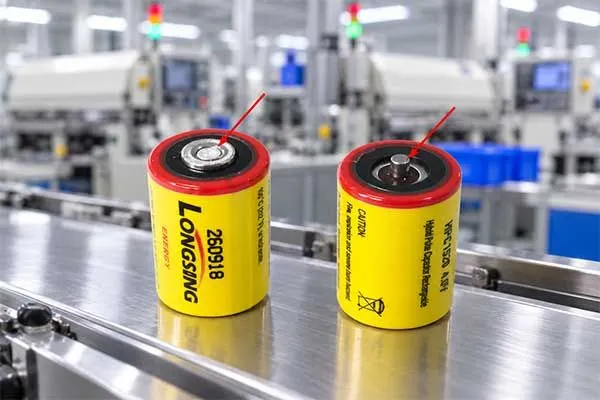
What Is the Lifetime of a Supercapacitor: Maintenance and Lifespan
Key Takeaways
- Some supercapacitor designs offer up to 20 years of service, but actual lifetime depends on chemistry, voltage, temperature, and operating conditions.
- Maintenance usually means checking operating conditions and electrical performance, not opening or repairing sealed cells.
- A hybrid supercapacitor needs product-specific cycle data; calendar years and charge–discharge cycles are separate limits.
- Glass-to-metal seals help prevent electrolyte loss, but cannot eliminate every aging mechanism.
A meter that resets during transmission can be costly to diagnose. Replacing a healthy battery leaves the actual fault unresolved. A lifetime assessment helps identify whether the weak point is the supercapacitor, its connections, or the operating environment.
The lifetime of supercapacitor determines by how environmental factors, electrical boundaries and system integration govern performance across industrial and automotive uses.
By examining optimal usage conditions and protective strategies, it is also important to find effective methods to maximize efficiency, prevent degradation, and ensure continuous high-power delivery in demanding environments.
Start with the lifetime specification, then examine the conditions and maintenance practices that determine whether your application can achieve it.
Table of Contents
- How Long Does a Supercapacitor Last in Real Applications?
- What Maintenance Helps Extend Supercapacitor Lifespan?
How Long Does a Supercapacitor Last in Real Applications?
Some electric double-layer capacitors (EDLCs) offer up to 20 years of calendar life and more than one million cycles under specified conditions. These are product-dependent limits, not universal promises.
A supercapacitor like hybrid pulse capacitor (HPC) requires its own life data, including operating temperature, voltage, discharge depth, and failure criteria.
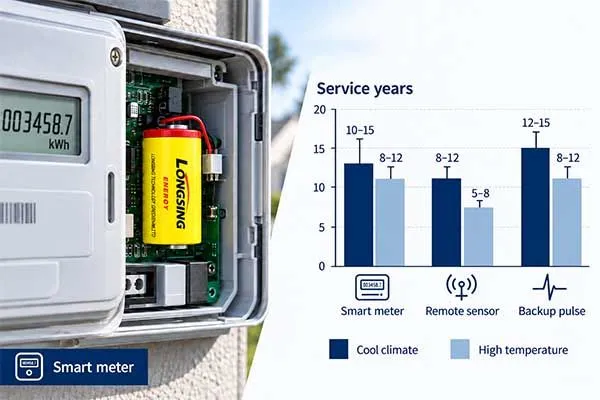
Separate Calendar Life from Cycle Life
The lifespan of supercapacitor products should be considered in two ways: calendar life and cycle life. Calendar life is time-based degradation that occurs even when a device is lightly used or stored, while cycle life describes how many charge and discharge events it can withstand. Temperature and applied voltage are widely recognized as the dominant variables for calendar aging in EDLC-style devices.
For industrial backup power, a device that sees short pulses every day may complete far more than 20,000 cycles without being limited by cycling alone. However, a continuously high float voltage in a hot sealed enclosure can shorten the lifetime of supercapacitor.
| Lifetime measure | What it describes | Required context |
|---|---|---|
| Calendar life | Aging over elapsed time | Temperature, voltage, storage conditions |
| Cycle life | Repeated charge–discharge endurance | Current, voltage window, discharge depth |
| End of useful life | Performance no longer meets requirements | Capacitance, resistance, minimum load voltage |
For supercapacitor model HPC1520, its service lifetime cycle reaches 15+ years and up to approximately 20,000 cycles with our unique glass-sealing technique, requiring application qualification.
Four cycles per day that match the specified test protocol, 20,000 cycles corresponds to approximately 13.7 years by arithmetic alone. Short communication pulses are not automatically equivalent to those test cycles. Conventional aluminum electrolytics[1] use different endurance specifications, often expressed in hours at a stated temperature.
Understand What Glass Sealing Can Improve
The glass sealing technique (most commonly referred to as glass-to-metal sealing (GTMS) for supercapacitors is an advanced encapsulation technology used to create a completely gastight (hermetic) seal around the capacitor’s housing and electrical terminals.
Instead of relying on standard organic or polymer gaskets (like rubber, resin, or epoxy)—which degrade, dry out, or leak over time—the electrical pins are fused directly to the metal housing using specialized insulating glass.
A hermetic glass-to-metal seal can reduce moisture ingress and electrolyte[2] loss compared with non-hermetic polymer sealing. This can support longer service where seal degradation is limiting. It does not remove electrode aging or justify a fixed lifetime increase for every product.
Assess the lifetime of supercapacitor modules against the complete device’s requirements. For a comparison of usable energy, pulse-power capability, and discharge behavior, see our
supercapacitor vs battery guide.
What Maintenance Helps Extend Supercapacitor Lifespan?
Keep the device within its specified voltage and temperature limits, inspect accessible connections, and trend pulse performance against an initial baseline. Sealed cells generally require no internal servicing. Maintenance can prevent avoidable stress and reveal degradation; it cannot restore permanently lost capacitance or repair internal electrolyte loss.
Maintenance can help prevent premature failure, but it cannot reverse permanent internal
degradation or guarantee a fixed service life.
Control Stress Before Scheduling Replacement
Measure temperature inside the enclosure, not only outdoors. Check individual cell voltages in series assemblies, and use the specified balancing arrangement. Avoid applying a generic percentage of voltage derating to hybrid devices: their permitted voltage window must come from the relevant specification.
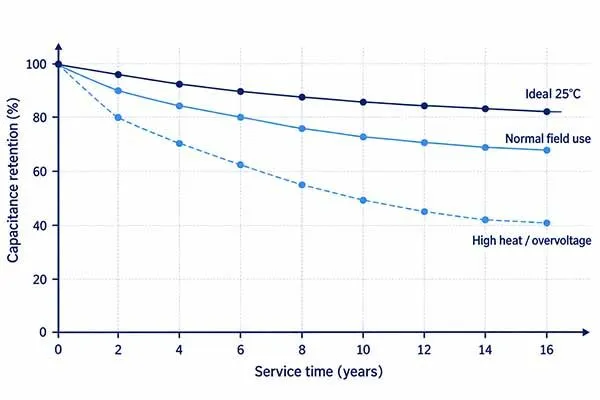
Cold conditions can temporarily increase ESR, or equivalent series resistance. Repeat comparisons at the same temperature before classifying a cold-weather voltage dip as permanent aging.
Troubleshoot Two Specific Product Problems
At Long Sing Technology, our recommended factory troubleshooting approach separates pulse-voltage sag from suspected seal-related electrolyte loss rather than replacing components without diagnosis.
| Product problem | Recommended investigation | Corrective action |
|---|---|---|
| Excessive voltage sag during a pulse | 1. Reproduce the load. 2. Measure voltage at cell and connector. 3. Compare resistance and pulse response with baseline. |
Correct connection resistance; replace degraded cells; reassess pulse capability. |
| Suspected electrolyte loss or seal damage | 1. Isolate the suspect unit. 2. Inspect seal and weld. 3. Perform a validated hermeticity test. |
Reject leaking cells; investigate sealing processes; verify corrected samples. |
Use acceptance limits from the product specification and the equipment’s minimum operating voltage. Set inspection frequency from environmental exposure and criticality, rather than assuming every installation needs the same schedule. Follow the supplier’s safe isolation procedure; do not disassemble sealed cells.
Ask your hybrid supercapacitor manufacturer to review pulse current, duration, repetition, temperature, and cutoff voltage before committing to a replacement interval.
Conclusion: What Matters Most for Supercapacitor Lifetime?
Supercapacitor lifetime depends on chemistry, operating stress, sealing, and application requirements. Separate calendar life from cycle endurance, verify product-specific claims, and monitor electrical performance. Sound maintenance prevents avoidable damage, while validated testing determines when replacement protects reliable operation in service.
Note:
[2]See how hermetic lid design can help limit moisture ingress and electrolyte loss.↪

What is the difference between industrial batteries and regular batteries?
Industrial batteries and regular batteries differ mainly in their construction, capacity, and intend

Continuous Monitoring: How to Prevent Battery Failure in Toxic Gas Monitor
Every year, industrial accidents happen because gas detectors fail at critical moments. The root cau

What Makes the Science Behind Lithium Thionyl Chloride Battery So Unique?
Keep Takeaways Li-SOCl2 batteries combine a lithium anode with thionyl chloride chemistry for high e