


How to Maximize Electronic Shelf Label Battery Life
An electronic shelf label may consume very little power on its own. The challenge appears when a retailer deploys hundreds or thousands of them across one or multiple stores.
At that scale, battery replacement is no longer a minor maintenance task. Every shortened replacement interval means more store labor, more service planning and more devices that need to be opened, checked and returned to operation.
For an ESL manufacturer, the real question is therefore not:
Which coin cell has the highest capacity?
It is:
Which battery can support the label’s actual sleep, wireless, display and indicator loads throughout the required deployment interval?
That requires looking beyond nominal mAh.
What battery is used in an electronic shelf label?
Electronic shelf labels commonly use compact primary lithium coin cells such as Li-MnO₂ CR-series batteries because they combine a 3 V-class output, compact dimensions and long-term storage capability. CR2032 and CR2450 are both possible ESL battery formats, but the correct choice depends on device voltage, sleep current, wireless activity, display updates, temperature, available space, pulse loads and the required replacement interval.
Table of Contents
1. Why Electronic Shelf Labels Create a Unique Battery Design Problem
Electronic shelf labels are well suited to long-life battery operation because most of their time is spent doing very little.
The load, however, is not constant.
An ESL may remain in deep sleep for long periods, wake briefly for wireless communication, process new pricing information, refresh the display, flash an LED and then return to sleep.
That combination of very low standby power and short active events is what makes battery selection more complicated than a simple average-current calculation.
E-Paper Reduces Continuous Display Power
E-paper is one of the main reasons battery-powered shelf labels can operate for long periods.
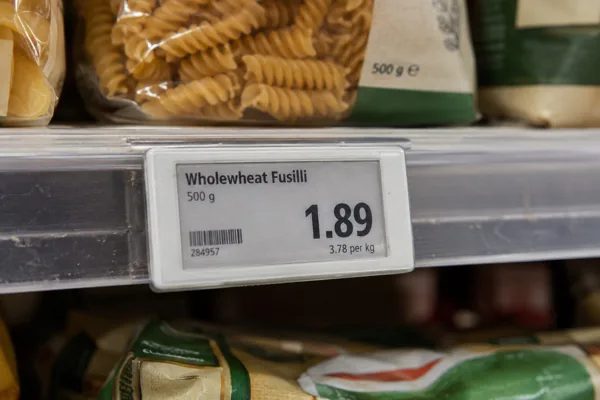
Unlike a conventional illuminated display, a bistable e-paper display does not need continuous power simply to keep an existing image visible. Once the image has been written, energy is mainly required when the display is changed. [1]
For a shelf label that may display the same price for hours or days, this removes a major continuous load.
But the display is only one part of the system.
Even while the image remains unchanged, the ESL may still consume energy through:
- MCU standby
- Wireless synchronization
- Timing circuitry
- Memory
- Sensors
- Power-management ICs
- Leakage paths
So a low-power display does not automatically mean a zero-power device.
The complete ESL should be measured as a system.
The Battery Sees Several Different Operating States
A simplified ESL operating cycle might look like this:
Deep sleep
→ wireless wake-up
→ receive / transmit data
→ MCU processing
→ display refresh
→ LED or sensor activity
→ return to sleep
Each stage has a different current and duration.
That is why the most useful battery-development input is not:
“The ESL consumes X µA.”
It is:
a measured current-versus-time profile covering the actual operating cycle.
The average can then be calculated from real behavior rather than guessed from one operating state.
Wireless Protocol Changes the Energy Budget
There is no single wireless architecture used by every electronic shelf label.
The Bluetooth LE Electronic Shelf Label specification is based on Bluetooth Low Energy and includes Periodic Advertising with Responses (PAwR), which supports communication with large numbers of tags without requiring every label to listen continuously. [2]
Other ESL systems may use:
- Proprietary 2.4 GHz
- Sub-GHz wireless
- Other low-power protocols
Standardized ESL network documentation shows how synchronized low-power communication, network timing and tag behavior shape a Bluetooth LE ESL implementation. [3]
This matters because battery consumption depends on much more than the radio’s headline peak current.
The real energy cost can be affected by:
- Wake frequency
- Listening time
- TX duration
- RX duration
- Synchronization
- Retries
- Network architecture
- Update frequency
Two labels with the same display and the same coin cell can therefore have very different battery lives if their communication strategies are different.
Battery Replacement Becomes a Deployment-Level Problem
One battery replacement may take only a short time.
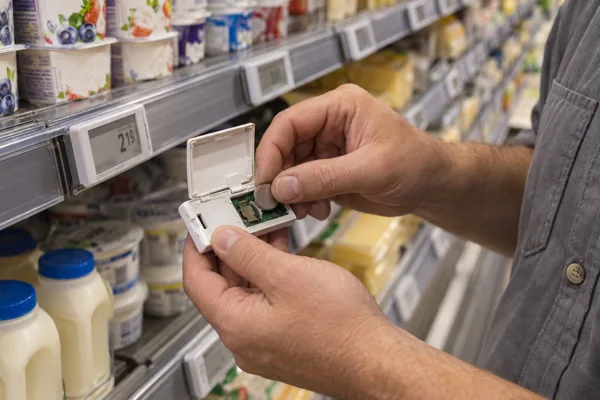
Multiply it by several thousand labels and it becomes an operational process.
A useful way to think about the maintenance burden is:
Number of ESLs × Replacement frequency × Handling time per label
No artificial dollar value needs to be assigned to see the impact.
For large retail deployments, the battery is not only an electrical component. Its service interval affects store maintenance planning.
The design target should therefore be:
a predictable replacement interval under defined operating conditions
rather than simply the largest coin cell that can be fitted into the enclosure.
2. What Actually Determines Electronic Shelf Label Battery Life?
Electronic shelf label battery life is determined by the entire device duty cycle and the amount of battery capacity that remains usable under real operating conditions.
Nominal mAh is only one input.
Sleep current, radio activity, refresh frequency, pulse load, temperature, internal resistance, self-discharge and the system cutoff voltage all influence the final result.
Start With the Real Duty Cycle
For a first-order battery budget, the charge consumed by each operating state can be estimated from:
Q = I × t
If current is measured in mA and time in hours:
Qevent (mAh) = Ievent × tevent
The total charge consumed over a representative period can then be expressed as:
Qperiod = Qsleep + Qwireless + Qdisplay + QLED + Qsensor + Qother
Each event is then multiplied by how often it occurs.
This is particularly important for communication and display updates.
Communication energy per event × Number of communication events
determines how much the wireless function contributes to long-term consumption.
A label updated twice per day should not automatically be assigned the same lifetime calculation as one updated dozens of times per day.
Nominal Capacity Is Not the Same as Usable Capacity
A coin cell’s rated capacity is measured under defined test conditions.
The ESL may operate under different conditions.
Suppose the electronics require:
Vbattery ≥ Vsystem,min
If the battery still contains chemical capacity but its voltage falls below the device’s minimum operating threshold during an active event, that remaining capacity is no longer useful to the product.
This distinction is important:
Rated capacity is not the same as usable ESL capacity.
Coin-cell reference designs demonstrate the same principle: internal impedance, pulsed load and a circuit’s minimum operating voltage can limit how much rated capacity the system can actually use. [4]
Internal Resistance Determines Voltage Under Load
A useful first-order relationship is:
Vload ≈ VOC − Iload × Rinternal
where:
- VOC = open-circuit voltage
- Iload = load current
- Rinternal = battery internal resistance
As load current rises, the voltage drop across the battery’s internal resistance also increases.
That matters because an ESL may spend most of its time at a very low current but briefly demand more current for:
- RF transmission
- RF reception
- E-paper refresh
- LEDs
- Other functions
Coin-cell technical data shows that discharge behavior changes with load, temperature and pulse conditions. A cell may still contain capacity yet fail to maintain the voltage required by the device during an active event. [5]
This is why battery evaluation should include the worst real active waveform, not only the calculated average current.
Pulse Duration Matters as Much as Peak Current
A current value without duration is incomplete.
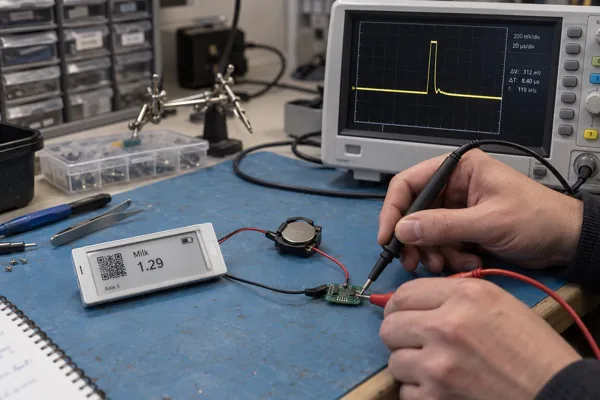
For example:
10 mA for 2 ms
and:
10 mA for 2 s
have the same peak current but place very different demands on the battery.
The same applies to repeated events.
A realistic ESL sequence may be:
wake → synchronize → receive → transmit → refresh display → flash LED → sleep
If these events occur close together, the battery response can differ from a single isolated pulse.
Coin-cell utilization under pulse loads can be affected by:
- Current
- Pulse duration
- Rest interval
- Temperature
- Internal resistance
For OEM qualification, it is usually more useful to reproduce the complete device event than to test one subsystem alone. LONGSING’s CR2032 load testing guide provides a useful starting point for moving beyond an open-circuit voltage check.
Low Self-Discharge Matters in Multi-Year Devices
For a high-drain device, most battery capacity is consumed directly by the application.
An ESL is different.
When average device current becomes extremely low, the battery’s own calendar-related losses become a larger part of the total energy budget.
Li-MnO₂ coin-cell technical literature identifies long storage capability and low self-discharge as important characteristics of this chemistry.
This leads to an important sizing principle:
The lower the application load becomes, the more important long-term battery behavior becomes in the lifetime model.
Simply dividing:
nominal capacity ÷ average current
can therefore overestimate service life if self-discharge, voltage limits and environmental effects are ignored.
Temperature Changes the Battery Response
Temperature affects both long-term capacity utilization and short-term pulse performance.
At lower temperatures, increased cell impedance can produce greater voltage drop under load. A radio or display event that works comfortably at room temperature may therefore have less voltage margin in a colder environment.
This should not be simplified into:
“Cold permanently removes battery capacity.”
A more accurate engineering statement is:
Low temperature can reduce the energy and power available to the device under load because the cell’s electrochemical and impedance behavior changes.
Higher temperatures create different concerns, including faster long-term deterioration during storage.
For ESL systems, this can matter in environments such as:
- Refrigerated retail areas
- Cold-storage displays
- Warehouses
- Hot storage or transport conditions
Battery testing should reflect the actual deployment environment.
System Cutoff Voltage Belongs in the Battery Specification
The battery supplier should also know the ESL’s real minimum operating voltage.
This may be controlled by:
- MCU brownout threshold
- Radio IC voltage requirement
- Display power circuitry
- LED driver
- DC/DC converter
- Other system electronics
A battery that has nominal capacity remaining can still reach the end of its useful life if active-event voltage falls below this threshold.
A meaningful validation plan should therefore include:
new battery + partially discharged battery + target temperature + actual radio / display event + real system cutoff voltage
3. CR2032 vs CR2450: Which Coin Cell Fits an ESL Design?
CR2032 and CR2450 are both relevant Li-MnO₂ coin-cell formats for electronic shelf label development.
LONGSING currently lists electronic shelf labels among the application directions for both its CR2032 and CR2450 products.
The design choice, however, is not simply:
smaller battery vs better battery
The useful question is:
Which cell provides enough usable energy and pulse-voltage margin within the available ESL enclosure?
LONGSING CR2032 vs CR2450
| Design Factor | LONGSING CR2032 | LONGSING CR2450 | Why It Matters for ESL Design |
|---|---|---|---|
| Chemistry | Li-MnO₂ | Li-MnO₂ | Both use primary lithium coin-cell chemistry |
| Nominal voltage | 3.0 V | 3.0 V | Must match the system voltage architecture |
| Published nominal capacity | 220 mAh | 600 mAh | Changes the available nominal energy budget |
| Standard size | 20 × 3.2 mm | 24.5 × 5.0 mm | Affects enclosure volume and label thickness |
| Published weight | 3.0 g | 7.0 g | Relevant to mechanical design |
| Published max. continuous current | 5 mA | 8 mA | Must be checked against actual device load |
| Published typical pulse capability | Up to 15 mA | Up to 20 mA | Actual ESL waveform still requires validation |
| Published operating range | −20°C to +60°C | −20°C to +60°C | Application performance still depends on load and temperature |
These are current published LONGSING product values.
The pulse figures should be treated as preliminary screening information, because the public product pages do not provide a complete pulse-duration and test-condition definition for an arbitrary ESL load.
They should not be interpreted as a guarantee that any radio waveform below the published current will automatically work.
When CR2032 May Fit Better
CR2032 may be worth evaluating when:
- The label must remain thin and compact
- The calculated energy budget fits the usable cell capacity
- The actual wireless and display load has sufficient voltage margin
- The target service interval can be met
- The enclosure cannot accommodate a larger coin cell
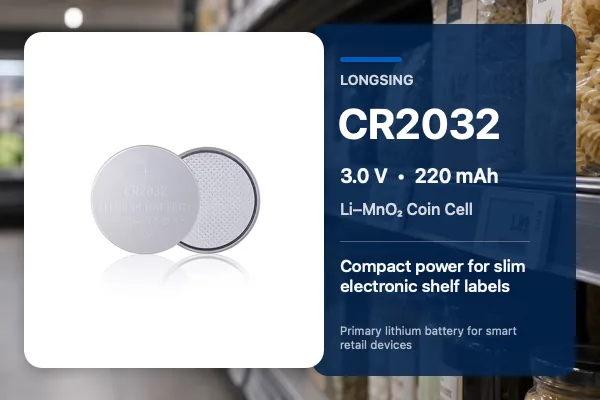
LONGSING currently publishes its CR2032 as:
3.0 V / 220 mAh
and lists electronic shelf labels among its applications.
That does not translate into a universal ESL lifetime.
A CR2032 used in two different labels can deliver very different field life because the device duty cycles may be completely different.
When CR2450 May Fit Better
CR2450 may enter the candidate set when:
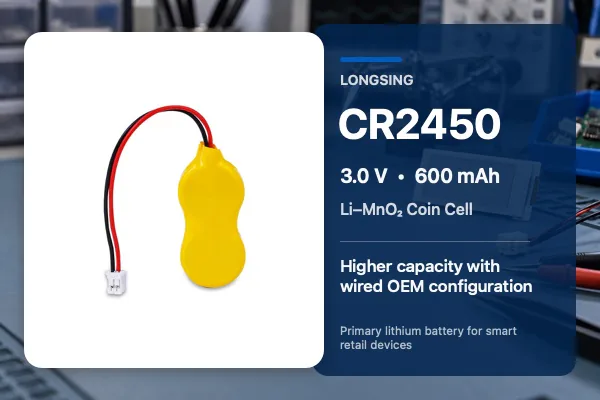
- More stored energy is required
- The enclosure has enough diameter and thickness
- The added weight is acceptable
- The service-life target requires more capacity
- The pulse / loaded-voltage requirement favors the larger format
LONGSING currently publishes its CR2450 as:
3.0 V / 600 mAh
and also lists electronic shelf labels as an application.
Its larger capacity can increase the available energy budget, but capacity alone does not determine service life.
The benefit may be partly offset by a heavier workload, such as:
- More frequent wireless updates
- Larger display refreshes
- Frequent LED activity
- Additional sensors
- More demanding temperature conditions
This is why CR2032 vs CR2450 should be treated as a system trade-off, not a fixed ranking. For dimensional context across common formats, see LONGSING’s CR battery sizes guide.
Why Li-MnO₂ Is Relevant to ESL Designs
Li-MnO₂ coin cells use a lithium-metal anode and manganese-dioxide cathode and provide a nominal 3 V-class output.
Lithium coin-battery technical documentation highlights characteristics and variants developed for compact, long-life IoT devices, including pulse-load and temperature considerations. [6]
These characteristics align well with many ESL architectures because the device spends most of its time at low power.
But chemistry alone does not guarantee a long service interval.
The cell must still support the actual:
- RF waveform
- Display update
- Temperature
- Cutoff voltage
- Required deployment interval
4. What Should ESL OEMs Specify Before Selecting a Battery?
A battery supplier can evaluate an ESL design much more effectively when the request includes the operating conditions that determine usable capacity.
“CR2032 or CR2450?” is not yet a complete battery specification.
The starting point should be the device’s electrical waveform, environment, mechanical constraints and required service interval.
Build the Battery Request Around the Complete Load Profile
The OEM should provide a representative current-versus-time capture for the complete label, including the current scale, pulse duration, rest interval and frequency of each event.
If several workflows exist, document the relevant cases separately. A normal price update, firmware transfer, LED alert and sensor read may not place the same demand on the cell.
| Requirement Group | Information the ESL OEM Should Define | Why the Battery Supplier Needs It |
|---|---|---|
| System voltage | Normal operating range, brownout threshold and minimum voltage during active events | Determines how much cell capacity remains usable |
| Sleep state | Measured current and typical sleep duration | Defines the long-duration base load |
| Wireless activity | TX/RX current, duration, interval, synchronization behavior and retries | Defines recurring pulse and communication energy |
| Display update | Refresh waveform, duration, display size and updates per day | Captures a load that average standby current misses |
| Other loads | LEDs, sensors, memory writes, buzzers and diagnostic modes | Prevents secondary functions from being omitted |
| Temperature | Operating, storage and transport conditions | Allows capacity and loaded-voltage margins to be tested realistically |
| Mechanical envelope | Maximum diameter, thickness, holder or tab requirement and permitted weight | Determines which cell and terminal configuration can fit |
| Lifetime target | Required replacement interval under a defined usage profile | Turns “long life” into a testable engineering requirement |
Define Normal, Worst-Case and Maintenance Scenarios
A useful specification distinguishes between at least three operating cases:
- Normal use: expected update frequency and network conditions
- Worst credible use: high update activity, retries, LED events or low-temperature operation
- Maintenance use: pairing, diagnostics, firmware updates or commissioning behavior
This prevents a battery from being selected around an average case that excludes the device’s most demanding real events.
The required field life should also be tied to a clear assumption set. If update frequency or listening strategy changes, the lifetime estimate should be recalculated.
Validate Loaded Voltage, Not Only Open-Circuit Voltage
An open-circuit voltage measurement can confirm that a coin cell is not completely depleted, but it cannot prove that the cell will support the ESL’s radio and display event.
Qualification should measure the voltage at the device input while the real event is taking place.
Useful validation points include:
- Fresh cells
- Partially discharged cells
- Cells aged for the intended storage period
- Minimum and maximum target temperatures
- Representative production hardware
- Worst credible radio / display sequence
The acceptance criterion should be linked to the actual system brownout or functional limit, with engineering margin.
Treat Published Battery Data as Screening Input
Nominal capacity, maximum continuous current and pulse-current figures help narrow the candidate set. They do not replace application testing.
A pulse rating is only meaningful when its conditions are understood, including:
- Pulse duration
- Rest interval
- Ambient temperature
- State of discharge
- End-voltage criterion
If those conditions do not match the ESL waveform, the published figure should not be converted into an automatic pass/fail rule.
For OEM battery sourcing, the better approach is to share the measured load profile with the battery manufacturer and agree on a validation method.
Specify the Mechanical and Supply Configuration
The electrical cell format is only one part of the sourcing decision.
An ESL OEM should also define whether the battery will use:
- A standard removable coin-cell holder
- Welded tabs or leads
- A specified terminal orientation
- Insulation or customized packaging
- Single-cell or multi-cell architecture
- Traceability and lot-control requirements
- Packaging suited to the assembly process
These details affect resistance, reliability, assembly and replacement procedures. They should be agreed before design freeze, not treated as a purchasing note at the end of development.
From Cell Selection to an OEM Battery Specification
The final battery specification should connect five elements:
device duty cycle → usable capacity → loaded-voltage margin → environment → replacement interval
Once those inputs are defined, the decision between CR2032, CR2450 or another primary lithium battery becomes an engineering comparison rather than a capacity guess.
For an ESL project, LONGSING can review the intended coin-cell format, terminal configuration, operating profile and qualification conditions. The most productive starting package is a measured waveform plus the voltage, temperature, mechanical and lifetime requirements described above.
Key Takeaway
The best electronic shelf label battery is not automatically the coin cell with the largest nominal capacity.
It is the cell that can deliver enough usable energy and loaded-voltage margin through the label’s real sleep, wireless, display and indicator events—at the intended temperature and for the required service interval.
That conclusion should be demonstrated with application-level measurements before the ESL design moves into volume production.
Electronic Shelf Label Battery FAQ
View all 8 frequently asked questions
1. What battery is used in an electronic shelf label?
Many compact electronic shelf labels use primary lithium coin cells, including Li-MnO₂ CR-series formats such as CR2032 or CR2450. The appropriate format depends on the voltage architecture, load waveform, temperature, enclosure and required replacement interval.
2. How long does an electronic shelf label battery last?
There is no universal ESL battery life. Field life depends on sleep current, wireless listening and transmission, display updates, LED or sensor activity, temperature, self-discharge, system cutoff voltage and the usable capacity of the selected cell.
3. Is CR2450 always better than CR2032 for an ESL?
No. CR2450 offers more nominal capacity and a larger physical format, while CR2032 may better suit a thin enclosure and a lighter energy budget. The correct choice is the smallest format that meets the validated energy and loaded-voltage requirements with suitable margin.
4. Can a CR2032 handle wireless transmission pulses?
It may, but the answer depends on peak current, pulse duration, rest interval, temperature, state of discharge and minimum system voltage. The actual radio and display waveform should be tested; a headline peak-current value alone is not enough.
5. Does an e-paper display use no battery power?
A bistable e-paper panel does not need continuous display power to hold a static image, but it consumes energy during image updates. The ESL’s radio, MCU, timing circuits, sensors and leakage paths can also continue to use energy while the image remains unchanged.
6. How does temperature affect an ESL coin cell?
Low temperature can increase cell impedance and reduce loaded-voltage margin during active events. Higher temperature can accelerate long-term deterioration. Testing should reproduce the ESL’s actual operating, storage and transport environments.
7. Can nominal capacity divided by average current predict ESL battery life?
It provides a first-order estimate, not a final prediction. A robust model also accounts for self-discharge, active-event voltage drop, cutoff voltage, temperature, aging and how frequently each operating state occurs.
8. What should an ESL OEM send to a battery supplier?
Provide the system voltage range, brownout threshold, measured current-versus-time waveform, sleep current, update frequency, wireless protocol behavior, display and LED events, target temperature range, mechanical envelope, terminal requirements and desired replacement interval.
References
- Bistable e-paper behavior: a static image can remain visible without continuous display power; energy is mainly required when the image changes. ↩
- Bluetooth LE ESL communication: PAwR organizes communication windows so large groups of labels do not need to listen continuously. ↩
- Wireless network timing: synchronization, listening intervals, retries and update frequency all contribute to the ESL energy budget. ↩
- Usable capacity: pulsed load, internal resistance and the device cutoff voltage can prevent a system from using all nominal cell capacity. ↩
- Coin-cell load response: loaded voltage and capacity utilization vary with current, pulse duration, temperature and state of discharge. ↩
- Li-MnO₂ selection: compact 3 V-class coin cells suit many long-life devices, but the actual pulse waveform and deployment environment still require validation. ↩

Lithium Primary Batteries: Types, Performance, and Selection Guide
Lithium primary batteries serve as the critical power backbone for long-term autonomous systems wher

Hybrid Charge–Discharge Dynamics of Lithium Batteries + Supercapacitor Systems: A Technical Deep Dive
Are you struggling with premature battery failure in industrial meters or IoT devices due to high-pu
Battery Selection Guide: Primary vs Secondary Lithium Batteries for Industrial Projects
Primary vs Secondary Lithium Batteries is a critical decision factor in industrial projects where re