

What Are the Drawbacks of Supercapacitors: Key Drawbacks & Engineering Fixes
Key Takeaways
- Supercapacitors store less energy than batteries of comparable size.
- Voltage decline, self-discharge, and balancing requirements limit standalone backup use.
- Assess usable energy, leakage, equivalent series resistance (ESR), and temperature together.
- Battery–capacitor combinations separate sustained energy delivery from brief power demands.
A device can reset even when its supercapacitor still holds charge. Oversizing capacitance may add cost without fixing voltage collapse or standby losses. Understanding the drawbacks of supercapacitors for energy storage helps engineers select the right device, circuit, and verification tests.
Start with energy and voltage limits, then examine the controls that matter in meters, industrial sensors, and backup supplies.
Table of Contents
- Why Do Supercapacitors Struggle with Long Duration Energy Storage?
- How Can Engineers Reduce the Practical Drawbacks of Supercapacitors?
Why Do Supercapacitors Struggle with Long Duration Energy Storage?
The main limitations are lower energy density than batteries, falling discharge voltage, and self-discharge. These characteristics make conventional supercapacitors better suited to brief backup intervals and power pulses than prolonged operation without recharging.
Usable Energy Is Smaller Than Stored Energy
Lower energy density means a larger assembly may be needed to match battery runtime. Yet this does not make supercapacitors inherently uneconomical: frequent cycling and high pulse demands can justify them.
Evaluate cost per usable watt-hour alongside duty cycle, enclosure space, and replacement requirements.
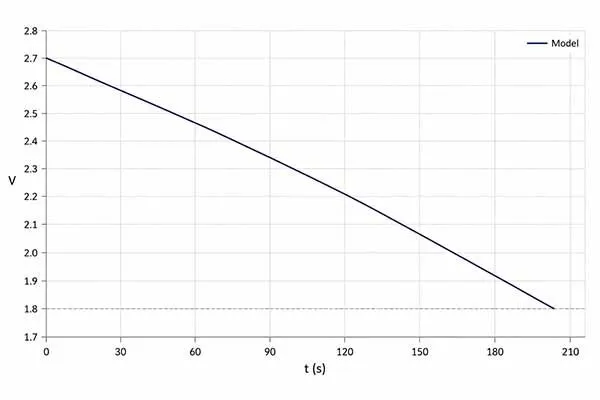
For an approximately constant-capacitance device, usable energy is E = ½C(Vmax² − Vmin²). The cutoff matters because the load cannot necessarily use the remaining charge below its operating voltage.
Evaluating supercapacitors for energy storagetherefore requires an application-specific voltage window. Consider this illustrative calculation, not a product specification or measured test:
| Design parameter | Assumed or calculated value |
|---|---|
| Capacitance | 10 F |
| Starting voltage | 2.7 V |
| Minimum usable voltage | 1.8 V |
| Usable energy | 20.25 J = 5.625 mWh |
| Constant output power | 0.1 W |
| Ideal backup duration | 202.5 seconds |
This estimate ignores ESR, conversion losses, leakage, and aging. Actual backup time will be shorter under those losses. For the broader technology tradeoff, see this comparison.
Standby Loss and Chemistry Differences
Leakage under applied voltage and self-discharge after disconnection are different measurements.
Internal charge redistribution can also cause early voltage relaxation, so a short voltage-decay test can exaggerate permanent energy loss. Use the manufacturer’s specified conditioning time.
Readers searching “types of supercapacitorss” should distinguish EDLCs, pseudocapacitors, and hybrid designs. Their storage mechanisms differ.
Some lithium-containing hybrid devices have mandatory minimum voltages; they cannot automatically be treated as zero-volt-tolerant EDLCs.
How Can Engineers Reduce the Practical Drawbacks of Supercapacitors?
Our Engineers, leading by Wilson Lu, can reduce voltage sag, overstress, and standby losses by matching ESR and capacitance to the load, protecting individual cell voltages, limiting charging current, and validating aged performance.
These measures improve reliability but add components, board space, and design effort.
Voltage Management and Lifetime Add System Costs
At constant current, ΔV ≈ I × ESR + I × t/C. The first term creates an immediate voltage step; the second causes continued decline.
Cold conditions can raise ESR, while heat and excessive voltage accelerate degradation. Overvoltage can cause gas generation or venting; cycle life is not calendar life.
Series-connected cells need individual voltage control; total pack voltage alone cannot reveal an overstressed cell. Passive balancing dissipates energy, while active balancing adds circuitry.
Compare the complete assembly cost, including converters, protection, and qualification, rather than cell price alone.
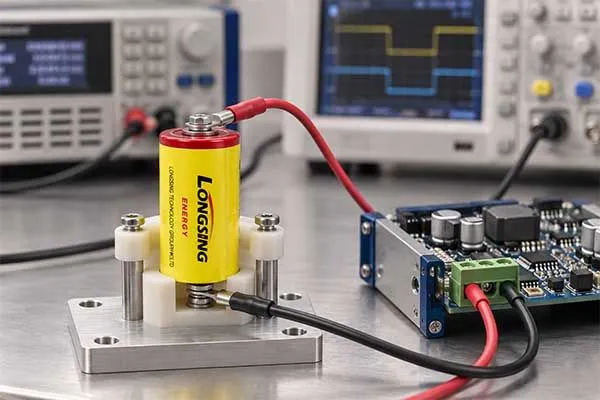
Low cell voltage also increases part count. Two identical 10 F cells in series provide 5 F, not 20 F. Series connection raises stack voltage capability but adds connections and monitoring.
A discharged bank also needs controlled charging; fast charge acceptance does not mean the upstream supply can tolerate unlimited inrush.
Factory Qualification Should Target Specific Failure Symptoms
For battery-pack projects at Long Sing Technology, I recommend a factory qualification plan targeting two symptoms: meter resets during transmission and premature standby depletion.
| Symptom | Possible cause | Proposed validation and correction |
|---|---|---|
| Meter resets during transmission | High ESR, connection resistance, or insufficient capacitance | 1. Replay the measured pulse load at the specified temperature limits. 2. Measure voltage at the device terminals. 3. Reduce resistance or resize capacitance, then retest. |
| Battery drains sooner than expected | Capacitor leakage or excessive balancing/controller current | 1. Condition cells as specified. 2. Measure stabilized cell and assembled-pack standby currents separately. 3. Correct outliers or circuit drain; repeat retention and load tests. |
For Li-SOCl₂ systems, a compatible pulse buffer can reduce battery pulse stress, but cannot eliminate its own leakage or charging burden. Verify recharge time between events and prevent reverse charging of the primary cell.
When consulting a hybrid supercapacitor manufacturer, request application-specific voltage, leakage, and pulse data rather than transferring EDLC assumptions to another chemistry.
Conclusion
The drawbacks of supercapacitors for energy storage are manageable, but not removable. Evaluate usable energy, voltage limits, leakage, ESR, temperature, and system costs. Choose capacitor-only storage for suitable short-duration duties, or a validated battery–capacitor architecture when sustained energy also matters.
IoT Power Supply Manufacturer Selection & Design : From Battery to AC/DC Solutions
Are your remote field devices suffering from unexpected shutdowns? Replacing depleted energy sources
9 Reliable Ways to Size Your NB-IoT Water Meter Battery
An NB-IoT water meter battery may support years of very low-current operation, yet an NB-IoT communi

Lithium Metal Batteries for Long-Life Industrial Applications: Design and Performance Insights
Industrial applications devices often work for years without service, yet power failure still causes