


Lithium Metal Batteries for Long-Life Industrial Applications: Design and Performance Insights
Industrial applications devices often work for years without service, yet power failure still causes data loss, safety risks, and high labor cost. Many systems fail because the battery choice is based on capacity alone. A better design view reduces risk, extends service life, and lowers total ownership cost.
Lithium metal batteries support long-life industrial applications by offering very low self-discharge, stable voltage, and wide temperature tolerance. These traits allow devices to operate for 10–20 years with minimal maintenance, even in remote or harsh environments.
Long-life power is not only about chemistry. It also involves system design, load profile, and real operating conditions. The following sections explain how design and performance work together in industrial applications.
Table of Contents
- 5 Innovative Applications of Lithium Metal Batteries
- What makes lithium metal batteries suitable for long-life industrial applications?
- Why do industrial applications demand different battery design priorities?
- How do hybrid solutions improve reliability in industrial IoT systems?
- What should buyers evaluate when selecting batteries for industrial deployment?
5 Innovative Applications of Lithium Metal Batteries
From powering the next generation of Smart Cities to enabling deep-space exploration, lithium metal batteries—particularly those utilizing Lithium Thionyl Chloride (Li-SOCl2) chemistry—are the unsung heroes of the industrial revolution.

Harnessing the Energy of the Future
The shift toward lithium metal batteries is driven by their unmatched energy density, which can be up to double that of traditional lithium-ion systems.
For industries requiring decades of reliability without maintenance, such as utility metering or remote environmental sensing[1], these batteries are not just a component; they are a strategic asset.
Lithium metal technology is no longer confined to specialized labs. Today, it is the primary driver for five key sectors where weight, longevity, and extreme temperature resilience are non-negotiable.
Here is the Top 5 innovative applications that shaping 2025:
- Smart Utility Infrastructure (AMR/AMI): Modern water, gas, and heat meters require autonomous power for over 15 years. Li-SOCl2 batteries provide a stable voltage plateau, ensuring accurate data logging and remote transmission across wide-area networks like NB-IoT and LoRaWAN.
- Aerospace and Defense: With the fastest-growing demand in the sector, ultra-high purity lithium metal batteries power satellites, high-altitude drones, and tactical equipment that must operate in the vacuum of space or the freezing temperatures of high-altitude flight.
- Industrial IoT (IIoT) & Asset Tracking: In global logistics, lithium metal batteries enable real-time tracking of containers across oceans. Their low self-discharge rate (less than 1% per year) ensures the tracker remains active even after months of storage.
- Medical Implants and Portable Devices: For life-critical applications like pacemakers or portable emergency ventilators, the high energy-to-weight ratio of lithium metal allows for smaller, less invasive designs with extended service intervals.
- Subsurface Exploration (Oil & Gas): Downhole drilling tools operate in environments exceeding 125°C. Specialized high-temperature Li-SOCl2 cells from Long Sing are engineered to maintain structural integrity and power delivery under these punishing conditions.
| Application Sector | Key Battery Requirement | Long Sing Solution |
|---|---|---|
| Smart Cities (IoT) | High Pulse & Long Life | Li-SOCl2 + HPC Pack |
| Aerospace | Extreme Temp (-55°C to +85°C) | High-Energy Density Primary Cells |
| Oil & Gas | Heat Resistance (>125°C) | Specialized High-Temp Batteries |
| Logistics | Low Self-Discharge | ER Series (Bobbin-type) |
Want to try our lithium batteries for your industrial applications?
Submit the form below, and Long Sing Technology engineers will analyze your power profile for free.
What makes lithium metal batteries suitable for long-life industrial applications?
Lithium metal batteries are suitable because they combine high energy density, low annual self-discharge, and long shelf life, which allows stable operation in industrial applications that require multi-year autonomy.

Design fundamentals behind long service life
Lithium metal batteries are widely used in industrial applications because their chemistry supports predictable aging.
Unlike rechargeable systems, they do not rely on cycling efficiency. Instead, they focus on energy retention over time. This matters in industrial application scenarios where devices transmit data only a few times per day.
A key example is the Li-SOCl₂ battery. This chemistry offers extremely low self-discharge, often below 1% per year at room temperature.
That allows lithium metal battery applications to support meters, sensors, and alarms for over a decade.
In industrial applications, current draw is often uneven. A battery must remain stable during long idle periods and still deliver energy when needed.
Lithium metal designs handle this balance well, especially when paired with proper passivation control and load planning.
| Design Factor | Impact on Industrial Use |
|---|---|
| Low self-discharge | Supports long unattended operation |
| High energy density | Reduces battery size in compact devices |
| Stable voltage | Ensures consistent sensor accuracy |
Why do industrial applications demand different battery design priorities?
Industrial applications demand priorities such as longevity, safety, and predictability rather than high cycle life or fast charging performance.

Design priorities shaped by application reality
Consumer devices focus on daily use and frequent charging.
Industrial applications focus on reliability and risk reduction. In an industrial application, battery failure may stop a meter, disable a safety alarm, or interrupt data flow.
Lithium metal batteries fit these needs because their failure modes are well understood.
Designers can calculate service life based on load and temperature. This is critical in industrial IoT application planning, where devices are often sealed.
Industrial applications also require compliance with transport and safety standards. Proper battery design includes mechanical stability, venting strategy, and predictable end-of-life behavior.
Lithium metal battery applications are often selected because they meet these expectations with less complexity.
| Priority | Industrial Focus |
|---|---|
| Longevity | 10+ years without service |
| Safety | Stable behavior over time |
How do hybrid solutions improve reliability in industrial IoT systems?
Hybrid solutions improve reliability by combining lithium metal batteries with pulse-handling components[2] to support peak current without stressing the primary cell.

Managing pulse loads in industrial IoT application design
Many industrial IoT application devices transmit data wirelessly. This creates short pulse loads that pure lithium metal batteries may not handle efficiently alone. A common solution is pairing them with a hybrid pulse capacitor.
This hybrid approach allows the battery to provide steady energy, while the capacitor handles bursts. It reduces voltage drop and limits stress on the lithium metal chemistry.
As a result, industrial applications achieve longer real service life.
Hybrid designs also improve performance in cold environments. They are now common in smart meters, asset tracking, and industrial application monitoring systems that require stable communication.
| System Element | Function |
|---|---|
| Lithium metal battery | Long-term energy supply |
| Hybrid capacitor | Handles peak current |
What should buyers evaluate when selecting batteries for industrial deployment?
Buyers should evaluate service life modeling[3], environmental fit, supplier stability, and system-level compatibility when selecting batteries for industrial deployment.

Practical evaluation beyond datasheets
Industrial applications involve long contracts and slow replacement cycles.
Buyers should not rely on nominal capacity alone. Instead, they should review discharge curves[4], passivation behavior, and supplier experience in similar industrial application fields.
Lithium metal battery applications succeed when battery selection aligns with system design. This includes enclosure, communication interval, and backup needs.
For industrial IoT application projects, early testing under real load conditions is essential.
| Evaluation Item | Why It Matters |
|---|---|
| Life modeling | Avoids early field failure |
| System match | Ensures stable operation |
Case Study: Long Sing’s Maintenance-Free Solution for French Smart Infrastructure
The Challenge:
A leading smart infrastructure company based in France was facing significant operational costs due to the frequent battery replacements required for their underground water pressure monitoring sensors.
The high humidity and difficult access to these sensors made manual maintenance both expensive and risky, demanding a power source that could last at least 15 years without intervention.
The Long Sing Solution:
Long Sing Technology engineered a customized power pack using our high-capacity Li-SOCl2 (Lithium Thionyl Chloride) Bobbin-type batteries integrated with Hybrid Pulse Capacitors (HPC).
- Chemistry Advantage: We utilized the Li-SOCl2 chemistry for its exceptionally low self-discharge rate (<1% per year) and high energy density.
- Pulse Management: By adding the HPC, we solved the “voltage delay” common in lithium metal batteries, allowing the sensors to provide the high-current pulses needed for daily LoRaWAN data transmissions while remaining in a low-power “sleep” mode for the rest of the day.
- Environmental Sealing: The assembly featured a specialized hermetic glass-to-metal seal and a waterproof housing to withstand the damp, underground French utility vaults.
Post-Purchase Feedback:
Since the deployment of over 50,000 units, the client has reported zero battery-related failures. The procurement team highlighted three key successes:
- Cost Reduction: A 40% reduction in long-term operational expenditure (OPEX) by eliminating biannual maintenance trips.
- Reliability: The batteries maintained a stable voltage plateau even during the record-breaking cold winters in northern France.
- Sustainability: By tripling the device’s service life, the client significantly reduced electronic waste, aligning with EU green initiatives.
This was what he said not long ago:
“Long Sing’s technical expertise transformed our product’s value proposition. We no longer sell just a sensor; we sell a ‘fit-and-forget’ solution that our municipal clients can trust for two decades.” — CTO, French Infrastructure Partner.
Working with experienced manufacturers like Long Sing Technology helps reduce risk. Our focus has always been on industrial applications where long life and predictable behavior matter more than headline performance.
Want to try our maintenance-free lithium batteries?
Submit the form below, and Long Sing Technology engineers will analyze your power profile for free.
Conclusion
Lithium metal batteries play a key role in long-life industrial applications because they support stable, low-maintenance operation. When combined with proper design and hybrid support, they reduce risk and cost over time. For industrial application planning, chemistry choice, system design, and supplier experience must work together to achieve reliable performance across years of service.
Quick FAQ Review About Industrial Applications
(Click to Unfold)
Q: What are the industrial applications?
A: Industrial lithium batteries, particularly those from Long Sing’s Li-SOCl2 (Lithium Thionyl Chloride) and HPC (Hybrid Pulse Capacitor) ranges, are primarily used in Smart Utility Metering (AMR/AMI) for water and gas, Industrial IoT (IIoT) sensors for remote monitoring, and Asset Tracking in logistics.
They also power Smart City infrastructure such as smart manhole covers and cabinet locks, as well as critical Medical Devices and Subsurface Exploration tools where maintenance-free operation[5] for 10–20 years is mandatory.
Q: What are the industrial applications of lithium?
A: Beyond battery manufacturing, the industrial applications of lithium as a material include its use in lubricating greases for heavy machinery, glass and ceramics production to reduce melting points, and aluminum-lithium alloys for aerospace components to enhance strength while reducing weight.
In the chemical sector, lithium is also used in air treatment systems for moisture absorption and in pharmaceutical synthesis as a critical reagent for organic reactions.
Q: What are the industrial applications of materials?
A: The advanced materials used in battery assembly—such as nickel-plated steel, specialized electrolytes, and high-purity lithium metal foils—enable broader industrial functions.
These materials are applied in corrosion-resistant coatings for marine environments, thermal management systems for high-temperature electronics, and hermetic sealing technologies used in aerospace and vacuum equipment to ensure structural integrity under extreme pressure.
Note:
[1]Understand the critical role of batteries in enabling remote monitoring and data collection.↪
[2]Learn how pulse-handling components enhance battery performance in demanding applications.↪
[3]Understand the importance of service life modeling for reliable battery performance.↪
[4]Explore how discharge curves help evaluate battery performance over time.↪
[5]Discover how maintenance-free batteries reduce operational costs and enhance reliability.↪
Also read further information about lithium metal battery:
- The Ultimate Guide to Lithium Metal Battery for Professionals
- What Makes the Science Behind Lithium Thionyl Chloride Battery So Unique?
- The 3.0V Standard: Unlocking the Power of Lithium Manganese Dioxide Batteries
- How to Choose Between Lithium Metal vs Lithium Ion?
- Beyond 500 Wh/kg: Lithium Metal Battery Energy Density Under Real IoT Load Conditions
- The Science of the Plateau: Why Voltage Stability is the Lifeline of in Power System
- Operating Temperature Range: How temperature affects lithium metal battery performance
- The Real Cost of Cheap Batteries: How High Self Discharge Rate Increase Your TCO
- The Silent Shelf-Life Secret: Why Battery Passivation is Actually a Good Thing
- Mechanical Robustness: Designing Robust Battery That Survive Shock, Vibration, and Long-Term Stress
- Thermal Runaway Prevention: Why Factory-Level Testing is Non-Negotiable for Lithium Battery Safety
- Lithium Metal Battery Long Term Cost Analysis: Initial Price vs Lifetime Value
- Solid state batteries vs lithium metal batteries: Which One Elevates Your Product Performance?

CR123A, CR17450, and CR14505 The Ultimate CR Li-MnO2 Cylindrical Battery Comparison
Your industrial meter just failed in the field. The replacement costs are mounting. You need a batte
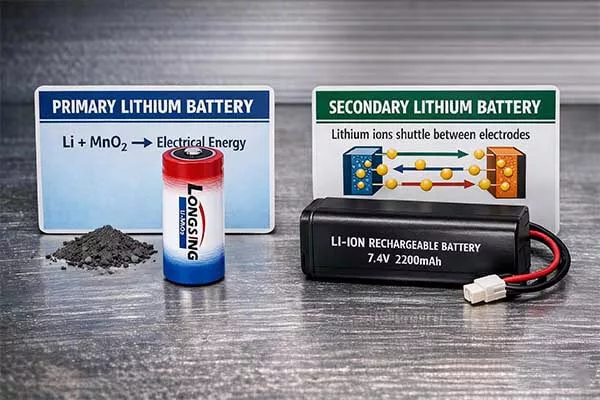
Battery Selection Guide: Primary vs Secondary Lithium Batteries for Industrial Projects
Primary vs Secondary Lithium Batteries is a critical decision factor in industrial projects where re

How to Choose a Long Life Smart Meter Battery?
People often struggle to pick a long life smart meter battery for their project. The wrong ch