


LoRa Battery Life: Power Consumption Analysis of Wireless SHM Protocols
LoRa’s exceptionally long battery life — often 10+ years — comes from its ultra-low power consumption in sleep mode (as low as ~1µA), short transmission bursts, and adaptive data rate[1] that minimizes airtime.
LoRa battery life depends on multiple factors including spreading factor settings, transmission frequency, device class selection, and battery chemistry. Under optimal conditions with Class A operation and low spreading factors, LoRaWAN devices can achieve 10+ years of battery life using lithium thionyl chloride (Li/SOCI2) batteries.
Structural health monitoring systems are transforming how we maintain critical infrastructure. Yet, one challenge keeps engineers awake at night: power.
The key to maximizing longevity lies in balancing transmission parameters, sleep mode efficiency, and selecting appropriate power sources for specific structural health monitoring applications.
Wireless sensors deployed on bridges, buildings, and industrial assets must operate for years without maintenance.
Poor battery performance means costly site visits, system failures, and unreliable data.
This article breaks down the power consumption characteristics of LoRa and competing protocols for SHM IoT battery applications.
We examine how spreading factors[2], device classes, and battery technologies interact to determine real-world performance.
Table of Contents
- What Factors Determine LoRa Battery Life in SHM Applications?
- How Do LoRaWAN Device Classes Affect Power Consumption?
- What Is the Role of Spreading Factor in LoRa Power Efficiency?
- What Battery Technologies Optimize LoRaWAN Battery Performance?
What Factors Determine LoRa Battery Life in SHM Applications?
LoRa battery life in structural health monitoring applications is determined by four primary factors: transmission frequency, spreading factor selection, device class operation, and the underlying battery chemistry.

A typical LoRaWAN sensor consuming 40mA during transmission and spending 99% of time in sleep mode can achieve 10-15 years of operation with properly sized LiSOCl2 batteries. Understanding LoRa battery life requires examining how wireless sensor networks actually consume energy.
Most power is not spent collecting measurements from accelerometers or strain gauges. The radio transmissions dominate the energy budget. A LoRa message takes anywhere from 50 milliseconds to several seconds depending on configuration parameters.
During this window, the transceiver draws significant current.
Energy Budget Components in LoRaWAN SHM Sensors
| Component | Current Draw | Duration per Cycle | Energy Impact |
|---|---|---|---|
| Sleep Mode | 1-10 µA | 99%+ of time | Low |
| Sensor Measurement | 1-5 mA | 10-100 ms | Low |
| MCU Processing | 5-15 mA | 50-200 ms | Medium |
| LoRa Transmission | 30-120 mA | 50 ms – 2.8 s | High |
| Receive Windows | 10-15 mA | Variable | Medium-High |
The table above illustrates why transmission parameters matter so much.
Sleep current might seem negligible, but over 10 years those microamps add up. Meanwhile, transmission events lasting just seconds can consume the equivalent of weeks of sleep current in a single burst.
I have seen projects where engineers focus exclusively on reducing transmission frequency while ignoring spreading factor optimization. This approach misses half the equation.
A sensor transmitting every hour at SF12 might consume more energy than one transmitting every 30 minutes at SF7.
The time-on-air difference between these spreading factors reaches 32x for identical payloads.
Environmental conditions also affect LoRa battery life significantly.
Temperature extremes increase internal resistance in batteries and can trigger voltage drops during high-current pulses.
In Structure Health Monitoring deployments on bridges or outdoor infrastructure, sensors routinely experience temperatures from -40°C to +85°C.
Standard lithium-ion cells struggle at these extremes. This is where LiSOCl2 battery chemistry proves essential, maintaining stable voltage output across wide temperature ranges.
Payload size matters as well. Each additional byte extends transmission time.
SHM sensors collecting vibration data face a tradeoff between data resolution and energy consumption[3].
On-board processing can reduce payload sizes[4] by transmitting only relevant parameters rather than raw waveforms.
This preprocessing adds MCU active time but typically saves net energy through shorter transmissions.
How Do LoRaWAN Device Classes Affect Power Consumption?
LoRaWAN[5] defines three device classes—A, B, and C—each with distinct power profiles.

Class A devices achieve the lowest power consumption by opening receive windows only after uplink transmissions, enabling battery lifetimes exceeding 10 years.
Class B adds scheduled receive slots for reduced downlink latency at moderate power cost.
Class C maintains nearly continuous receive capability but requires mains power for most applications.
The device class selection fundamentally shapes how a lorawan battery deployment performs over time.
Class A represents the baseline that all LoRaWAN devices must support. After each uplink transmission, Class A opens two brief receive windows (RX1 and RX2) before returning to sleep.
This asymmetric communication pattern minimizes receiver on-time, which directly translates to energy savings.
LoRaWAN Device Class Comparison for SHM Applications
| Characteristic | Class A | Class B | Class C |
|---|---|---|---|
| Power Consumption | Lowest | Medium | Highest |
| Downlink Latency | High (depends on uplink) | Medium (scheduled slots) | Low (near real-time) |
| Battery Suitability | Excellent | Good | Poor (mains preferred) |
| Typical Battery Life | 10-15 years | 3-7 years | Months (battery mode) |
| SHM Use Case | Periodic monitoring | Utility meters, alerts | Actuators, real-time control |
Class A works well for most structural health monitoring scenarios.
Vibration sensors, strain gauges, and tilt monitors typically transmit data at intervals ranging from minutes to hours.
The infrastructure being monitored changes slowly.
Immediate downlink capability is rarely necessary.
A bridge experiencing gradual settlement does not require second-by-second command responsiveness.
Class B becomes relevant when network-initiated communication matters.
Consider a utility meter network where the operator needs to push firmware updates or configuration changes.
Class B devices synchronize with network beacons and open scheduled “ping slots” for downlinks.
This adds power consumption compared to Class A because the device must wake periodically to receive beacons and maintain time synchronization.
However, Class B still supports multi-year battery operation in many applications.
Class C devices keep their receive windows open nearly continuously.
The receiver only closes during active transmission. This enables immediate downlink communication but consumes substantial power.
In measurements comparing Class A and Class C operation, researchers have found that Class C devices consume orders of magnitude more energy over equivalent operational periods.
For battery-powered SHM sensors, Class C is generally impractical. Long Sing Technology typically recommends Class A operation for remote monitoring applications where extended battery life is critical.
The decision between classes affects not just battery sizing but also system architecture.
Class A sensors can be deployed in truly remote locations where battery replacement every decade is acceptable.
Class C sensors need reliable power infrastructure—solar panels, energy harvesting systems, or direct grid connection.
What Is the Role of Spreading Factor in LoRa Power Efficiency?
Spreading factor (SF) SF7 provides the fastest data rate and shortest time-on-air, consuming approximately 25 times less energy than SF12 for equivalent payloads.

Spreading factor (SF) directly controls the tradeoff between range and power consumption in LoRa transmissions.
Higher spreading factors extend range through increased receiver sensitivity but dramatically increase transmission duration and energy consumption.
The spreading factor parameter deserves deep attention because it has the single largest impact on LoRa battery life after sleep mode efficiency.
LoRa modulation uses chirp spread spectrum technology where the spreading factor controls how many chirps encode each data symbol.
Higher spreading factors spread data across more chirps, improving noise immunity and range at the cost of data rate.
Spreading Factor Impact on Transmission Time and Energy
| Spreading Factor | Bit Rate (125kHz BW) | Time-on-Air (20 bytes) | Relative Energy | Range Benefit |
|---|---|---|---|---|
| SF7 | 5,470 bps | ~56 ms | 1x (baseline) | Shortest |
| SF8 | 3,125 bps | ~102 ms | ~2x | +2.5 dB |
| SF9 | 1,760 bps | ~185 ms | ~4x | +5 dB |
| SF10 | 980 bps | ~370 ms | ~8x | +7.5 dB |
| SF11 | 440 bps | ~740 ms | ~16x | +10 dB |
| SF12 | 250 bps | ~1,480 ms | ~32x | Longest |
The numbers in this table have profound implications for system design.
A sensor operating at SF12 with hourly transmissions might consume equivalent energy to one operating at SF7 transmitting every two minutes.
Yet both sensors report data at similar intervals. The SF12 device simply wastes energy on unnecessary range margin.
Adaptive Data Rate (ADR) helps optimize this automatically.
When enabled, the network server monitors link quality and adjusts the spreading factor dynamically.
A device that initially connects at SF12 might eventually operate at SF8 once the network determines the link supports it.
ADR works best for stationary devices with stable propagation conditions—exactly the profile of most SHM sensors.
However, ADR has limitations that engineers should understand.
The algorithm requires multiple successful transmissions to converge on optimal settings.
Devices in challenging RF environments might oscillate between settings.
In some deployments, manually fixing spreading factor based on site surveys provides more predictable performance.
The interaction between spreading factor and payload size also matters.
At SF12 with 125kHz bandwidth, the maximum payload drops to 51 bytes compared to 242 bytes at SF7.
For SHM sensors transmitting complex vibration data, this constraint can force either data compression, multiple transmissions, or accepting higher spreading factors than otherwise necessary.
From a practical standpoint, I have observed that many commercial LoRaWAN sensors default to conservative spreading factors out of the box.
Changing these defaults during commissioning can significantly extend LoRa battery life without compromising reliability.
A sensor deployed 500 meters from a gateway rarely needs SF12 capability designed for 15+ kilometer links.
What Battery Technologies Optimize LoRaWAN Battery Performance?
Lithium thionyl chloride (LiSOCl2) batteries offer the optimal combination of energy density, self-discharge rate, and temperature range for LoRaWAN SHM sensors.

With self-discharge rates below 1% per year and operating temperatures from -60°C to +85°C, LiSOCl2 cells can support 10-20 year deployments.
For applications requiring high pulse currents, pairing bobbin-type LiSOCl2 cells with hybrid pulse capacitors (HPC) delivers both capacity and pulse capability.
Battery selection determines whether theoretical LoRa battery life estimates translate into actual field performance.
The choice involves balancing energy density, pulse current capability, operating temperature, self-discharge, and cost.
Battery Technologies for LoRaWAN SHM Sensors
| Battery Type | Energy Density | Self-Discharge | Temp Range | Pulse Capability |
|---|---|---|---|---|
| LiSOCl2 Bobbin | Very High | <1%/year | -60°C to +85°C | Low-Medium |
| LiSOCl2 Spiral | High | <2%/year | -55°C to +85°C | High |
| LiSOCl2 + HPC | Very High | <1%/year | -40°C to +85°C | Very High |
| Alkaline AA | Medium | 2-3%/year | -20°C to +55°C | Medium |
| Li-Ion Rechargeable | High | 3-5%/year | -20°C to +60°C | High |
LiSOCl2 batteries dominate long-life IoT applications for good reason.
The chemistry provides 3.6V nominal voltage, matching the requirements of most LoRa transceivers without voltage regulation overhead.
More importantly, the passivation effect that forms a protective lithium chloride layer on the anode surface reduces self-discharge to below 1% annually.
Over a decade, this preserves far more capacity than alternative chemistries.
The passivation layer does create challenges for pulse applications.
When current demand spikes, the passivation layer causes temporary voltage depression until it breaks down.
For LoRaWAN devices with peak currents around 40mA, standard bobbin-type LiSOCl2 cells usually perform adequately.
But higher-power protocols or sensors with additional loads may require enhanced solutions.
Hybrid pulse capacitors (HPC) solve the pulse current challenge elegantly.
These lithium-ion based capacitors connect in parallel with the primary LiSOCl2 cell.
During transmission, the HPC supplies the high-current pulse while the primary cell recharges it during sleep periods.
This combination delivers both the energy density of bobbin-type cells and the pulse capability of spiral-wound designs.
Long Sing Technology has developed integrated battery packs combining LiSOCl2 cells with HPC for IoT applications.
These solutions simplify system design by providing pre-matched components with validated performance across temperature ranges.
For engineers deploying LoRaWAN sensors in demanding SHM environments, such integrated solutions reduce development risk.
Standard supercapacitors represent an alternative to HPC but carry significant drawbacks for long-term deployments.
Supercapacitors exhibit high self-discharge rates (potentially 50-60% per year), limited temperature tolerance, and require cell balancing circuits when connected in series.
These characteristics make them poorly suited for multi-year unattended operation.
Conclusion
LoRa stands out in Structural Health Monitoring (SHM) because it offers ultra-low average power consumption, long-range connectivity[6], and steady performance in remote sites.
Its real battery advantage comes from short transmit windows, long sleep cycles, and optimized spreading factors.
When engineers combine these features with high-energy primary lithium cells such as Li/SOCI₂ and pulse-handling hybrid supercapacitors, SHM nodes can operate for 10–20 years without maintenance.
This makes LoRa one of the most reliable protocols for long-term geotechnical and structural monitoring applications.
Contact Long Sing Technology for more Lora battery details.
Note:
[1]Find out how adaptive data rate can enhance the performance of LoRa devices.↪
[2]Discover how adjusting the spreading factor can optimize energy use in LoRa transmissions.↪
[3]Find effective methods to minimize energy consumption in your IoT devices.↪
[4]Explore the relationship between payload size and energy consumption in IoT applications.↪
[5]Get insights into how LoRaWAN technology operates and its applications in IoT.↪
[6]Learn about the advantages of long-range connectivity for IoT applications.↪
Contact BloggerAlso read contents related to wireless sensor battery:
- Designing Energy-Efficient Wireless Sensor Battery: A Comprehensive Battery Guide for Engineers
- Geotechnical Monitoring: How Li/SoCI2 Battery Powering Remote Landslide Warning System
- How to achieve 10 year battery smoke detector under Ultra-low self-Discharge and high reliability
- Gas Leak Detector Power Supply: Intrinsic Safety (IS) Standards for Gas Sensor Batteries Explained
- Continuous Monitoring: How to Prevent Battery Failure in Toxic Gas Monitor
- IoT in Agriculture: Real Sustainable High Energy Density Battery under Extreme Temperature Tolerance for Smart Farming Devices
- Waterproof Batteries for Wastewater Flow Meters: Why Sealing and Corrosion Resistance Matter?

Continuous Monitoring: How to Prevent Battery Failure in Toxic Gas Monitor
Every year, industrial accidents happen because gas detectors fail at critical moments. The root cau
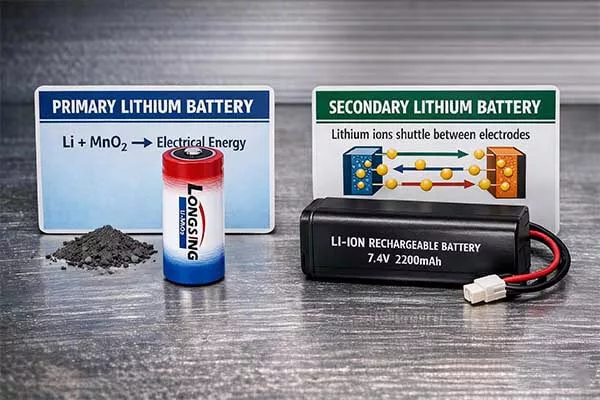
Battery Selection Guide: Primary vs Secondary Lithium Batteries for Industrial Projects
Primary vs Secondary Lithium Batteries is a critical decision factor in industrial projects where re

What is the difference between industrial batteries and regular batteries?
Industrial batteries and regular batteries differ mainly in their construction, capacity, and intend