


Mechanical Robustness: Designing Robust Battery That Survive Shock, Vibration, and Long-Term Stress
Many industrial devices fail early because their power source breaks under stress. This creates downtime, safety risk, and cost pressure.
A robust battery design reduces these risks by surviving shock, vibration, and long service life in real conditions.
A robust battery survives mechanical shock, vibration, and long-term stress without losing electrical performance or safety. It uses stable chemistry, strong internal structure, and validated testing to ensure reliable power in harsh industrial and utility environments.
If you design or buy batteries for meters or safety systems, understanding mechanical limits helps you avoid failure and extend service life.
Table of Contents
- What does mechanical robustness mean in battery design?
- How do shock and vibration damage batteries in real deployments?
- Why does long-term mechanical stress matter for field devices?
- How do primary lithium systems achieve both stability and strength?
- What testing methods prove a battery is truly robust?
What does mechanical robustness mean in battery design?
Mechanical robustness means a battery keeps its structure, safety, and output stable when exposed to shock, vibration, and repeated stress over time.
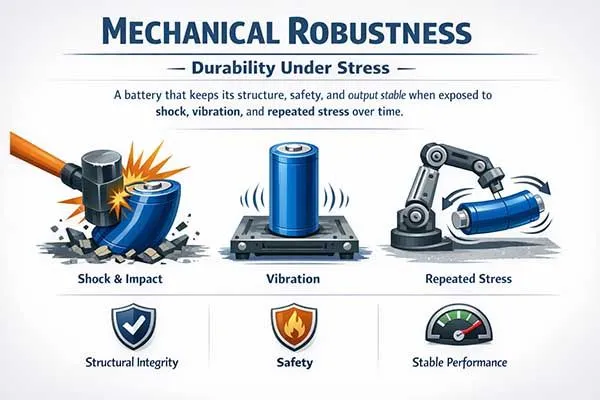
Mechanical robustness as a system concept
Mechanical robustness is not only about a strong metal can. It also depends on how electrodes, separators, and welds behave under force.
A robust battery design balances internal support with controlled flexibility. If parts are too rigid, they crack. If they are too soft, they deform and short.
In industrial meters and backup systems, the battery often faces transport shock, installation impact, and years of vibration. This is why mechanical robustness must work together with chemical stability[1] and controlled assembly steps.
For primary lithium systems, stable electrode placement and consistent pressure inside the cell reduce internal movement during stress.
A robust battery also supports predictable aging[2].
When structure stays stable, electrochemical reactions stay controlled. This link between structure and performance is why mechanical robustness is a core design target, not an afterthought.
| Design Element | Role in Robustness |
|---|---|
| Cell casing | Resists impact and compression |
| Internal supports | Limits electrode movement |
Want to try our real long life lithium batteries?
Submit the form below, and Long Sing Technology engineers will analyze your power profile[3] for free.
How do shock and vibration damage batteries in real deployments?
Shock and vibration cause internal movement, weld fatigue, and separator damage, which can reduce capacity or create safety risks[4].
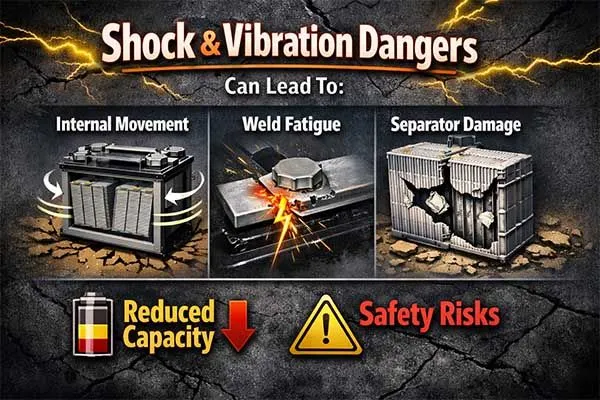
Failure paths under dynamic stress
During transport or installation, a sudden drop can shift internal components.
Over time, vibration from pumps, traffic, or machinery causes micro-movements. These forces build up fatigue at weld points and current collectors. In weak designs, this leads to open circuits or internal shorts.
For field devices, a shock resistant battery and a vibration resistant battery reduce these risks by controlling mass movement inside the cell.
This is where mechanical robustness supports field deployment reliability. A robust battery stays aligned even after thousands of vibration cycles.
Chemistry also plays a role.
Systems with strong chemical stability are less sensitive to small structural changes.
When structure and chemistry work together, the battery keeps stable voltage and low self-discharge even after stress exposure. This is critical for long-life meters that cannot be serviced often.
Why does long-term mechanical stress matter for field devices?
Long-term stress slowly degrades weak structures and increases failure risk late in the battery life cycle.
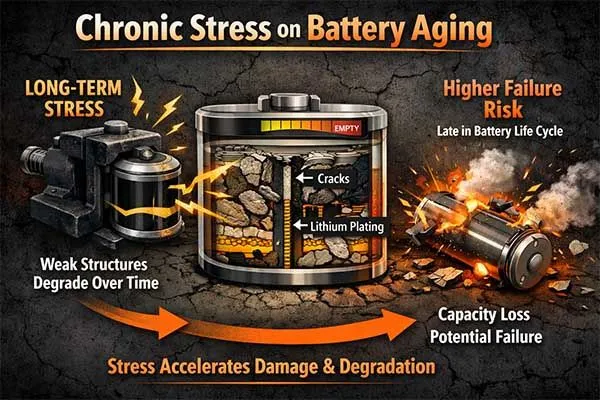
Stress accumulation over years
Long-term stress does not cause immediate failure. Instead, it creates slow changes.
Seals relax, internal pressure shifts, and electrode alignment[5] drifts. After many years, these small changes add up. This is why mechanical robustness must be designed for the full service life, not only for early use.
In public utility meters, devices often stay sealed for 10 to 20 years.
A robust battery reduces unexpected failures and supports maintenance cost reduction by avoiding early replacement. When structure remains stable, voltage curves stay predictable, and system alarms remain accurate.
This is also where mechanical robustness connects with chemical stability again.
Stable chemistry reduces gas generation and pressure changes. In turn, this lowers mechanical stress on seals and welds.
Together, they define a truly robust battery for unattended use.
How do primary lithium systems achieve both stability and strength?
Primary lithium systems combine stable chemistry with reinforced structure to deliver long service life under stress.
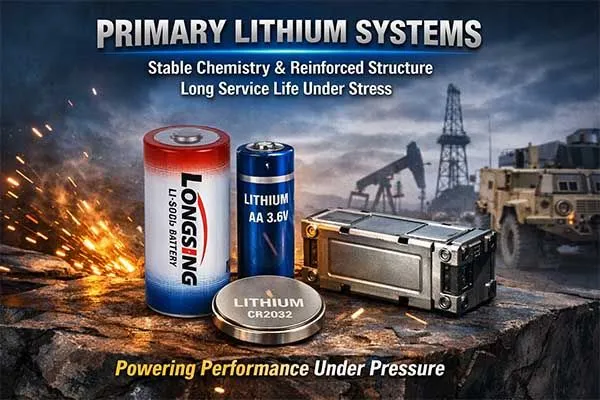
Design balance in primary lithium cells
Primary lithium systems such as lithium thionyl chloride cells are widely used in meters and safety devices.
They offer high energy density and strong chemical stability, which supports long shelf life.
To turn this into a robust battery, designers reinforce internal supports and control electrode winding tension.
In applications with pulse loads, pairing a primary cell with a hybrid pulse capacitor reduces stress peaks.
This protects the primary cell from sudden current demand and mechanical reaction forces. It also improves mechanical robustness at the system level.
As primary lithium battery manufacturer, our approach to mechanical robustness is defined by our recent collaboration with a leading German industrial engineering firm.
Tasked with providing a predictable long-life battery solution for high-stress environments, we utilized a multi-layered testing and design protocol to ensure survival against extreme physical variables.
How Long Sing Delivers Predictable Long-Life Solutions
To guarantee a lifespan that meets rigorous German engineering standards, we don’t just estimate—we validate through accelerated life testing and mechanical stress simulations.
- Vibration and Resonance Mapping: For our German partner, we conducted swept-sine and random vibration testing[6] (aligned with SAE J2380 standards). This identifies the natural frequency of the battery pack, allowing us to reinforce internal structures and prevent harmonic resonance from damaging sensitive cell interconnects.
- Precision Resistance Monitoring: We provide long-term predictability by tracking DC Internal Resistance (DCIR) throughout the battery’s life cycle. By analyzing the rate of resistance increase under simulated long-term stress, we can accurately predict the “End of Life” (EoL) before a field failure occurs.
- Advanced Structural Integrity: Our robust designs utilize specialized shock-absorbent housings and cell-to-pack bonding techniques. These ensure that even when subjected to the mechanical shocks typical of heavy industrial machinery or transport, the internal chemical stability remains uncompromised.
- Thermal-Mechanical Coupling: Recognizing that mechanical stress is often accompanied by thermal fluctuations, our solution for the German market involved testing the battery’s structural integrity at temperature extremes. This ensures that materials do not become brittle or lose their sealing properties over a 10+ year service life.
What testing methods prove a battery is truly robust?
Validated robustness requires mechanical, environmental, and electrical testing that reflects real use conditions.

From lab tests to real confidence
Testing is the bridge between design intent and real reliability.
Drop tests simulate handling shock. Sinusoidal and random vibration tests model transport and operation. Thermal cycling adds combined stress.
A robust battery passes these tests without loss of capacity or safety margin.
Good testing also tracks internal resistance and voltage drift. These indicators show hidden damage before failure.
When results stay stable, it confirms both mechanical robustness and chemistry control.
This is especially important for lithium thionyl chloride systems used in safety and healthcare devices.
| Test Type | Purpose |
|---|---|
| Drop test | Check impact resistance |
| Vibration test | Validate long-term stress tolerance |
Ready to Enhance Your Battery’s Durability?
If you’re looking to ensure your batteries can withstand the toughest environments, don’t wait! Reach out now to learn how we can help you design robust, high-performance battery solutions.
Conclusion
Mechanical robustness defines whether a battery survives real life or fails early. A robust battery combines stable structure, controlled chemistry, and proven testing.
In industrial and utility systems, this approach supports long service life, predictable performance, and lower risk. By aligning mechanical design with chemical stability and validated stress tests, manufacturers and buyers can achieve reliable power for demanding field deployments.
Quick FAQs About Robust Battery
(Click to Unfold)
Q: What is a robust battery?
A: A robust battery refers to a power source designed to maintain consistent performance under demanding conditions.
It possesses high tolerance for environmental stressors such as extreme temperatures, high vibration, and physical impact without significant degradation in capacity or safety.
Q: What is a resistance battery?
A: This usually refers to the internal resistance of a battery. Every battery has a degree of resistance that opposes the flow of current.
A battery with “high resistance” is often old or damaged, leading to heat generation and voltage drops, while a “low resistance” battery is more efficient.
Q: What is battery durability?
A: Battery durability is the ability of a battery to withstand wear, pressure, or damage over time. It encompasses both cycle life (how many times it can be charged/discharged) and calendar life (how long it lasts while standing idle), reflecting its overall lifespan.
Q: What does “mechanically robust” mean?
A: In the context of batteries, being mechanically robust means the physical structure—including the casing, electrodes, and internal connections—is strong enough to resist deformation, cracking, or leakage when subjected to external forces like drops or pressure.
Q: What is meant by chemical stability?
A: Chemical stability refers to the ability of the battery’s electrolytes and electrode materials to resist unwanted chemical reactions. High chemical stability prevents issues like “thermal runaway[7],” electrolyte decomposition, and the formation of dendrites that cause short circuits.
Q: What is the definition of mechanical stability?
A: Mechanical stability is the capacity of a battery’s internal components to remain in their original configuration during operation. This ensures that layers do not delaminate and internal parts do not shift, which is crucial for maintaining electrical contact and safety.
Q: What drains your battery the most?
A: In electronic devices, the display (screen brightness) and wireless connectivity (5G, GPS, Wi-Fi) are the primary consumers. In electric vehicles, high-speed driving and the use of climate control (heating/cooling) are the largest drains.
Q: What is a good resistance on a battery?
A: “Good” resistance depends on the battery type.
For a new 12V automotive lead-acid battery, a reading below 10 to 15 milliohms (mΩ) is typically excellent. For Lithium-ion cells, internal resistance is often much lower, frequently below 50mΩ depending on the cell size.
Q: How does vibration affect batteries?
A: Vibration can cause mechanical fatigue, leading to cracked solder joints, loosened internal connections, and damage to the separators. In severe cases, constant vibration leads to internal short circuits or leaking of the electrolyte.
Q: How to check battery resistance?
A: Internal resistance is measured using a battery analyzer or a multimeter capable of an AC conductance test. By applying a small load and measuring the voltage drop (V = I x R), the internal resistance can be calculated.
Q: What are the standards for battery vibration testing?
A: Common international standards include UN 38.3 (for transport safety), IEC 62133, and SAE J2380.9 These tests subject batteries to specific frequencies and g-forces to ensure they remain safe and functional during use and shipping.
Note:
[1]Discover how chemical stability prevents issues like thermal runaway in batteries.↪
[2]Explore how predictable aging can help in battery management and maintenance.↪
[3]Learn how to assess a battery’s power profile for optimal performance.↪
[4]Understand the potential safety risks that can arise from battery failures.↪
[5]Discover how proper electrode alignment enhances battery performance and safety.↪
[6]Explore the international standards that ensure battery reliability under vibration.↪
[7]Explore the risks of thermal runaway and how to ensure battery safety.↪
Also read further information about lithium metal battery:
- The Ultimate Guide to Lithium Metal Battery for Professionals
- What Makes the Science Behind Lithium Thionyl Chloride Battery So Unique?
- The 3.0V Standard: Unlocking the Power of Lithium Manganese Dioxide Batteries
- How to Choose Between Lithium Metal vs Lithium Ion?
- Beyond 500 Wh/kg: Lithium Metal Battery Energy Density Under Real IoT Load Conditions
- The Science of the Plateau: Why Voltage Stability is the Lifeline of in Power System
- Operating Temperature Range: How temperature affects lithium metal battery performance
- The Real Cost of Cheap Batteries: How High Self Discharge Rate Increase Your TCO
- The Silent Shelf-Life Secret: Why Battery Passivation is Actually a Good Thing
- Lithium Metal Batteries for Long-Life Industrial Applications: Design and Performance Insights
- Thermal Runaway Prevention: Why Factory-Level Testing is Non-Negotiable for Lithium Battery Safety
- Lithium Metal Battery Long Term Cost Analysis: Initial Price vs Lifetime Value
- Solid state batteries vs lithium metal batteries: Which One Elevates Your Product Performance?
IoT Battery Guide: Selection, Lifetime Calculation & Industrial Applications
Struggling with unreliable power in remote IoT setups? Frequent battery replacements disrupt industr

UN38.3 and ADR: Common Shipping Mistakes for Lithium Metal Battery Transportation
Lithium battery transportation for safety is a complex regulatory landscape where even a minor overs

Lithium Metal Battery Long Term Cost Analysis: Initial Price vs Lifetime Value
While a low initial investment may look favorable on a quarterly budget, it often masks a looming de