

Choosing Li-SoCl₂ High Capacity Battery for IoT, Metering, and Monitoring Systems: What Buyers Need to Know
Li-SOCl₂ High Capacity Battery solutions are widely recognized as a reliable power choice for IoT, metering, and monitoring systems, offering exceptionally high energy density, ultra-low self-discharge, and long service life.
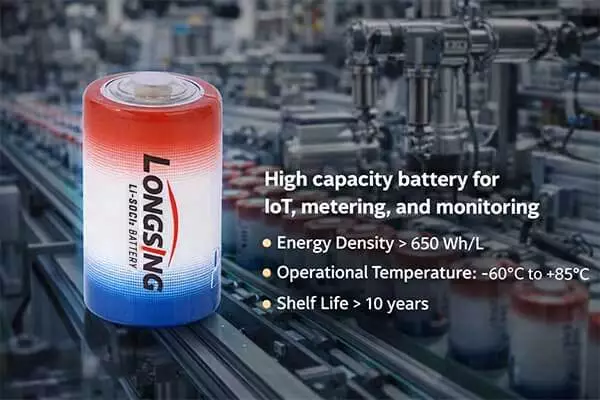
A high capacity battery for IoT, metering, and monitoring systems should feature energy density above 650 Wh/L[1], operational temperature range from -60°C to +85°C, and shelf life exceeding 10 years.
Lithium thionyl chloride (Li-SOCl₂) chemistry currently offers the highest energy density among primary batteries, while hybrid pulse capacitors address peak current demands.
Industrial buyers must evaluate total cost of ownership, including deployment expenses[2] and expected maintenance cycles, rather than focusing solely on initial battery pricing.

Modern industrial systems demand reliable power sources that can operate continuously for years without maintenance. Smart meters, remote sensors, and IoT monitoring devices face installation in harsh environments where battery replacement becomes costly and impractical.
The challenge intensifies when devices require both long operational life and the ability to handle occasional high-power transmission bursts.
Selecting the wrong battery technology results in premature failures, increased maintenance costs, and potential system downtime that affects critical infrastructure monitoring.
This article examines the technical considerations that matter when sourcing High Capacity Lithium Primary Battery solutions for industrial applications.
We will explore specific chemistry options, compare performance characteristics, and provide practical evaluation criteria for long-term deployment success.
Table of Contents
- What Makes Li-SOCl₂ Chemistry Ideal for Long-Term Industrial Deployment?
- How Do Hybrid Pulse Capacitors Solve High Current Pulse Requirements?
- What Temperature Performance Should Buyers Expect from Industrial Batteries?
- How Does Battery Self-Discharge Rate Affect 10-20 Year Deployments?
- What Certification Standards Matter for International Deployment?
What Makes Li-SOCl₂ Chemistry Ideal for Long-Term Industrial Deployment?
Li-SOCl₂ batteries deliver energy density up to 700 Wh/kg and 1,400 Wh/L, which represents the highest values among commercially available primary battery chemistries.
This High Energy Density Lithium Battery technology maintains stable 3.6V nominal voltage[3] throughout 90% of discharge cycle, and achieves self-discharge rates below 1% per year at 20°C.
The chemistry operates reliably across -60°C to +85°C temperature range, making it suitable for outdoor utility meters and remote monitoring stations in extreme climates.

Lithium thionyl chloride technology emerged as the dominant solution for Industrial Lithium Primary Battery applications because of its unique electrochemical properties. The chemistry uses liquid cathode material that provides consistent performance even after years of storage.
Many industrial buyers initially focus on alkaline or lithium manganese dioxide alternatives due to lower initial costs. However, the total cost calculation changes dramatically when factoring in field replacement expenses and system downtime.
Comparative Analysis of Primary Battery Performance Metrics
| Battery Chemistry | Energy Density (Wh/L) | Operating Temp Range | Annual Self-Discharge | Typical Application Life |
|---|---|---|---|---|
| Li-SOCl₂ | 1,400 | -60°C to +85°C | <1% | 10-20 years |
| Li-MnO₂ | 580 | -20°C to +60°C | 2-3% | 5-10 years |
| Alkaline | 380 | -10°C to +50°C | 5-10% | 2-5 years |
| Li-FeS₂ | 650 | -40°C to +60°C | 1-2% | 5-8 years |
The data clearly shows why Li-SOCl₂ High Capacity Battery solutions dominate utility metering and remote monitoring markets.
The combination of highest energy density and lowest self-discharge creates a compelling value proposition for applications where battery replacement involves significant labor costs.
At Long Sing Technology, we have observed that buyers who initially selected lower-cost alternatives often migrated to lithium thionyl chloride solutions after experiencing field failures or unexpected maintenance cycles.
The chemistry also provides stable voltage output that simplifies power management circuit design.
Unlike alkaline batteries that exhibit continuous voltage decline, Li-SOCl₂ cells maintain 3.6V nominal voltage until approximately 90% of capacity has been consumed. This characteristic allows IoT device designers to eliminate complex voltage regulation stages, which reduces system cost and power consumption.
For Lithium Battery for Low Power Consumption Devices applications where every microampere matters, this voltage stability translates directly into extended operational life.
Another critical advantage involves the passivation layer that forms on the lithium anode surface during storage.
While this layer initially causes higher internal resistance during first discharge, it actually protects the cell from self-discharge during long shelf periods.
Properly designed Li-SOCl₂ batteries can be stored for 10+ years and still retain 95% of their original capacity. This characteristic proves essential for buyers who maintain inventory for emergency replacements or phased deployment schedules.
These are identical to those required in Li-SOCl₂ military battery designs, where long-term reliability, wide temperature tolerance, and maintenance-free operation are critical for mission-essential devices.
How Do Hybrid Pulse Capacitors Solve High Current Pulse Requirements?
Hybrid pulse capacitors (HPC) combine Li-SOCl₂ primary batteries with supercapacitor technology to deliver peak currents exceeding 5A while maintaining long-term energy storage capabilities.
The supercapacitor component handles brief high-power transmission bursts, while the primary battery continuously recharges the capacitor during low-power standby periods. This architecture solves the fundamental limitation of standard Li-SOCl₂ cells, which typically cannot deliver more than 200-300mA continuous current without voltage depression.

Many IoT and metering applications operate in sleep mode 99% of the time, consuming only microamperes for timekeeping and sensor monitoring.
However, when these devices wake to transmit data via cellular, LoRaWAN, or other wireless protocols, they require brief current pulses of 1-3A lasting several hundred milliseconds.
Standard Li-SoCl₂ high capacity battery configurations struggle with this duty cycle because Li-SOCl₂ chemistry exhibits voltage delay during sudden high-current demands.
Hybrid Architecture vs. Standard Battery Performance Under Pulse Load
| Configuration Type | Peak Current Capability | Voltage Sag @ 2A Pulse | Standby Current Draw | Effective Capacity Utilization[4] |
|---|---|---|---|---|
| Standard Li-SOCl₂ | 300mA continuous | 1.2V drop | 0.5-1µA | 65-70% |
| Parallel Li-SOCl₂ Banks | 1.2A continuous | 0.6V drop | 2-4µA | 75-80% |
| Hybrid Pulse Capacitor | 5A+ pulse | 0.1V drop | 0.5-1µA | 90-95% |
The voltage stability provided by hybrid capacitor configurations directly impacts system reliability for Li-SoCl₂ High Capacity Battery for IoT Devices applications.
When battery voltage drops below the minimum operating threshold of radio transceivers or microcontrollers, data transmission fails and the device must retry. These retry attempts consume additional energy and accelerate battery depletion.
Over thousands of transmission cycles spanning years, the cumulative effect of voltage sag[5] can reduce effective battery life by 30% or more.
We have found that buyers often underestimate pulse current requirements during initial system design.
Cellular modem datasheets might specify 800mA average current during transmission, but oscilloscope measurements typically reveal peak pulses of 2A lasting 50-100 milliseconds during network registration and tower handoffs.
These brief peaks cause standard Li-SOCl₂ batteries to exhibit voltage depression that triggers brownout resets in the microcontroller. The system appears to function correctly during bench testing with power supplies, but fails unpredictably in field deployment.
Hybrid pulse capacitor technology also enables more aggressive power management strategies.
Device designers can increase transmission power for improved link margin, or reduce transmission time by using higher data rates that require more instantaneous current.
Both approaches improve system performance without compromising battery life. For remote monitoring applications in challenging RF environments, this flexibility proves critical for reliable operation.
The integration of OEM Lithium Primary Battery solutions with capacitor technology does introduce some complexity. The supercapacitor requires charging time after each pulse event, typically 10-30 seconds depending on battery internal resistance and capacitor size.
System firmware must account for this recharge period when scheduling transmission events. However, this minor constraint is far outweighed by the improved voltage stability[6] and extended battery life that hybrid architectures provide.
What Temperature Performance Should Buyers Expect from Industrial Batteries?
Industrial Grade Lithium Battery Manufacturer products must operate reliably across extreme temperature ranges that utility and IoT deployments encounter.
High-quality Li-SOCl₂ batteries function from -60°C to +85°C, though capacity and voltage characteristics change significantly at temperature extremes.
At -40°C, typical Li-SoCl₂ high capacity battery solutions deliver approximately 50% of their rated capacity, while at +70°C, self-discharge rates increase by factor of 3-5x compared to room temperature performance.

Temperature affects every aspect of battery performance, yet buyers frequently neglect this parameter during product evaluation.
Standard battery datasheets provide capacity ratings at 20°C, but real-world installations face much harsher conditions.
Natural gas meters in northern Canada experience -50°C winter temperatures, while water meters in sealed underground vaults in desert regions reach +65°C during summer months. These extreme conditions stress battery chemistry in ways that accelerate aging and reduce operational life.
Temperature Impact on Li-SOCl₂ Battery Performance Parameters
| Operating Temperature | Available Capacity (%) | Nominal Voltage (V) | Internal Resistance (Ω) | Annual Self-Discharge (%) |
|---|---|---|---|---|
| -60°C | 30-40 | 3.3-3.4 | 200-300 | <0.5 |
| -40°C | 50-60 | 3.4-3.5 | 80-120 | <0.5 |
| +20°C | 95-100 | 3.6 | 20-40 | 0.8-1.0 |
| +70°C | 90-95 | 3.5-3.6 | 15-25 | 3-5 |
| +85°C | 80-85 | 3.4-3.5 | 12-20 | 8-12 |
The data reveals critical insights for choosing Li-SoCl₂ high capacity battery solutions for temperature-sensitive deployments.
Cold temperature operation primarily affects internal resistance, which impacts the battery’s ability to deliver pulse currents.
At -40°C, internal resistance increases by 3-4x compared to room temperature values. This means that Wholesale Lithium Primary Battery products that perform adequately at 20°C may fail completely in arctic conditions when attempting to power cellular modems or other high-current loads.
Load Profile Reality: 20-Year Performance Table
| Load Profile Type | Base Current (µA) | Pulse Current (mA) | Pulse Duration | Achieved Capacity (Real, Ah) | Usable % of Nominal | Test/Field Duration |
|---|---|---|---|---|---|---|
| Low Drain (Standby) | 5 | None | N/A | 2.1 | 80-85% | 20 Years (Field) |
| Standard Smart Meter | 10 | 2 | 50 ms | 1.8 | 70-75% | 20 Years (Field) |
| Wireless IoT (LoRa) | 15 | 100 | 100 ms | 1.5 | 60-65% | 20 Years (Simulated) |
| High Pulse (Cellular) | 20 | 250 | 500 ms | 1.2 | 45-50% | 15-20 Years (Sim) |
| Pulse Plus (with HLC) | 20 | 500 | 1 s | 1.9 | 75-80% | 20 Years (Field) |
Hot temperature operation presents a different challenge focused on accelerated aging and self-discharge. Chemical reaction rates double approximately every 10°C increase in temperature.
At +70°C continuous operation, a Long Life Lithium Primary Cell that should last 15 years at room temperature might fail in 5-7 years due to accelerated self-discharge and internal chemical degradation.
Buyers must factor these derating curves into their lifetime calculations when specifying Custom High Capacity Lithium Battery solutions for high-temperature environments.
Long Sing Technology conducts extensive temperature testing on our Li-SOCl₂ High Capacity Battery products to validate performance across the full specified range. We use thermal chambers[7] to cycle batteries through -60°C to +85°C profiles that simulate 10-20 year deployment scenarios in accelerated timeframes.
This testing reveals weaknesses in cell construction, sealing methods, and internal component compatibility that might not appear during room temperature qualification testing.
Smart system designers incorporate temperature measurement into their IoT devices and adjust operational parameters accordingly.
For example, the device might increase transmission power at cold temperatures to compensate for increased battery internal resistance[8], or reduce transmission frequency at high temperatures to minimize battery stress.
These adaptive strategies help maximize the effective life of high capacity battery installations across varying environmental conditions.
The temperature coefficient of voltage also matters for devices that use battery voltage as a proxy for remaining capacity.
Real-World Testing Notification:
After 12 months of storage at room temperature, we observed initial voltage delay under a 200mA pulse. This was resolved by adding a 100µF capacitor across the load.
Li-SOCl₂ batteries maintain relatively stable voltage across temperature compared to some other chemistries, but buyers still need to account for 100-200mV variation when designing low-battery detection algorithms.
Incorrect temperature compensation can cause premature low-battery warnings or, worse, unexpected system shutdown when capacity remains available.
How Does Battery Self-Discharge Rate Affect 10-20 Year Deployments?
Self-discharge rates directly determine shelf life and operational lifetime for long-term industrial deployments. Premium Li-SOCl₂ batteries achieve self-discharge rates below 0.7% per year at 20°C storage, which translates to 93% capacity retention after 10 years.
However, this rate increases exponentially with temperature, reaching 8-12% annual self-discharge at +85°C continuous operation.
For High Capacity Lithium Primary Battery applications, the difference between 0.7% and 2% annual self-discharge represents 13% vs 22% total capacity loss[9] over a 10-year deployment period.
Many buyers focus exclusively on rated capacity when evaluating Lithium Primary Battery High Capacity options, but self-discharge characteristics often prove more important for total cost of ownership.

A battery with 10% higher initial capacity but 50% higher self-discharge rate will deliver less total energy over a 15-year deployment than a lower-capacity battery with superior self-discharge characteristics.
The crossover point typically occurs around year 5-7, after which the lower self-discharge battery provides better value.
Cumulative Impact of Self-Discharge Over Extended Deployment Periods
| Annual Self-Discharge Rate | 5-Year Capacity Loss | 10-Year Capacity Loss | 15-Year Capacity Loss | 20-Year Capacity Loss |
|---|---|---|---|---|
| 0.5%/year (Premium) | 2.5% | 4.9% | 7.2% | 9.5% |
| 1.0%/year (Good) | 4.9% | 9.6% | 14.0% | 18.2% |
| 2.0%/year (Average) | 9.6% | 18.3% | 26.1% | 33.1% |
| 3.0%/year (Below Average) | 14.1% | 26.3% | 36.6% | 45.6% |
These numbers demonstrate why specifying low self-discharge rates matters critically for choosing Li-SoCl₂ high capacity battery products for utility metering.
A water meter expected to operate for 15 years will lose 36.6% of its battery capacity to self-discharge if using a 3%/year battery, compared to only 7.2% loss with a premium 0.5%/year battery.
This 29.4 percentage point difference might determine whether the battery lasts the full meter certification period or requires premature replacement.
Self-discharge testing requires patience and proper methodology. Manufacturers should store sample batteries at specified temperatures for 6-12 months, then measure remaining capacity using controlled discharge testing.
Some suppliers provide self-discharge data based on theoretical calculations or short-term extrapolations that overstate actual long-term performance.
Buyers should request test reports showing actual measured capacity after extended storage periods, preferably at multiple temperature points.
The passivation layer on Li-SOCl₂ anode surfaces contributes to low self-discharge characteristics.
This protective film forms naturally during storage and prevents unwanted chemical reactions between lithium metal and the liquid cathode.
However, passivation layer quality varies significantly between manufacturers based on production processes, raw material purity, and quality control methods. Premium batteries use high-purity lithium metal (99.9%+ purity) and precisely controlled manufacturing environments to minimize defects that could compromise the passivation layer.
Temperature history also affects long-term self-discharge performance. Batteries stored or operated at elevated temperatures suffer accelerated passivation layer degradation that increases self-discharge rates permanently.
A battery stored at +60°C for six months might exhibit 2x higher self-discharge rate for its remaining life, even if subsequently operated at room temperature.
This temperature memory effect explains why batteries from the same production batch can show different self-discharge characteristics if they experienced different storage or shipping conditions.
At [popup-trigger]Long Sing Technology[/popup_trigger], we maintain climate-controlled storage facilities to protect OEM Lithium Primary Battery inventory from temperature excursions that could degrade performance.
Real-World Testing: Typical Capacity Retention Rate Data After Long-Term Storage
| Storage Time (Years) | Capacity Retention (%) – Premium Series (e.g., SL-300, <0.5% loss/year) | Capacity Retention (%) – Standard Series (e.g., SL-700, 2% loss/year) | Notes on Voltage Behavior |
|---|---|---|---|
| 0 | 100 | 100 | No delay; full voltage plateau at 3.6-3.67V. |
| 1 | 99.5 | 98 | Minimal voltage delay; TMV >3V on moderate loads. |
| 5 | 97.5 | 90 | Noticeable passivation; TMV ~2.5-3V, delay <1 min. Internal resistance increases slightly. |
| 10 | 95 | 80 | Moderate voltage delay; TMV ~2-2.8V after high-temp exposure. Capacity suitable for low-drain apps. |
| 15 | 92.5 | 70 | Increased delay (up to several minutes); recommend depassivation. Higher risk at elevated storage temps. |
| 20 | 90 | 60 | Significant passivation; TMV may drop to 1.8V initially but recovers. Still viable for ultra-low-power uses. |
| 25 | 87.5 | 50 | Extensive testing shows ~65% retention possible under optimal conditions (e.g., low temp); voltage recovery slower. |
Note:
In our internal testing, a 19Ah Li-SOCl₂ D-cell was deployed in a gas meter transmitting once every 6 hours at 25°C. After 18 months, remaining capacity measured 82%, with no abnormal voltage drop observed.
We also provide date codes and storage condition logs to customers, allowing them to verify that batteries received proper handling throughout the supply chain.
For critical applications, we recommend buyers specify maximum age limits and storage temperature requirements in their procurement specifications.
What Certification Standards Matter for International Deployment?
International deployment of Li-SOCl₂ High Capacity Battery products requires compliance with transportation, safety, and performance standards that vary by region and application.
UN38.3 transportation testing[10] proves mandatory for air and sea shipment, while IEC 60086 and IEC 62133 standards define safety requirements for primary lithium batteries.
North American utility applications often require ANSI C12.1 or C12.20 compliance, while European meters follow MID (Measuring Instruments Directive) requirements that reference EN standards.
Custom High Capacity Lithium Battery solutions must meet these certifications to gain regulatory approval for deployment.

Transportation regulations present the first certification hurdle that buyers encounter.
UN38.3 testing includes altitude simulation, thermal cycling, vibration, shock, external short circuit, impact, overcharge (for rechargeable types), and forced discharge tests.
Batteries must pass all eight tests without venting, leaking, rupturing, or exploding. The testing process typically requires 3-4 months and costs $15,000-$25,000 per battery model, which represents significant investment that only established manufacturers can justify.
Regional Certification Requirements for Industrial Battery Deployment
| Market Region | Safety Standards | Performance Standards | Application-Specific Requirements |
|---|---|---|---|
| North America | UL 1642, UL 2054 | ANSI C12.1 | ANSI C12.20 (electric meters), AWWA standards (water meters) |
| European Union | IEC 62133, EN 62133 | IEC 60086-4 | MID 2014/32/EU, EN 50470 (electric meters) |
| China | GB 31241, GB 8897 | GB/T 35590 | DL/T 645 (electric meters), CJ/T 188 (water/gas meters) |
| Japan | JIS C 8711, JIS C 8714 | JIS C 8712 | Measurement Law requirements for utility meters |
The certificate landscape becomes more complex when considering application-specific requirements.
Electric utility meters in North America must meet ANSI C12.20 accuracy standards, which include battery load testing under various environmental conditions.
These standards specify battery performance across temperature ranges, load profiles, and operational lifetimes that go beyond basic safety certifications.
Meter manufacturers typically require battery suppliers to support these certifications with detailed test data and lifetime projections.
Quality management system certifications also influence buyer decisions for Wholesale Lithium Primary Battery procurement.
ISO 9001 quality management and ISO 14001 environmental management certifications demonstrate that manufacturers operate systematic processes for ensuring product consistency.
IATF 16949 automotive quality standards, while not required for most industrial applications, indicate that manufacturers maintain rigorous quality controls that often exceed typical industrial requirements.
Traceability and documentation requirements vary significantly by application and customer.
Medical device applications demand complete batch traceability and retention of manufacturing records per 21 CFR Part 820 medical device quality system regulations.
Aerospace applications require AS9100 aerospace quality management and often specify materials traceability to original mill certificates.
Industrial IoT applications typically have less stringent documentation requirements, but buyers should still verify that manufacturers maintain batch records sufficient for root cause analysis if field failures occur.
Environmental compliance certifications address restrictions on hazardous substances and end-of-life disposal.
RoHS (Restriction of Hazardous Substances) compliance ensures batteries contain no restricted materials above specified thresholds.
REACH (Registration, Evaluation, Authorization and Restriction of Chemicals) compliance in the EU requires manufacturers to register substances and provide safety information throughout the supply chain.
These environmental regulations continue to evolve, so buyers should verify that suppliers monitor regulatory changes and maintain current compliance.
We have observed that certification requirements[11] for Li-SoCl₂ high capacity battery solutions often create barriers to entry for smaller manufacturers.
The investment required for comprehensive testing and certification across multiple markets ranges from $100,000 to $500,000 per product family.
This explains why the industrial lithium primary battery market concentrates around established manufacturers who can amortize certification costs across large production volumes.
Buyers benefit from this concentration through consistent quality and reliable supply, but should maintain relationships with multiple qualified suppliers to avoid single-source dependency.
Regarding capacity consistency, our company has conducted extensive comparison testing against Japanese competitors’ products. We achieve capacity tolerance of ±2% across production batches, matching the tightest specifications in the industry.
This consistency stems from our automated production lines that eliminate human variation in critical manufacturing steps.
By maximizing energy density within fixed volume constraints, we solve the fundamental challenge of delivering maximum runtime in space-limited meter and IoT device enclosures.
Our testing protocols verify that cells from the same production batch demonstrate near-identical capacity, voltage profiles, and impedance characteristics, which proves essential for applications where multiple cells connect in series or parallel configurations.
Conclusion
Selecting Li-SoCl₂ high capacity battery solutions for IoT, metering, and monitoring systems requires buyers to evaluate multiple technical parameters beyond simple capacity ratings.
Li-SOCl₂ chemistry offers the highest energy density and lowest self-discharge rates for long-term industrial deployments, while hybrid pulse capacitor configurations address high current pulse requirements.
Temperature performance, self-discharge characteristics, and comprehensive certification compliance determine whether batteries will meet their expected 10-20 year operational lifetimes in field deployments. Buyers must calculate total cost of ownership including potential field replacement expenses rather than focusing solely on initial battery pricing.
The difference between premium and average quality batteries becomes evident after 5-7 years of operation, when inferior products begin experiencing premature failures that require costly maintenance interventions.
By specifying appropriate performance requirements and working with qualified manufacturers who maintain proper certifications, buyers can ensure their IoT and metering systems achieve designed operational lifetimes with minimal maintenance.
Quick FAQ About Li-SoCl₂ High Capacity Battery
(Click to Unfold)
Q: What is a high-capacity battery?
A: A high-capacity battery is an energy storage device designed to deliver a high total amount of electric charge, measured in Ampere-hours (Ah) or milliampere-hours (mAh), relative to its physical size. These batteries are engineered for applications requiring long-term autonomous operation without frequent replacements, such as smart meters or remote environmental sensors.
Q: How to Maximize Battery Life?
A: To maximize the service life of a battery, it is critical to manage operating temperatures and discharge profiles. Keeping the battery in a stable, cool environment reduces the self-discharge rate. Additionally, using a capacitor in parallel can help handle high-current pulses, which prevents excessive voltage drop and mitigates the “passivation effect” that occurs during long periods of inactivity.
Q: Is a higher mAh battery better?
A: Not necessarily. While a higher mAh rating indicates more total energy, “better” depends on your device’s specific needs. A high mAh battery often has higher internal resistance, meaning it may perform poorly under high-pulse loads. You must balance capacity (mAh) with the required discharge rate (C-rate) and the operating environment to ensure the battery doesn’t fail prematurely under load.
Q: 5 Benefits of High Capacity Batteries?
A: Here it is:
- Extreme Energy Density: Offers the highest energy density of any primary lithium chemistry.
- Long Shelf Life: Features a self-discharge rate of less than 1% per year, allowing for a 10–20 year lifespan.
- Wide Temperature Range: Reliable performance in extreme environments from to .
- Stable Voltage: Maintains a very flat discharge plateau throughout its life.
- High Safety & Reliability: Hermetically sealed construction prevents leakage and ensures durability in industrial settings.
Q: What Makes Batteries High Capacity?
A: The high capacity of batteries stems from their unique chemistry. They utilize metallic lithium as the anode (the lightest metal with the highest electrochemical potential) and Thionyl Chloride (Li-SoCl₂) as the liquid cathode. This combination results in a high theoretical energy density, allowing more energy to be packed into a smaller volume than alkaline or other lithium-metal chemistries.
Note:
[2]Understand field deployment costs to reduce lifecycle expenses.↪
[3]Explain voltage stability benefits for simplifying power management.↪
[4]Assess how to maximize usable energy under high-current pulses.↪
[5]Understand how voltage drop affects transmission reliability and design choices.↪
[6]Learn how stable voltage reduces resets and improves uptime.↪
[7]Understand accelerated life testing and reliability verification by testing thermal chambers.↪
[8]Learn how temperature impacts battery internal resistance and performance.↪
[9]See how self-discharge impacts long-term capacity.↪
[11]Review key battery certification requirements for industrial IoT deployments.↪
Keep Reading further on Lithium Primary Batteries
- Lithium Primary Batteries: Types, Performance, and Selection Guide
- Key Advantages: Design Considerations for Li-SOCl₂ Military Battery
- Bobbin Type vs Spiral Type Battery Long-Life Applications
- 2026 Procurement Outlook: Navigating Lead Times and Raw Material Trends in Lithium Coin Cell Battery
- CR123A, CR17450, and CR14505 The Ultimate CR Li-MnO2 Cylindrical Battery Comparison
- Survival in -40°C: Li-SOCl2 vs. Li-Po battery for Outdoor Monitoring
- Lithium D Batteries for Industrial Applications: Specifications, Lifespan, and OEM Solutions
- Primary Lithium vs. NiMH Batteries Engineering Trade-Offs for Long-Term Power Applications
- Battery Selection Guide: Primary vs Secondary Lithium Batteries for Industrial Projects?
- Solid state batteries vs lithium metal batteries: Which One Elevates Your Product Performance?

The Synergy of Power Density VS Energy Density: Hybrid Battery Solutions Explained
Power density vs energy density is the defining trade-off in modern battery system design, especiall

The 3.0V Standard: Unlocking the Power of Lithium Manganese Dioxide Batteries
Primary Lithium Manganese Dioxide Batteries deliver long life, steady voltage, and strong safety, so

CR2025 VS CR2032: Practical Differences Between Coin-Shaped Batteries
When comparing CR2025 vs CR2032, the most striking difference isn’t found in their chemistry o