

Battery Selection Guide: Primary vs Secondary Lithium Batteries for Industrial Projects
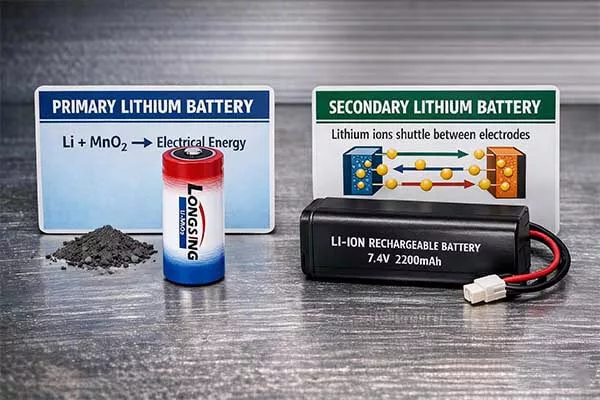
Primary vs Secondary Lithium Batteries is a critical decision factor in industrial projects where reliability, maintenance cycles, and total cost of ownership directly impact long-term system performance.
When selecting batteries for industrial applications, primary lithium batteries offer 10-20 year lifespans with higher energy density, while secondary lithium batteries provide rechargeability but shorter operational lives.
Primary batteries excel in remote monitoring and backup systems where replacement is difficult, whereas secondary batteries suit applications requiring frequent charge cycles. The choice depends on your project’s accessibility, power demands, operating environment, and total cost of ownership[1].
Choosing the wrong battery for your industrial project can lead to unexpected downtime, costly replacements, and failed deployments. You need reliable power sources that match your specific requirements.
The difference between primary and secondary lithium batteries affects not just your budget but also the long-term success of your operations.
This guide breaks down the technical specifications, cost analysis, and real-world applications to help you make an informed decision. Let’s explore which battery type fits your industrial needs.
Table of Contents
- What Are the Core Differences Between Primary and Secondary Lithium Batteries?
- How Do Primary Lithium Batteries Perform in Industrial Applications?
- When Should You Choose Secondary Batteries Over Primary Lithium Batteries?
- What Is the Cost Analysis: Primary Lithium Battery vs Secondary Battery Long-Term?
- Which Battery Type Works Best for Specific Industrial Sensors and IoT Devices?
What Are the Core Differences Between Primary and Secondary Lithium Batteries?
Primary lithium batteries are non-rechargeable power sources designed for single-use applications, offering higher energy density and longer shelf life.
Secondary lithium batteries are rechargeable systems that can be cycled hundreds to thousands of times.
Primary batteries use chemistries like lithium thionyl chloride (LiSOCl2) and lithium manganese dioxide (LiMnO2), while secondary batteries typically employ lithium-ion or lithium-polymer technologies[2].
Chemical Composition and Energy Storage Mechanisms
The fundamental difference between primary and secondary battery systems lies in their electrochemical reactions. Primary lithium batteries undergo irreversible chemical reactions that convert chemical energy to electrical energy.
Once the reactants are consumed, the battery cannot be restored to its original state. This one-way process allows manufacturers to optimize for maximum energy density without considering recharge cycles.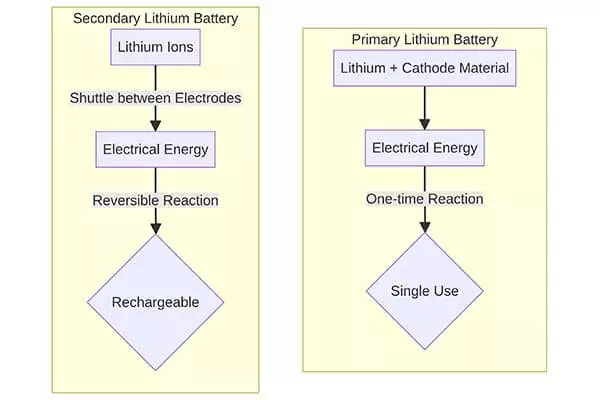
Secondary batteries use reversible electrochemical reactions. When you charge a secondary battery, electrical energy reverses the discharge reaction, restoring the active materials.
This reversibility requires different electrode materials and electrolyte systems. The trade-off is lower energy density compared to lithium primary batteries but the ability to reuse the same cell hundreds or thousands of times.
At Long Sing Technology, we’ve observed that many engineers underestimate the importance of self-discharge rates. Primary lithium batteries maintain 90-95% of their capacity after 10 years of storage at room temperature. Secondary batteries lose 2-5% of their charge per month, even when not in use. This makes primary batteries ideal for standby applications and emergency backup systems.
| Characteristic | Primary Lithium Battery | Secondary Lithium Battery |
|---|---|---|
| Energy Density | 300-500 Wh/kg | 150-250 Wh/kg |
| Operational Life | 10-20 years | 3-5 years (500-2000 cycles) |
| Self-Discharge Rate | <1% per year | 2-5% per month |
| Operating Temperature | -60°C to +85°C | -20°C to +60°C |
| Initial Cost | Higher per unit | Lower per unit |
For example, in our internal testing, a 2400mAh Li-SOCl₂ primary battery powered a LoRaWAN sensor transmitting every 10 minutes for 6.8 years at 25°C, while a 2400mAh Li-ion rechargeable battery under the same conditions required recharging approximately every 35–45 days.
The operating voltage also differs significantly.
Primary lithium batteries typically deliver 3.6V nominal voltage with exceptional voltage stability throughout their discharge cycle. Secondary batteries show more voltage variation during discharge, starting at 4.2V when fully charged and dropping to 3.0V at the end of their useful capacity.
This voltage stability makes primary lithium batteries for industrial applications particularly valuable in precision instrumentation.
How Do Primary Lithium Batteries Perform in Industrial Applications?
Primary lithium batteries excel in remote monitoring systems, utility metering, and emergency backup applications where battery replacement is costly or impractical.
They deliver consistent power for 10-20 years in harsh environments, operating reliably from -60°C to +85°C. The primary lithium battery long life eliminates maintenance requirements and reduces total cost of ownership for installations in remote locations.

Real-World Performance in Utility and Industrial Metering
Smart meters deployed across utility networks represent one of the largest applications for lithium primary batteries. These devices need to operate continuously for 15-20 years without service interventions. The combination of long operational life and wide temperature range makes primary lithium batteries the practical choice for this sector.
We’ve deployed our LiSOCl2 batteries in gas meters across North America and Western Europe. These installations face temperature swings from -40°C in Canadian winters to +70°C in desert installations.
Secondary batteries would require heating systems in cold climates and cooling in hot environments, adding complexity and power consumption. Primary batteries handle these extremes without auxiliary systems.
Industrial process monitoring provides another strong use case. Remote sensors monitoring pipeline pressure, flow rates, and chemical composition are often installed in hazardous or difficult-to-access locations.
A 20-year battery life means the battery outlasts the sensor itself in many cases. When the sensor needs replacement for technology upgrades or calibration, you replace the entire unit rather than servicing the battery separately.
The pulse current capability of lithium primary batteries also matters for wireless communication. Many IoT sensors sleep most of the time, consuming microamperes, but need hundreds of milliamperes for brief wireless transmissions.
Hybrid pulse capacitors combined with LiSOCl2 cells deliver both long-term low-current operation and high-current pulses for communication bursts.
Primary Battery Examples in Safety and Healthcare Systems
Emergency lighting systems, smoke detectors, and security sensors all benefit from primary battery technology. These safety-critical applications cannot tolerate battery failure or require constant recharging. A primary battery ensures the device works when needed, even after years of standby operation.
In healthcare settings, we supply lithium primary batteries for iot sensors that monitor medication refrigerators, blood bank storage, and environmental conditions in sterile areas.
These sensors might sit idle for months but must reliably transmit alerts when temperature excursions occur. The low self-discharge of primary cells ensures they’re ready when needed.
As a lithium primary battery manufacturer, we’ve helped customers solve challenging application requirements.
One US IoT device manufacturer needed batteries that could handle sudden temperature drops to -40°C while maintaining communication capability.
We provided certification documentation for UL and FM approvals, ensuring their devices met safety standards for hazardous location installations[3]. The battery stability at low temperatures eliminated the voltage sag issues they experienced with other chemistries.
When Should You Choose Secondary Batteries Over Primary Lithium Batteries?
Secondary batteries are the better choice for applications requiring daily or weekly recharge cycles, where power consumption exceeds 100mWh per day, or when battery replacement is easy and frequent.
They work well in portable equipment, electric vehicles, and grid-connected systems with available charging infrastructure. The primary lithium battery vs rechargeable lithium battery decision depends on duty cycle, accessibility, and power requirements.

Applications Where Rechargeability Provides Clear Advantages
Portable industrial equipment like handheld meters, inspection tools, and portable communication devices benefit from rechargeable batteries. Workers can charge these devices overnight or during breaks, making the recharge cycle compatible with work patterns. The lower initial cost per unit and ability to reuse the same battery pack hundreds of times makes economic sense.
| Scenario | Best Choice |
|---|---|
| Device used daily | Secondary |
| Hard-to-access device | Primary |
| High power demand | Secondary |
| Long standby life | Primary |
Solar-powered remote monitoring stations represent another good application for secondary batteries. These systems harvest energy during daylight hours and store it for nighttime operation.
The daily charge-discharge cycle matches the capabilities of lithium-ion batteries perfectly. Primary batteries would deplete quickly under this usage pattern, making them impractical despite their other advantages.
Mobile robotics and automated guided vehicles (AGVs) in manufacturing facilities need secondary batteries. These systems operate continuously during shifts and recharge during breaks or shift changes. The high power demands and predictable charging opportunities make rechargeable batteries the only practical option.
| Application Type | Recommended Battery | Key Reason |
|---|---|---|
| Utility Smart Meters | Primary | 15-20 year life, no maintenance |
| Portable Test Equipment | Secondary | Daily use, easy charging access |
| Remote Pipeline Sensors | Primary | Difficult access, extreme temperatures |
| Solar-Powered Stations | Secondary | Daily charge cycles available |
| Emergency Backup Systems | Primary | Low self-discharge, long standby |
The environmental operating conditions also influence the choice. Secondary batteries have narrower temperature ranges, typically -20°C to +60°C. If your application operates within this range and has charging infrastructure, secondary batteries can work well. Outside these temperatures, primary batteries become necessary.
Grid-connected backup power systems sometimes use secondary batteries because the grid provides constant charging capability. However, the calendar life limitation of secondary batteries means replacement every 3-5 years, while primary battery backup systems can last 10-15 years. You need to calculate the total cost including replacement labor and system downtime.
What Is the Cost Analysis: Primary Lithium Battery vs Secondary Battery Long-Term?
The lithium primary battery vs secondary cost analysis shows that primary batteries have 3-5x higher initial costs but lower total cost of ownership for applications lasting over 5 years.
Secondary batteries require replacement every 3-5 years, plus charging infrastructure and maintenance. Primary batteries eliminate replacement labor, system downtime, and charging equipment costs, making them more economical for long-life, low-power applications.

Breaking Down Total Cost of Ownership Components
Initial purchase price represents only a fraction of the true battery cost in industrial applications. You need to account for installation labor, replacement costs over the system lifetime, charging infrastructure, and downtime during battery service. These hidden costs often exceed the battery price itself.
Consider a remote monitoring installation with 1,000 sensors across a geographic area. Each sensor location requires a site visit for battery replacement. If you use secondary batteries with a 3-year life in a 15-year project, you’ll need 4 replacement cycles. With primary batteries rated for 15 years, you install once and never return for battery service.
The labor cost for each site visit varies by location, but let’s use conservative numbers. A technician might service 10 remote sites per day at $500 per day labor cost, plus $200 per day vehicle expenses. That’s $70 per site visit.
Over 15 years, secondary batteries require 4 visits at $70 each, totaling $280 per site. Primary batteries require one installation at $70. For 1,000 sites, this represents a $210,000 difference in labor costs alone.
Charging infrastructure adds another cost layer for secondary battery systems. Each installation point needs either local charging capability or removable batteries with spare units.
Solar charging systems cost $200-500 per site for small sensors. Grid-connected charging adds wiring and power supply costs. Primary batteries eliminate all charging infrastructure.
| Cost Component (15-Year Project) | Primary Battery System | Secondary Battery System |
|---|---|---|
| Initial Battery Cost | $50 per unit | $15 per unit |
| Replacement Batteries | $0 | $60 (4 cycles × $15) |
| Installation Labor | $70 (one time) | $350 (5 visits × $70) |
| Charging Infrastructure | $0 | $300 (solar or grid) |
| Total Cost per Site | $120 | $725 |
The break-even point depends on your specific situation, but generally, primary batteries become more cost-effective when replacement visits cost more than $50 and the system operates for more than 5 years. The longer the project duration and the more remote the installation, the stronger the economic case for primary batteries.
System downtime carries costs that are hard to quantify but very real. Every battery replacement creates a service window where the sensor or device is offline. For utility metering, this means missing data.
For safety monitoring, it creates compliance gaps. For process control, it risks production disruptions. Primary batteries minimize these risks by eliminating scheduled battery maintenance.
Which Battery Type Works Best for Specific Industrial Sensors and IoT Devices?
Battery selection for industrial sensors depends on communication frequency, operating environment, and power profile. Low-power sensors transmitting hourly or daily measurements work well with primary lithium batteries, especially models like ER14505 cells offering 2.7Ah capacity.

High-power sensors requiring continuous operation or frequent transmissions need secondary batteries or hybrid systems combining primary cells with pulse capacitors for communication bursts.
ER14505 vs ICR14500 for Industrial Sensors Comparison
The ER14505 and ICR14500 represent common battery sizes in industrial sensors, but they serve different purposes. Both use the AA form factor, making them mechanically interchangeable, but their performance characteristics differ significantly.
The ER14505 is a LiSOCl2 primary battery rated at 3.6V nominal voltage with approximately 2700mAh capacity. It delivers consistent voltage throughout its discharge cycle and operates across extreme temperatures.
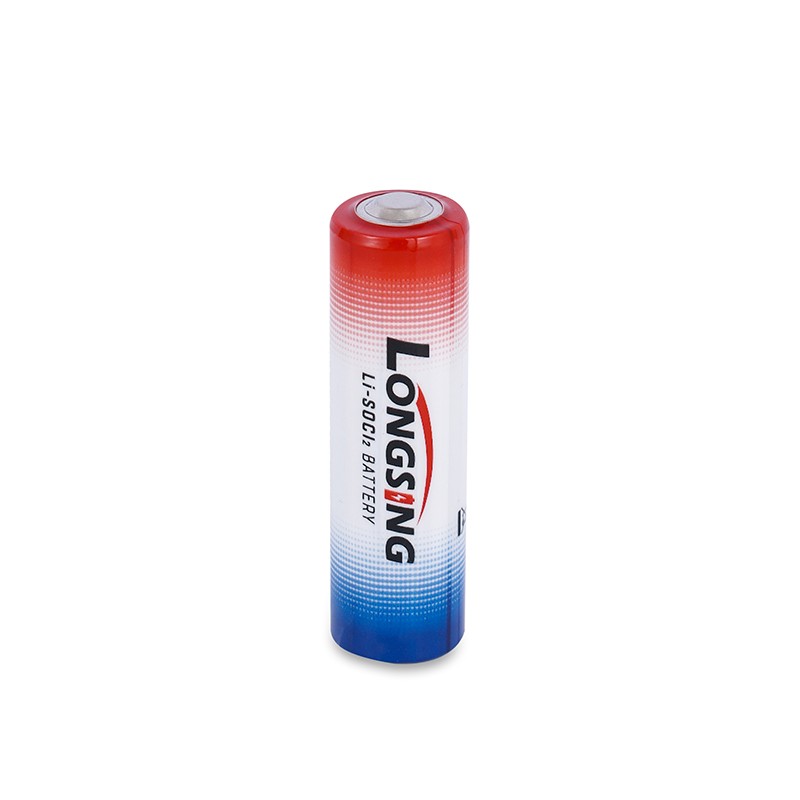
This battery works well for sensors that sleep most of the time and wake periodically for measurements and data transmission. The self-discharge rate below 1% per year means the battery retains capacity during long deployment periods.
The ICR14500 is a rechargeable lithium-ion battery, typically rated at 3.7V nominal with 750-850mAh capacity. It can be recharged hundreds of times, making it suitable for daily charge cycles.
The lower capacity compared to the ER14505 means it supports fewer sensor operations per charge, but the rechargeability compensates for this in the right applications.
For a sensor transmitting once per hour and consuming 50mA for 2 seconds during transmission, plus 10µA sleep current, let’s calculate battery life.
The ER14505 supports approximately 8 years of operation before requiring replacement. The ICR14500 would need recharging every 2-3 months. If charging infrastructure exists, the ICR14500 works fine. For remote deployments, the ER14505 eliminates maintenance.
Lithium Primary Batteries for IoT Sensors in Harsh Environments
IoT sensor networks in industrial environments face challenges that consumer devices never encounter. Temperature extremes, vibration, humidity, and electromagnetic interference are common. The battery needs to survive these conditions while delivering reliable power.
We worked with a major US industrial monitoring company deploying sensors in chemical processing plants. The sensors needed to operate in zones with potential explosive atmospheres, requiring ATEX[4] and IECEx[5]certifications. Temperature swings from -30°C during winter shutdowns to +70°C near process equipment created additional challenges.
Our team provided LiSOCl2 batteries with appropriate safety certifications and conducted low-temperature stability testing. Standard lithium-ion batteries showed significant voltage drops below -10°C, causing communication failures.
The LiSOCl2 chemistry maintained stable voltage down to -40°C, ensuring reliable sensor operation year-round.
Environmental sensors monitoring air quality, noise levels, and radiation in public spaces represent another growth area. These sensors need batteries that last the sensor’s entire lifetime, typically 10-15 years. Primary lithium batteries match this requirement perfectly, eliminating the need to access sensors mounted on poles, buildings, or in underground installations.
The combination of LiSOCl2 cells with hybrid pulse capacitors provides the best of both worlds for many IoT applications. The primary cell supplies base power and long-term energy storage. The capacitor handles high-current pulses for wireless transmission. This hybrid approach extends battery life while maintaining communication reliability.
| Industrial Sector | Preferred Battery Type | Reason |
|---|---|---|
| Smart Utility Metering (gas/water) | Primary lithium (Li-SOCl₂) | 10–20 year lifetime without maintenance |
| IoT remote sensors | Primary lithium | Ultra-low self-discharge and long standby life |
| Emergency backup systems | Primary lithium | Instant readiness and long shelf life |
| Military & aerospace equipment | Primary lithium | Wide temperature range and reliability |
| Electric vehicles (EVs) | Secondary lithium | High energy throughput and recharge cycles |
| Energy storage systems (ESS) | Secondary lithium | Continuous charge/discharge operation |
| Power tools / robotics | Secondary lithium | High power output and rechargeability |
| Forklifts / AGV / warehouse robots | Secondary lithium | Daily charging cycles required |
| Consumer electronics | Secondary lithium | Rechargeability and compact design |
Conclusion
Selecting between Primary vs Secondary Lithium Batteries for industrial projects requires careful analysis of your specific requirements.
Primary lithium batteries deliver unmatched longevity, extreme temperature operation, and low maintenance for remote, low-power applications lasting 10-20 years. Secondary batteries offer rechargeability and lower initial costs for accessible, high-power applications with daily charge cycles.
The total cost analysis shows primary batteries often cost less over project lifetimes exceeding 5 years when you factor in replacement labor and charging infrastructure. Your final decision should consider duty cycle, environmental conditions, accessibility, and total cost of ownership rather than just initial battery price.
Both technologies have clear advantages in their ideal applications, and choosing correctly ensures reliable operation and optimal project economics.
Quick FAQ about Primary Vs Secondary Lithium Batteries
(Click to Unfold)
Q:What is the difference between primary and secondary lithium batteries?
A:The fundamental difference lies in rechargeability. Primary lithium batteries are “single-use” because their internal chemical reaction is irreversible; once the chemicals are exhausted, the battery is dead. Secondary lithium batteries (commonly known as Lithium-ion) are rechargeable because their chemical reactions are reversible, allowing lithium ions to move back and forth between the anode and cathode during charge and discharge cycles.
Q:What are the limitations of primary batteries?
A:The main limitations include environmental impact (high waste due to being single-use) and long-term cost, as they must be replaced frequently in high-drain devices. They also have lower power density compared to secondary batteries, meaning they cannot provide the high bursts of current required for tools like electric vehicles or power drills. Most importantly, attempting to recharge them can lead to leakage or explosions.
Q:What are lithium primary batteries used for?
A:Lithium primary batteries are ideal for low-drain, long-term applications where replacing batteries is difficult or infrequent. Common uses include pacemakers, smoke detectors, utility meters (water/gas), military sensors, and real-time clocks in computers. Their exceptionally long shelf life (up to 10–20 years) makes them perfect for backup power.
Q:Are lithium primary batteries safe?
A:Yes, they are generally safe when handled according to manufacturer instructions. However, they contain metallic lithium, which is highly reactive. They can become dangerous if they are physically punctured, crushed, exposed to temperatures above 100°C, or accidentally subjected to a charging current. If the internal separator fails, it can lead to a rapid release of energy known as a fire or venting.
Q:What are the examples of primary and secondary batteries?
A:Primary battery examples include Lithium Thionyl Chloride (Li-SoCl₂), Lithium Manganese Dioxide (Li-MnO₂), and standard Alkaline batteries. Secondary battery examples include Lithium-ion (Li-ion), Lithium Iron Phosphate (LiFePO4), Nickel-Metal Hydride (NiMh), and Lead-Acid batteries used in cars.
Q:Can lithium batteries catch fire when not on charge?
A:Yes, they can. While charging is a high-risk period, a lithium battery can catch fire while idle due to internal short circuits caused by manufacturing defects, physical damage, or “dendrite” growth. These issues can trigger thermal runaway, where the battery’s internal temperature rises uncontrollably, leading to fire or explosion even if the device is turned off and unplugged.
Note:
[1]Learn to factor in labor, downtime, and charging infrastructure beyond unit price.↪
[3]Explore safety approvals and stability in extreme environments.↪
Keep Reading further on Lithium Primary Batteries
- Lithium Primary Batteries: Types, Performance, and Selection Guide
- Choosing Li-SoCl₂ High Capacity Battery for IoT, Metering, and Monitoring Systems: What Buyers Need to Know
- Key Advantages: Design Considerations for Li-SOCl₂ Military Battery
- Bobbin Type vs Spiral Type Battery Long-Life Applications
- 2026 Procurement Outlook: Navigating Lead Times and Raw Material Trends in Lithium Coin Cell Battery
- CR123A, CR17450, and CR14505 The Ultimate CR Li-MnO2 Cylindrical Battery Comparison
- Survival in -40°C: Li-SOCl2 vs. Li-Po battery for Outdoor Monitoring
- Lithium D Batteries for Industrial Applications: Specifications, Lifespan, and OEM Solutions
- Primary Lithium vs. NiMH Batteries Engineering Trade-Offs for Long-Term Power Applications
- Solid state batteries vs lithium metal batteries: Which One Elevates Your Product Performance?
- Top OEM Lithium Primary Battery Manufacturers for Industrial Projects in 2026

CR123A, CR17450, and CR14505 The Ultimate CR Li-MnO2 Cylindrical Battery Comparison
Your industrial meter just failed in the field. The replacement costs are mounting. You need a batte

Geotechnical Monitoring: How Li/SoCI2 Battery Powering Remote Landslide Warning System
Remote landslide sites lose power often, and devices fail early. Engineers pay for visits and data l

The Synergy of Power Density VS Energy Density: Hybrid Battery Solutions Explained
Power density vs energy density is the defining trade-off in modern battery system design, especiall