

Why Supercapacitors Can’t Replace Batteries—And When They Should
Key Takeaways
- Lower energy density prevents conventional supercapacitors from replacing batteries where long runtime and compact size matter.
- Supercapacitors can replace batteries when brief backup, fast recharge, and frequent cycling matter more than sustained operation.
- Falling voltage, leakage, and balancing requirements reduce the energy actually available to a device.
- A battery–capacitor combination can separate long-duration energy storage from short pulse delivery.
A device can draw a sharp current pulse yet need years of stored energy.
Choosing for only one requirement risks resets or oversized power packs. Understanding why supercapacitors do not generally replace batteries starts with separating those two demands.
Look beyond charging speed to see which technology matches your device’s energy demand, standby time, and pulse load.
Table of Contents
- What Stops Supercapacitors from Replacing Batteries?
- When Should You Use Supercapacitors Instead of—or Alongside—Batteries?
What Stops Supercapacitors from Replacing Batteries?
Conventional supercapacitors cannot generally replace batteries because their energy density is lower, their voltage declines during discharge, and stored charge leaks away. Their high power capability solves short bursts, not automatically hours or years of operation.
Energy Is Not the Same as Power
Batteries store energy through electrochemical reactions; conventional electric double-layer capacitors (EDLCs) store charge mainly at electrode–electrolyte interfaces.
Watts describe delivery rate; watt-hours describe quantity. High power is not the same as long runtime. Our supercapacitor vs battery comparison explores this distinction.
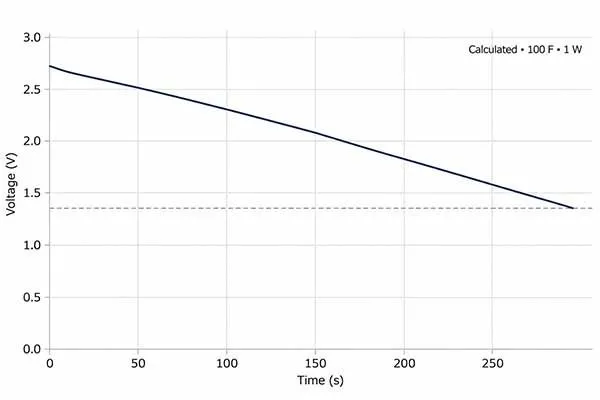
For an ideal capacitor, usable energy is E = C(Vmax² − Vmin²)/7,200 Wh, with capacitance in farads and voltage in volts. The following values are calculated examples.
| Illustrative device | Energy calculation | Result |
|---|---|---|
| 100 F EDLC, 2.7 V to zero | 100 × 2.7² ÷ 7,200 | 0.101 Wh total |
| Same EDLC, 2.7 V to 1.35 V cutoff | 100 × (2.7² − 1.35²) ÷ 7,200 | 0.0759 Wh usable |
| Assumed 3.6 V, 2 Ah battery | 3.6 × 2 | 7.2 Wh nominal |
These are illustrative electrical ratings, not equal-size products or measured results. At a hypothetical constant 1 W load, the EDLC’s calculated usable energy represents only about 4.6 minutes, before conversion losses.
Voltage, Leakage, and Circuit Costs
An EDLC’s output falls during discharge. A converter can recover more energy, but cutoff voltage and conversion losses still matter. Series cells need voltage balancing; leakage and balancing currents consume energy while equipment sleeps. Temperature and operating voltage also affect capacitor aging.
Calculated Supercapacitor Discharge Curve
An assumed 10 µA parasitic draw at the battery rail consumes 0.0876 Ah over 365 days, even without useful work.
Budget for charging, protection, conversion, and balancing circuitry rather than comparing cell prices alone. Frequent cycling may justify that circuitry; a rarely activated device may gain little from an exceptionally high cycle rating.
When Should You Use Supercapacitors Instead of—or Alongside—Batteries?
Use supercapacitors instead of batteries when energy demand is small, recharging is available, and repeated pulses or short backup dominate. Combine them with batteries when equipment needs both long unattended operation and high peak current.
Choose by the Load Profile
A capacitor still needs an energy source; rapid charging does not create energy. A brief power-failure reporting burst and overnight operation therefore require different sizing.
The following are starting points for evaluation, not universal recommendations.
| Operating requirement | Architecture to evaluate | Critical check |
|---|---|---|
| Repeated bursts with frequent charging | Supercapacitor | Energy between charges |
| Long unattended sensing | Primary battery | Pulse capability and cutoff |
| Long standby plus radio bursts | Battery plus pulse buffer | Leakage and recharge time |
| Sustained portable operation | Rechargeable battery | Usable energy and charging access |
For Li-SOCl₂ meter designs, a suitable buffer can supply radio bursts while the battery provides average energy. The primary cell remains non-rechargeable: limit buffer-charging current and design protection against unintended charging of the battery.
A buffer is not automatically necessary: check whether the selected battery already meets the pulse requirement before adding another storage component.
Distinguish Hybrid Cells from Hybrid Packs
A hybrid supercapacitor combines battery-like and capacitive storage mechanisms within one device; a battery–capacitor pack combines separate components.
When comparing products called supercapacitor batteries, ask for actual chemistry, usable energy, equivalent series resistance (ESR), and voltage limits. Lithium-ion hybrid capacitors must not inherit an EDLC’s discharge-to-zero assumptions.
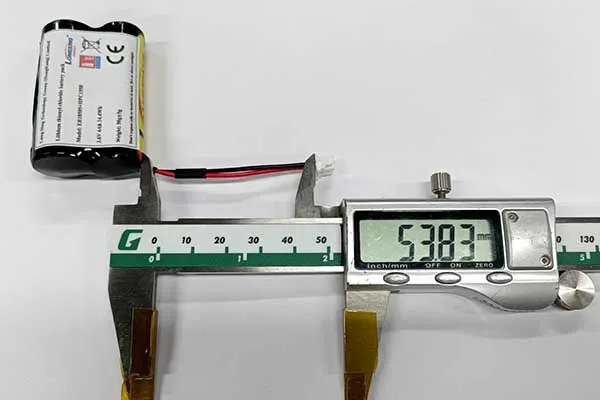
At Long Sing Technology, we recommend comparing complete load profiles. Ask any hybrid supercapacitor manufacturer to document pulse performance, leakage, and permitted voltage limits under your operating conditions.
Conclusion
Supercapacitors excel at rapid energy delivery, while batteries usually provide longer runtime within limited space. Choosing between them requires checking usable energy, leakage, voltage, and recharge opportunities. Share your device’s load profile to evaluate battery, capacitor, or combined power architectures.
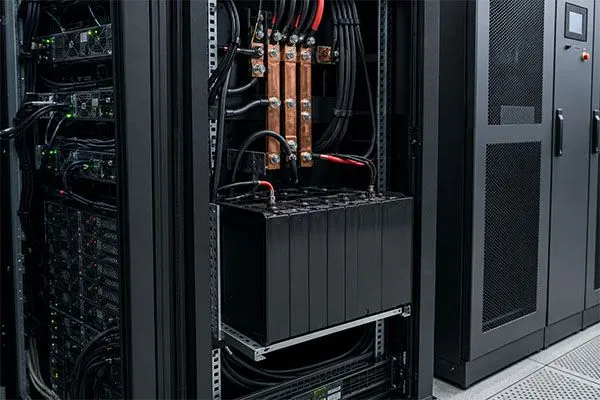
Taming the Millisecond AI Surge: How Hybrid Pulse Capacitors Solve AI Data Center Power Challenges
AI training clusters swing from idle to full GPU draw within a few milliseconds. That transient curr

What Makes the Science Behind Lithium Thionyl Chloride Battery So Unique?
Power systems need reliable energy sources. Industrial applications face harsh conditions every day.

Operating Temperature Range: How temperature affects lithium metal battery performance?
The operating temperature range of lithium metal batteries defines the limits at which the cell can